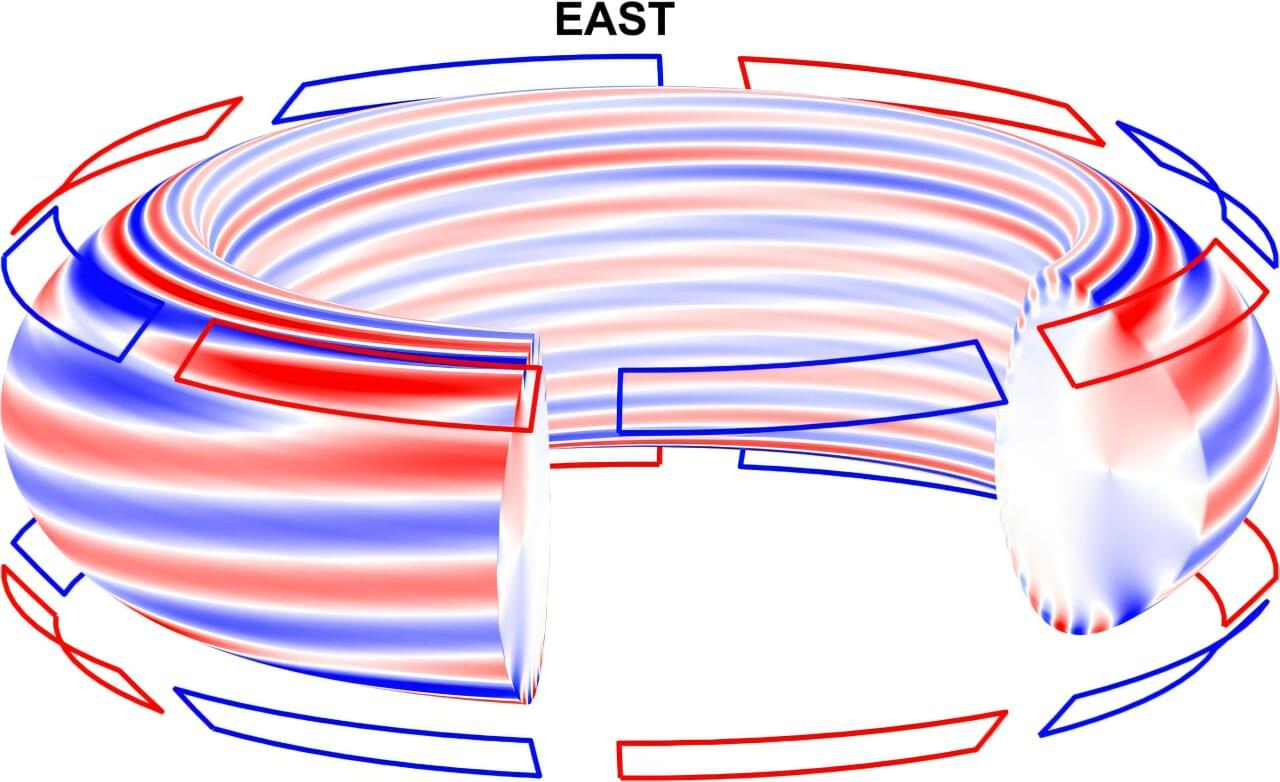
A research group has achieved a new plasma confinement regime using small 3D magnetic perturbations that simultaneously suppress edge instabilities and enhance core plasma confinement in the Experimental Advanced Superconducting Tokamak (EAST). The research results are published in PRX Energy.
Sustained high plasma confinement at both the core and the edge without edge crash events due to edge instabilities is critical for efficient fusion energy production in tokamaks. However, achieving stable, high-core confinement with an internal transport barrier (ITB) is extremely challenging, especially in tungsten-wall devices where tungsten impurity accumulation must be controlled. Furthermore, controlling edge instabilities usually results in degraded core plasma confinement.
In this study, the researchers applied small 3D magnetic perturbations localized at the plasma edge. This method achieved the suppression of edge instabilities and control of tungsten impurities. For the first time, it also enabled the induction and sustained confinement of high-core plasma with an ITB.