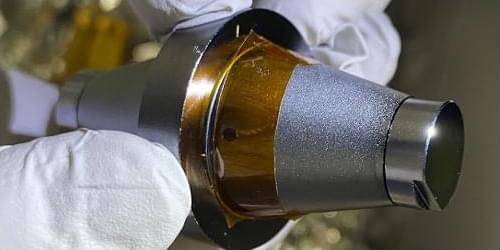
To make an ultrastable laser beam for applications such as gravitational-wave detectors, the frequency of a beam confined within an optical cavity is locked to the cavity’s resonant frequency. This frequency is determined by the cavity’s length. The stability of the laser beam’s frequency and the quality of the cavity’s resonance depend on the thermal noise of the mirrors that define that length. Dahyeon Lee at JILA and the University of Colorado Boulder and his colleagues have now demonstrated a crystalline mirror coating with superior thermomechanical properties compared to conventional coatings [1]. The new coating could lead to ultrastable cavities for optical clocks and next-generation interferometers.
Recently, mirrors coated with crystalline alloys of gallium arsenide (GaAs) have emerged as promising candidates to replace those with conventional amorphous dielectric coatings. GaAs-coated mirrors have excellent optical qualities and exhibit low thermal noise at room temperature. But previous studies found that these crystalline coatings suffer from additional noise contributions, which undermine their potential usefulness.
The origins of some of those noise contributions remain unclear. Nevertheless, Lee and colleagues have demonstrated that crystalline GaAs-based coatings can still be superior at cryogenic temperatures. The researchers constructed a 6-cm-long cavity bounded by two mirrors made of alternating layers of GaAs and aluminum gallium arsenide on silicon substrates. They used more layers compared to previous experiments, which reduced photon loss. Operating the cavity at 17 K, where the thermal expansion coefficient of the silicon substrate is zero, they achieved a frequency stability of 2.5 × 10⁻¹⁷. This stability is 4 times better than the expected limit for conventional coatings and sets a new record for cavity-stabilized lasers.