Toggle light / dark theme

Navigating Challenges and Opportunities in MultiOmics Integration for Personalized Healthcare

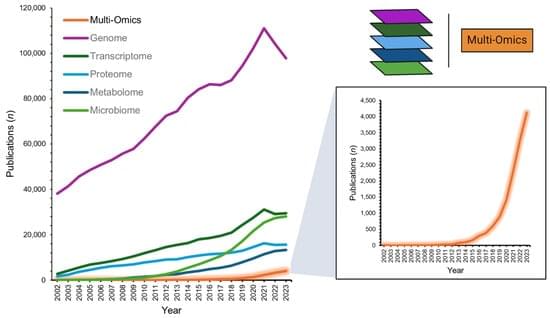
The field of multi-omics has witnessed unprecedented growth, converging multiple scientific disciplines and technological advances. This surge is evidenced by a more than doubling in multi-omics scientific publications within just two years (2022–2023) since its first referenced mention in 2002, as indexed by the National Library of Medicine. This emerging field has demonstrated its capability to provide comprehensive insights into complex biological systems, representing a transformative force in health diagnostics and therapeutic strategies. However, several challenges are evident when merging varied omics data sets and methodologies, interpreting vast data dimensions, streamlining longitudinal sampling and analysis, and addressing the ethical implications of managing sensitive health information. This review evaluates these challenges while spotlighting pivotal milestones: the development of targeted sampling methods, the use of artificial intelligence in formulating health indices, the integration of sophisticated n-of-1 statistical models such as digital twins, and the incorporation of blockchain technology for heightened data security. For multi-omics to truly revolutionize healthcare, it demands rigorous validation, tangible real-world applications, and smooth integration into existing healthcare infrastructures. It is imperative to address ethical dilemmas, paving the way for the realization of a future steered by omics-informed personalized medicine.

Dysphoria IoT Botnet Adds Blockchain C2 and Victim Relays After JackSkid Disruption

The lineage runs through JackSkid, one of four IoT botnets targeted in coordinated U.S., German, and Canadian law-enforcement actions on March 19. Court documents attributed more than 90,000 DDoS commands to JackSkid alone.

Within days, Nokia Deepfield and Comcast’s threat lab documented the operator falling back to an Ethereum Name Service (ENS) domain, m3rnbvs5d[.]eth, for command-and-control (C2). XLab’s Dysphoria timeline opens with a JackSkid sample captured on March 25, six days after the disruption, that resolves C2 through the same domain.

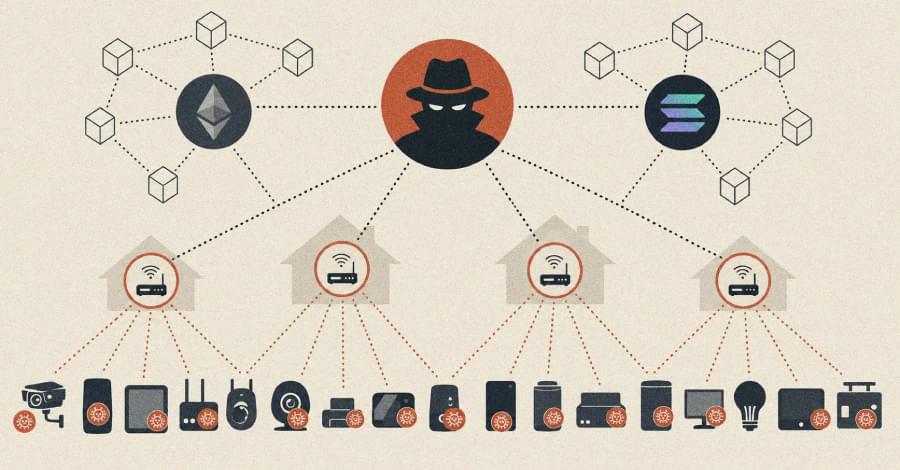
XLab found that the burrberry[.]eth record encodes distribution-node IPv4 addresses, while 24carnforth2merseyside[.]sol supplies other infrastructure records. The DDoS sample asks a distribution node over HTTP for a current server list, and the listed endpoints are infected machines relaying traffic to the real controllers. The design keeps those controllers one step removed from the addresses exposed to bots.

New Dysphoria DDoS botnet spreads to 200k devices worldwide

A botnet called Dysphoria has compromised around 200,000 devices across the world and is using them for distributed denial of service (DDoS) attacks and traffic relay operations.

According to QiAnXin XLab cybersecurity researchers, Dysphoria evolved from the ‘jackskid’ and ‘fbot’ malware by adding a covert blockchain-based command-and-control (C2) resolution mechanism.

Specifically, the botnet uses Ethereum ENS and Solana SNS domains to retrieve infrastructure information, while C2 addresses are concealed inside fake IPv6 strings and recovered using a custom byte-transformation algorithm.

Miasma Malware Targets npm Packages and GitHub Actions in Supply Chain Attack

Cybersecurity researchers have flagged yet another evolution of the supply chain attack linked to the Mini Shai-Hulud, Miasma, and Hades malware family that has compromised a new set of npm packages, even as it has propagated to the Go ecosystem.

“The latest activity includes malicious npm releases affecting LeoPlatform and RStreams packages, GitHub Actions workflow abuse, and a related Go module compromise involving the Verana Blockchain project,” Socket said.

The end goal of the campaign, as before, is to harvest developer or maintainer credentials and weaponize the stolen data to spread across package registries, repositories, and trusted developer workflows.

Glassworm botnet disrupted after resilient C2 infrastructure takedown

The Glassworm botnet targeting developers in software supply-chain attacks has been disrupted after researchers took down its resilient command-and-control infrastructure relying on Solana blockchain transactions and the BitTorrent DHT network.

In a coordinated operation conducted yesterday, CrowdStrike, Google, and The Shadowserver Foundation cut off the botnet operators’ access to four distinct command-and-control (C2) channels designed to resist conventional disruption efforts.

Glassworm campaigns have been ongoing since October 2025 and initially targeted developers with malicious OpenVSX and Microsoft VS Code extensions that stole cryptocurrency wallets and developer credentials.

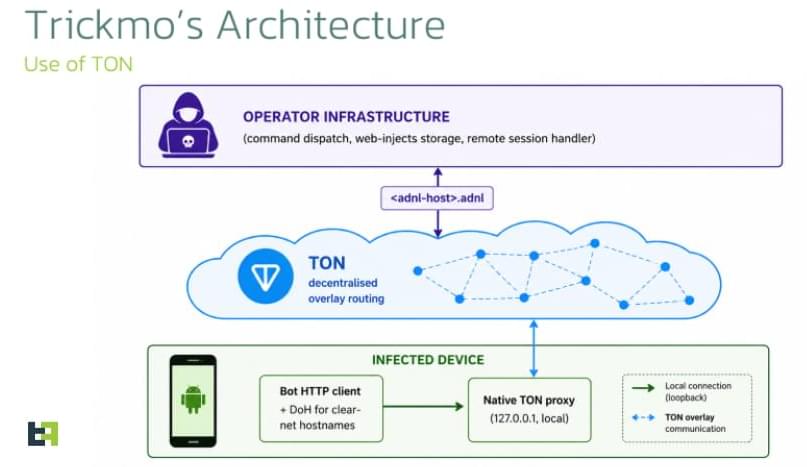
TrickMo Android banker adopts TON blockchain for covert comms

A new variant of the TrickMo Android banking malware, delivered in campaigns targeting users across Europe, introduces new commands and uses The Open Network (TON) for stealthy command-and-control communications.

The TrickMo banker was first spotted in September 2019 and has remained in active development, constantly receiving updates since then.

In October 2024, Zimperium analyzed 40 variants of the malware delivered via 16 droppers, communicating with 22 distinct command-and-control (C2) infrastructures, and targeting sensitive data belonging to users worldwide.

GlassWorm malware hits 400+ code repos on GitHub, npm, VSCode, OpenVSX

The GlassWorm supply-chain campaign has returned with a new, coordinated attack that targeted hundreds of packages, repositories, and extensions on GitHub, npm, and VSCode/OpenVSX extensions.

Researchers at Aikido, Socket, Step Security, and the OpenSourceMalware community have collectively identified 433 compromised components this month in attacks attributed to GlassWorm.

Evidence of a single threat actor running the GlassWorm campaigns across multiple open-source repositories is provided by the use of the same Solana blockchain address used for command-and-control (C2) activity, identical or functionally similar payloads, and shared infrastructure.

Joscha Bach delivers “The Machine Consciousness Hypothesis” at Future Day 2026

Can AI become conscious?

What is consciousness for? And is biological consciousness best understood as a self-organising algorithm that could, in principle, be recreated in machines?

In this talk, Joscha explores consciousness as perception of perception, coherence maintenance, modelling, resonance, self-organisation, and the possibility that machine consciousness may emerge through the right virtual architecture.

Essay: ‘The Machine Consciousness Hypothesis’ by Joscha Bach & Hikari Sorenson: https://cimc.ai/cimcHypothesis.pdf

CIMC: https://cimc.ai

Post: https://scifuture.org/joscha-bach-the… Intro

/* */