A working prototype that can see, remember and interact with the world like the human brain could one day underpin smart bionic eyes while using far less energy than today’s technologies. The invention from RMIT University combines sensing, memory and information processing within the same system, reducing the need to constantly move data between separate sensors, memory banks and processors.
While still an early-stage research demonstration, the neuromorphic vision innovation could dramatically reduce the amount of data and energy required to perform complex visual tasks.
RMIT has an international patent application filed under the Patent Cooperation Treaty (PCT) for the invention.
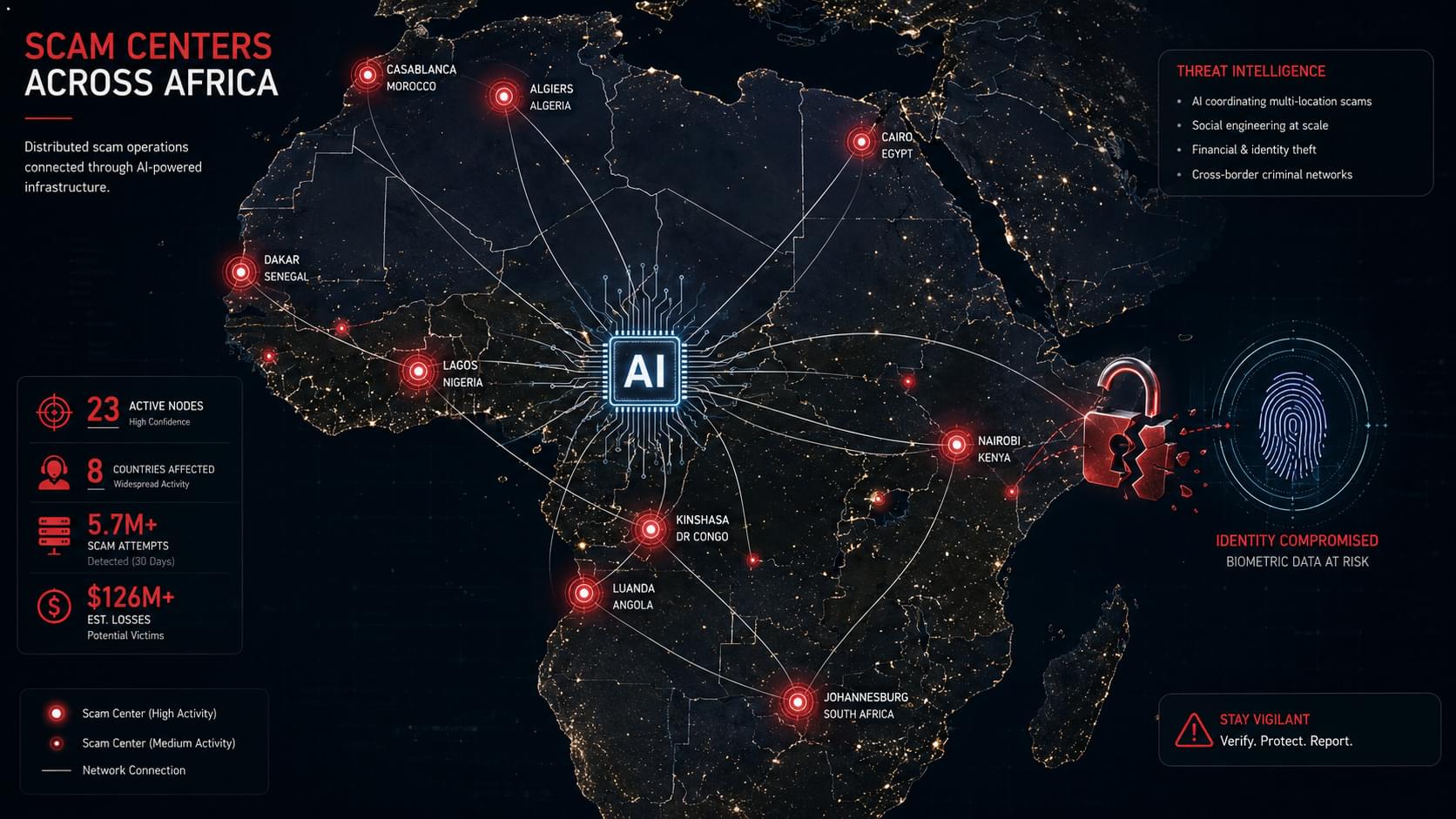
INTERPOL’s African Cyberthreat Assessment Report 2026 found that AI cybercrime in Africa now touches 55% of reported cases, with losses more than doubling to $484 million since 2024. Scam centers operate in 72% of surveyed countries, and AI-generated deepfakes are already defeating biometric security. The region’s governing cybercrime treaty was written before any of this technology existed.
AI cybercrime in Africa has crossed a line that security researchers had been warning about for years. INTERPOL’s African Cyberthreat Assessment Report 2026, released August 3 and drawn from survey data across 36 member countries, found that artificial intelligence is now linked to 55% of reported cyber incidents on the continent, according to INTERPOL’s own release. Financial losses have more than doubled since 2024, climbing from $192 million to $484 million.
What makes this report different from earlier cybercrime warnings is the specificity of how AI is being used, not just that it’s involved. AI cybercrime in Africa is concentrated in three vectors: AI-related scams, credential harvesting, and automated social engineering, according to Crypto Briefing’s coverage of the report. Business email compromise alone accounts for 10% of reported cases and remains one of the costliest categories, because AI now writes emails convincing enough to mimic a specific executive, supplier, or trusted partner rather than a generic phishing template.
Bloomberg Philanthropies has identified a funding shortfall in the implementation of many countries’ ocean protection plans, and has attempted to fill it with a quarter-billion dollar donation.
The aim writ small is to translate the paper gains for ocean conservation and management secured with the passage of the UN’s new High Seas Treaty into real gains by helping to cover the cost of management and enforcement for small island nations that lack these resources.
The updated High Seas Treaty has been under negotiation for over 2 decades. Its passage secured major gains for the potential protection of critical ocean habitats.
In 2024, a U.S. government official warned that Russia could be developing a new satellite designed to carry nuclear weapons into space. The statement followed the launch of a suspicious Russian satellite into low-Earth orbit in 2022, just a few weeks before the country’s full-scale invasion of Ukraine.
A nuclear detonation in low-Earth orbit—the region about 100 miles to 1,200 miles above Earth’s surface—would release trillions of highly energetic electrons that would destroy many of the satellites in space, disrupting telecommunications networks, GPS, space-based internet and more.
The 1967 Outer Space Treaty bans the placement of nuclear weapons in space, but there’s currently no way to verify satellites don’t contain nuclear weapons. In fact, no verification methods have even been proposed in unclassified, peer-reviewed literature.
Among the newly discovered species is the ‘ghost shark’ chimaera, a distant relative of sharks and rays, found in the Coral Sea. Other notable finds include symbiotic worms on volcanic seamounts in Japan and a striking new species of shrimp in Marseille, France. These discoveries highlight the diversity and complexity of life beneath the ocean surface.
Dr. Michelle Taylor, Head of Science at Ocean Census, emphasized the importance of these discoveries, stating, “We are in a race against time to understand and protect ocean life.” The Ocean Census is not only about finding new species but also generating evidence to drive global science and policy.
The discoveries provide crucial data for international agreements like the Biodiversity Beyond National Jurisdiction Treaty and the Kunming-Montreal Global Biodiversity Framework. As the Census continues, its global network and open-access platform, NOVA, will ensure that this critical data informs global decision-making.
Matthew Weinzierl and Brendan Rosseau, authors of Space to Grow, explain the commercial space economy and the role of NASA, Artemis, commercial space stations, space-based data centers, Starlink, GPS, China’s space program, national security, and space governance.
The conversation covers how governments, private companies, and investors build, fund, regulate, and compete in space, from microgravity research and launch markets to lunar exploration, space resources, and the economics of commercial space.
We also try and re-write the Space Treaty and look at the politics of the space race.
Please enjoy the show.
Thinking on Paper is a technology podcast about AI, Space, quantum computing, science, and the systems shaping the future.
Advancements in AI, robotics, and space exploration are driving us towards a future of sustainable abundance, enabled by innovations such as space-based solar power, humanoid robots, and scalable AI infrastructure. ## ## Questions to inspire discussion.
Terafabs and AI Chips.
🛠️ Q: What are Elon Musk’s plans for terafabs?
A: Musk plans to build terafabs with 10 lines, each producing 100k wafers/month, costing **$10–20 billion/line.
🔋 Q: What challenges do AI chips face for scaling?
A: Scaling AI faces bottlenecks in AI chips and energy, with Musk’s terafabs and solar power as key solutions.
A debate/discussion on ASI (artificial superintelligence) between Foresight Senior Fellow Mark S. Miller and MIRI founder Eliezer Yudkowsky. Sharing similar long-term goals, they nevertheless reach opposite conclusions on best strategy.
“What are the best strategies for addressing risks from artificial superintelligence? In this 4-hour conversation, Eliezer Yudkowsky and Mark Miller discuss their cruxes for disagreement. While Eliezer advocates an international treaty that bans anyone from building it, Mark argues that such a pause would make an ASI singleton more likely – which he sees as the greatest danger.”
What are the best strategies for addressing extreme risks from artificial superintelligence? In this 4-hour conversation, decision theorist Eliezer Yudkowsky and computer scientist Mark Miller discuss their cruxes for disagreement.
They examine the future of AI, existential risk, and whether alignment is even possible. Topics include AI risk scenarios, coalition dynamics, secure systems like seL4, hardware exploits like Rowhammer, molecular engineering with AlphaFold, and historical analogies like nuclear arms control. They explore superintelligence governance, multipolar vs singleton futures, and the philosophical challenges of trust, verification, and control in a post-AGI world.
Moderated by Christine Peterson, the discussion seeks the least risky strategy for reaching a preferred state amid superintelligent AI risks. Yudkowsky warns of catastrophic outcomes if AGI is not controlled, while Miller advocates decentralizing power and preserving human institutions as AI evolves.
Plastic pollution is a “grave, growing and under-recognized danger” to health that is costing the world at least $1.5 trillion a year, experts warned in a report on Monday.
The new review of the existing evidence, which was carried out by leading health researchers and doctors, was published one day ahead of fresh talks opening in Geneva aiming to seal the world’s first treaty on plastic pollution.
“Plastics cause disease and death from infancy to old age and are responsible for health-related economic losses exceeding US$1.5 trillion annually,” said the review in The Lancet medical journal.