Ray Kurzweil is an American inventor and futurist best known for his pioneering work in optical character recognition and his predictions regarding the technological singularity.
Peter H. Diamandis, MD, is the Founder of XPRIZE, Singularity University, ZeroG, and A360.
Salim Ismail is the founder of Open ExO, a GP at Exponential Venture Capital/The Organizational Singularity Fund and a sought after global speaker and thought leader.
Dave Blundin is the founder \& GP of Link Ventures.
This summer I attended Singularity University’s graduate studies program. Alongside 79 extraordinary entrepreneurs and scientists from around the globe, I had the opportunity to learn from some of the best minds in the world about a variety of rapidly advancing areas of technology. The context of these discussions was how we might use these technologies to implement solutions capable of affecting the lives of more than a billion people over the next decade.
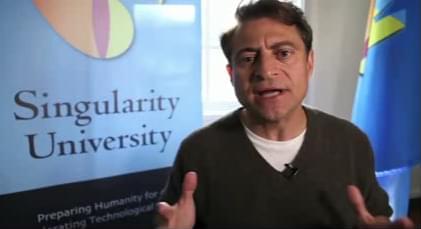
Learn about the projects Singularity University (SU) students developed during its 2010 Graduate Studies Program, with SU Co-Founder and Chancellor Ray Kurzweil, SU Co-Founder & Chairman Peter Diamandis, and SU faculty head Dan Barry, three-time NASA astronaut.
In 1933, Franklin Roosevelt assembled what was then the most credentialed group of forecasters in the world. He called it the Brain Trust.
He asked them to map the next 25 years.
They missed transistors. They missed atomic energy. They missed antibiotics. They missed faster-than-sound travel. They missed space probes. They missed World War II.
I have spent the last 16 years interviewing 300 of the most credentialed futurists alive. From Ray Kurzweil to Peter Diamandis to Marvin Minsky to Sir Martin Rees.
They agree on almost nothing.
That is my report from inside the room.
There is now a professional class that sells certainty about an inherently uncertain thing. Call it the crystal ball industry. The product is confidence. The buyer is the anxious executive. The medium is the keynote stage.
Peter Diamandis is one of the most extraordinary minds I’ve ever had the privilege of calling a friend, a man who doesn’t just predict the future, he builds…
This episode was filmed at the 2026 Abundance360 Summit.
This interview explores the groundbreaking work of Colossal in synthetic biology, de-extinction, and AI integration. Colossal CEO Ben Lamm explains how the company is revolutionizing biodiversity preservation, tackling plastic pollution, and creating living products with immense potential.
In this third conversation with Steven Kotler — our first in 14 years — we dig into his latest book, We Are As Gods: A Survival Guide for the Age of Abundance, co-written with Peter Diamandis. And while the book makes a powerful case for abundance, I came prepared to challenge it.
Because abundance without purpose, as Kotler himself argues, is not salvation. It is a different kind of crisis.
Solving Job Loss, and the Future of Work ## Andrew Yang advocates for the implementation of Universal Basic Income (UBI) as a necessary solution to address job loss, income inequality, and societal unrest caused by technological advancements and AI-driven changes in the economy ## ## Questions to inspire discussion.
Universal Basic Income Implementation.
🔹 Q: What UBI amount should be set to provide an effective safety net?
A: UBI should be set at twice the poverty level, around $25,000 per person per year, providing enough for survival but not happiness to maintain work incentives while protecting against economic collapse.
🔹 Q: How can UBI be funded without government action initially?
A: Well-resourced tech billionaires could fund UBI directly to local communities to keep the middle class afloat during AI-driven changes, potentially catalyzing further philanthropy and government action.
Humanoid robots with full-body autonomy are rapidly advancing and are expected to create a $50 trillion market, transforming industries, economy, and daily life ## ## Questions to inspire discussion.
Neural Network Architecture & Control.
🤖 Q: How does Figure 3’s neural network control differ from traditional robotics? A: Figure 3 uses end-to-end neural networks for full-body control, manipulation, and room-scale planning, replacing the previous C++-based control stack entirely, with System Zero being a fully learned reinforcement learning controller running with no code on the robot.
🎯 Q: What enables Figure 3’s high-frequency motor control for complex tasks? A: Palm cameras and onboard inference enable high-frequency torque control of 40+ motors for complex bimanual tasks, replanning, and error recovery in dynamic environments, representing a significant improvement over previous models.
🔄 Q: How does Figure’s data-driven approach create competitive advantage? A: Data accumulation and neural net retraining provides competitive advantage over traditional C++ code, allowing rapid iteration and improvement, with positive transfer observed as diverse knowledge enables emergent generalization with larger pre-training datasets.
🧠 Q: Where is the robot’s compute located and why? A: The brain-like compute unit is in the head for sensors and heat dissipation, while the torso contains the majority of onboard computation, with potential for latex or silicone face for human-like interaction.