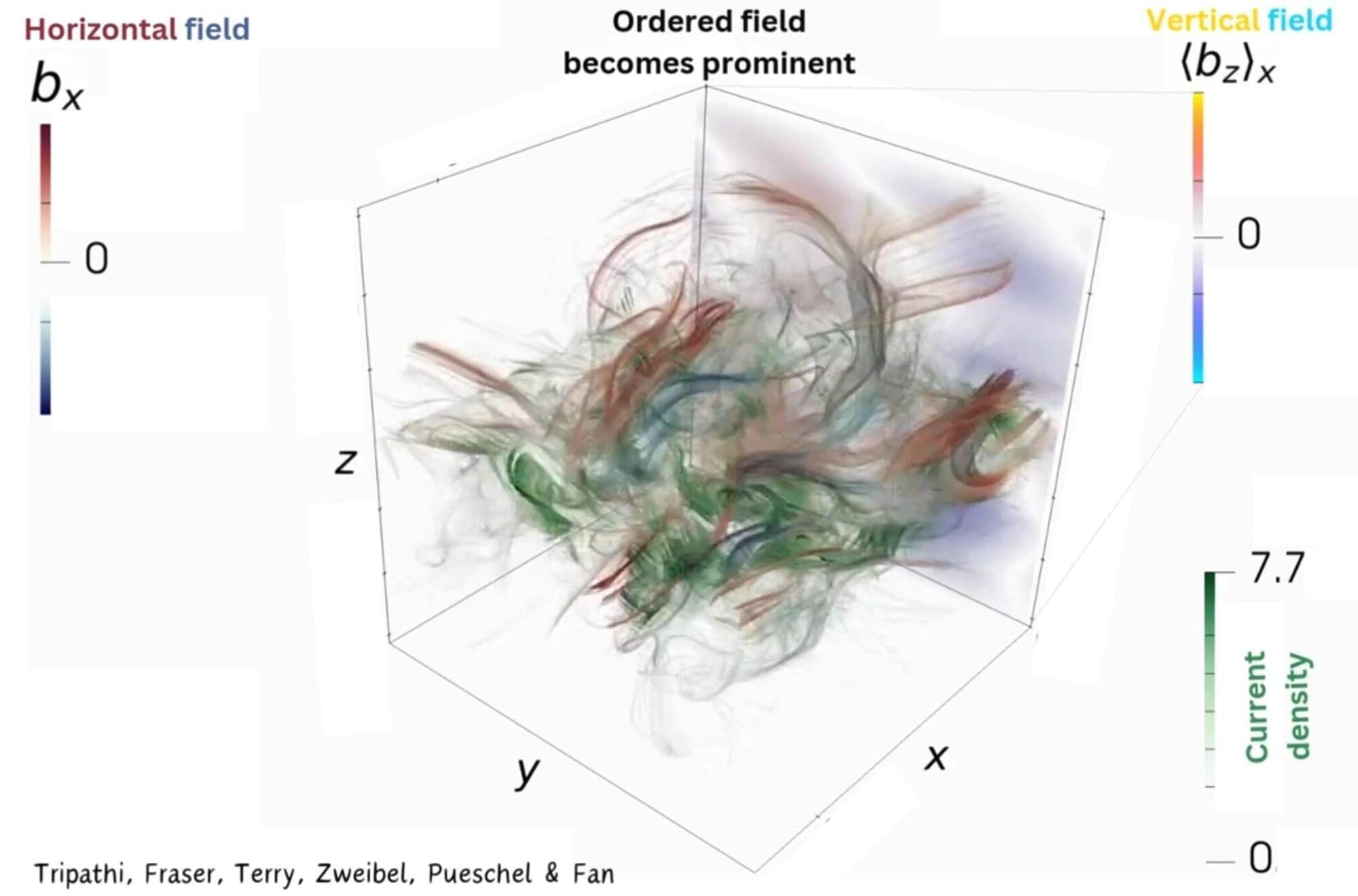
All celestial bodies—planets, suns, even entire galaxies—produce magnetic fields, affecting such cosmic processes as the solar wind, high-energy particle transport, and galaxy formation. Small-scale magnetic fields are generally turbulent and chaotic, yet large-scale fields are organized, a phenomenon that plasma astrophysicists have tried explaining for decades, unsuccessfully.
In a paper published January 21 in Nature, a team led by scientists at the University of Wisconsin–Madison have run complex numerical simulations of plasma flows that, while leading to turbulence, also develop structured flows due to the formation of large-scale jets. From their simulations, the team has identified a new mechanism to describe the generation of magnetic fields that can be broadly applied, and has implications ranging from space weather to multimessenger astrophysics.
“Magnetic fields across the cosmos are large-scale and ordered, but our understanding of how these fields are generated is that they come from some kind of turbulent motion,” says the study’s lead author Bindesh Tripathi, a former UW–Madison physics graduate student and current postdoctoral researcher at Columbia University.