Dark energy, the mysterious phenomenon that powers the expansion of the universe, may undergo periodic ‘violent transitions’ that reverse the growth of the cosmos, a new pre-print study hints.
Space exploration is on the verge of a revolution. With new propulsion systems, upcoming missions to Mars and beyond, and theories that could one day take us to other star systems, the future of space travel is closer than ever.
But how will it actually happen? Will we ever leave our solar system? And is faster-than-light travel even possible?
In this video, we explore:
🚀 Where We Are Now – The progress we’ve made in space travel.
🌍 Mars & Beyond – The next steps for humanity’s expansion into space.
🌌 Interstellar Travel – Is It Possible? – The challenges of traveling beyond the solar system.
⚡ Future Propulsion Technologies – New ways to push past our current limits.
🌀 Warp Drives & Faster-Than-Light Travel – The theories that could change everything.
🚀 Space Travel Is About to Change Forever — But How? — Space Documentary.
Don’t forget to subscribe for more content! ❤
Will humanity ever reach another star, or are we trapped in our own cosmic neighborhood? 🌌👇
Researchers have discovered that eight different psychiatric conditions share a common genetic basis.
A study published in early 2025 pinpointed specific variants among those shared genes, showing how they behave during brain development.
The US team found many of these variants remain active for extended periods, potentially influencing multiple developmental stages – and offering new targets for treatments that could address several disorders at once.
Here, Deepak A. Rao & team use mass cytometry immune profiling to identify T cell features in pre-treatment blood samples from patients that are associated with irAEs after ICI therapy.
1Division of Rheumatology, Inflammation, Immunity, Brigham and Women’s Hospital and Harvard Medical School, Boston, Massachusetts, USA.
2Division of Rheumatology, Hospital for Special Surgery and Weill Cornell Medicine, New York, New York, USA.
3Memorial Sloan Kettering Center and Weill Cornell Medical College, New York, New York, USA.
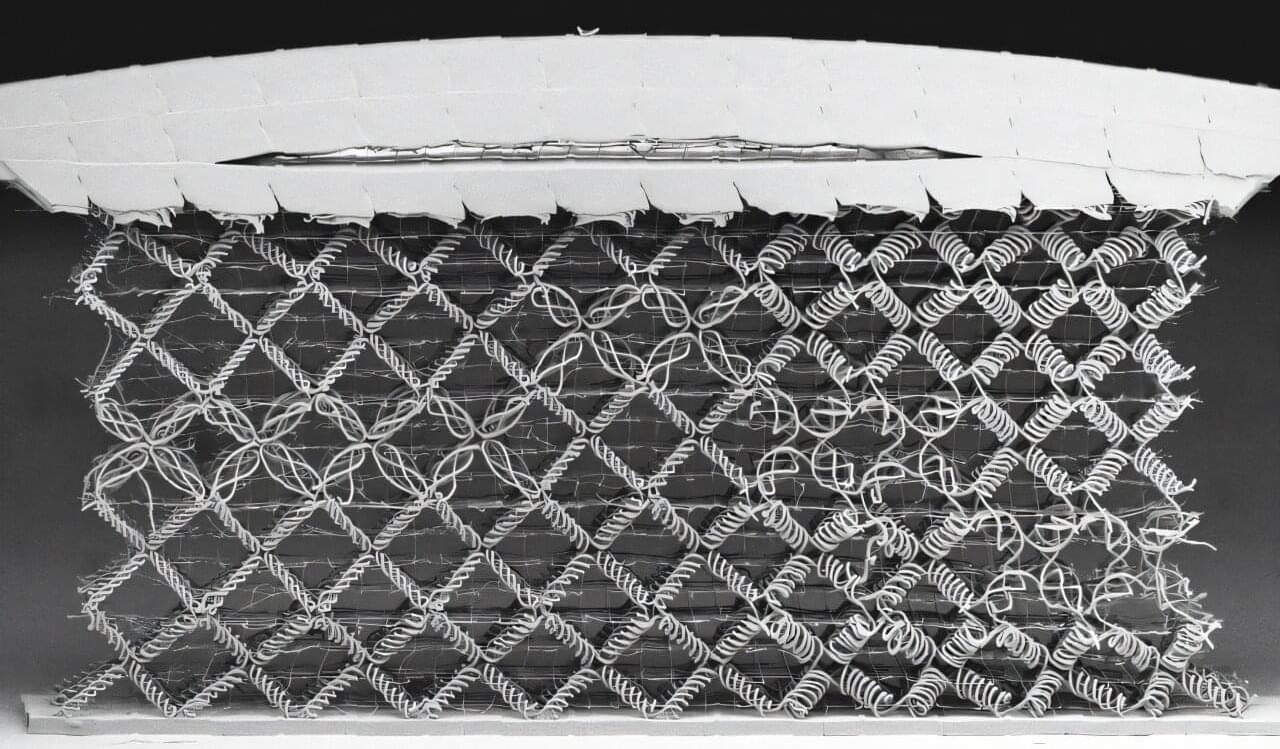
Penn Engineers have developed a novel design for solar-powered data centers that will orbit Earth and could realistically scale to meet the growing demand for AI computing while reducing the environmental impact of data centers.
Reminiscent of a leafy plant, with multiple, hardware-containing stems connected to branching, leaf-like solar panels, the design leverages decades of research on “tethers,” rope-like cables that naturally orient themselves under the competing forces of gravity and centrifugal motion. This architecture could scale to the thousands of computing nodes needed to replicate the power of terrestrial data centers, at least for AI inference, the process of querying tools like ChatGPT after their training concludes.
Unlike prior designs, which typically require constant adjustments to keep solar panels pointed toward the sun, the new system is largely passive, its orientation maintained by natural forces acting on objects in orbit. By relying on these stabilizing effects, the design reduces weight, power consumption, and overall complexity, making large-scale deployment more feasible.
Abigail Laura Jackson, Silja Heilmann, Pia Nyeng (Roskilde Universitet – RUC) and colleagues use a new apical polarity reporter mouse & high-resolution live imaging to demonstrate that pancreatic tubulogenesis is driven by dynamic transformations of existing lumens, which establish and remodel the pancreatic duct.
Jackson and Heilmann et al. use a new apical polarity reporter mouse and high-resolution live imaging to demonstrate that pancreatic tubulogenesis is drive.
After years of trying, scientists have finally created a stable superatom of copper, a long-sought-after chemical breakthrough that could revolutionize how we deal with carbon emissions.
Copper is a cheap and common metal, and because of its ability to bind carbon atoms together (C-C coupling), scientists have wanted to use it to turn carbon dioxide into products like ethylene for plastics and fuels. However, it corrodes or falls apart almost immediately when exposed to air or harsh industrial conditions.
A superatom is a cluster of atoms that behaves like a single atom, but with greater stability. In this new study published in the Journal of the American Chemical Society, scientists from Tsinghua University in Beijing built a nanocluster made from 45 copper atoms (Cu45).