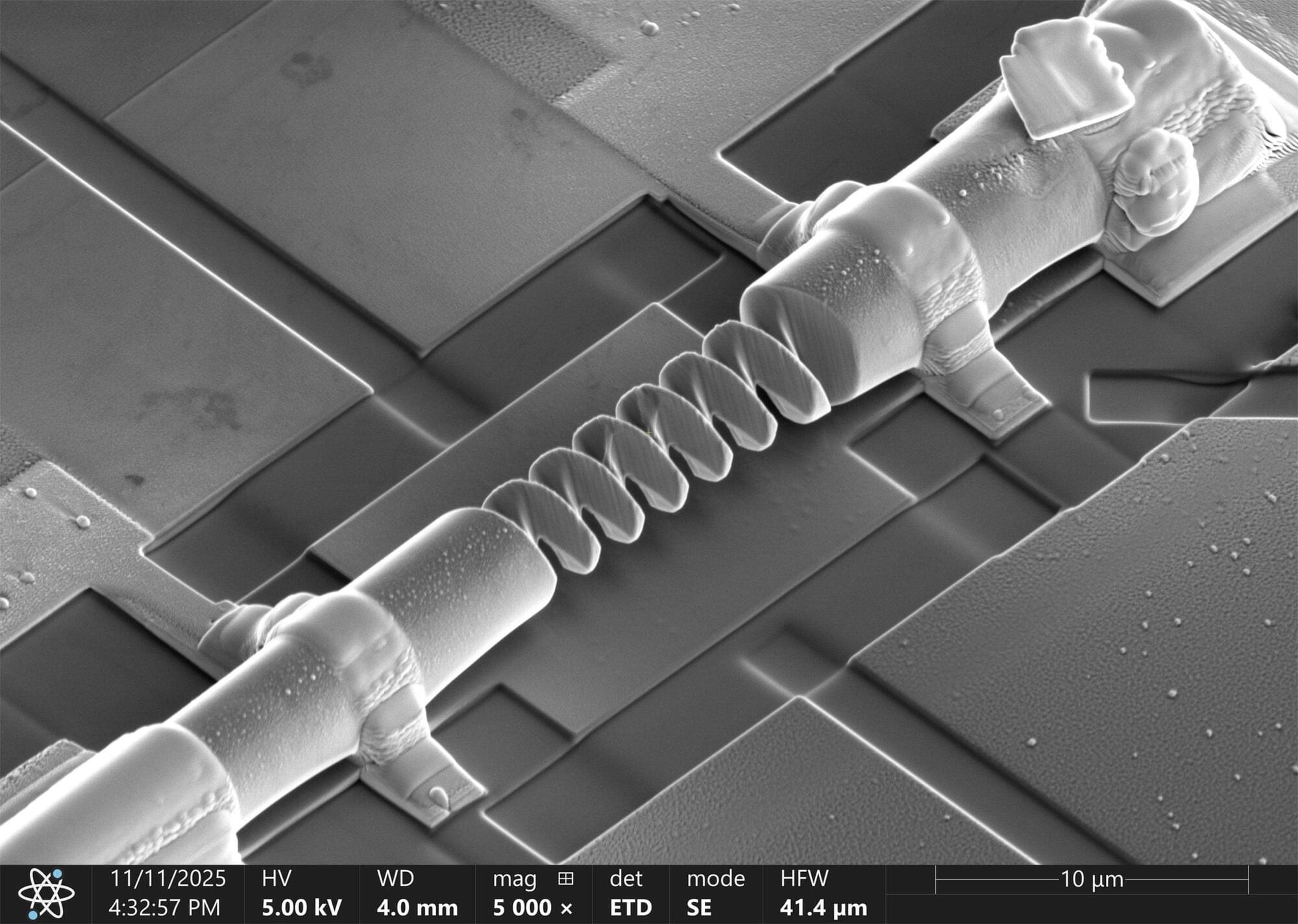
Scientists have shown that twisting a crystal at the nanoscale can turn it into a tiny, reversible diode, hinting at a new era of shape-engineered electronics.
A quantum state of matter has appeared in a material where physicists thought it would be impossible, forcing a rethink on the conditions that govern the behaviors of electrons in certain materials.
The discovery, made by an international team of researchers, could inform advances in quantum computing, improve electronic efficiencies, and deliver enhanced sensing and imaging technologies.
The state, described as a topological semimetal phase, was theoretically predicted to appear at low temperatures in a material composed of cerium, ruthenium, and tin (CeRu4Sn6), before experiments verified its existence.

The scientist Stephen Hawking lived with amyotrophic lateral sclerosis (ALS), the most common type of motor neurone disease, for 55 years. He was one of the longest-surviving people with the condition.
However, most people with motor neurone disease are not as lucky. It often progresses quickly, and many pass away within two to five years of diagnosis.
There is still no cure. Genetics account for only about 10% of cases, and the rest of the causes are still largely a mystery.
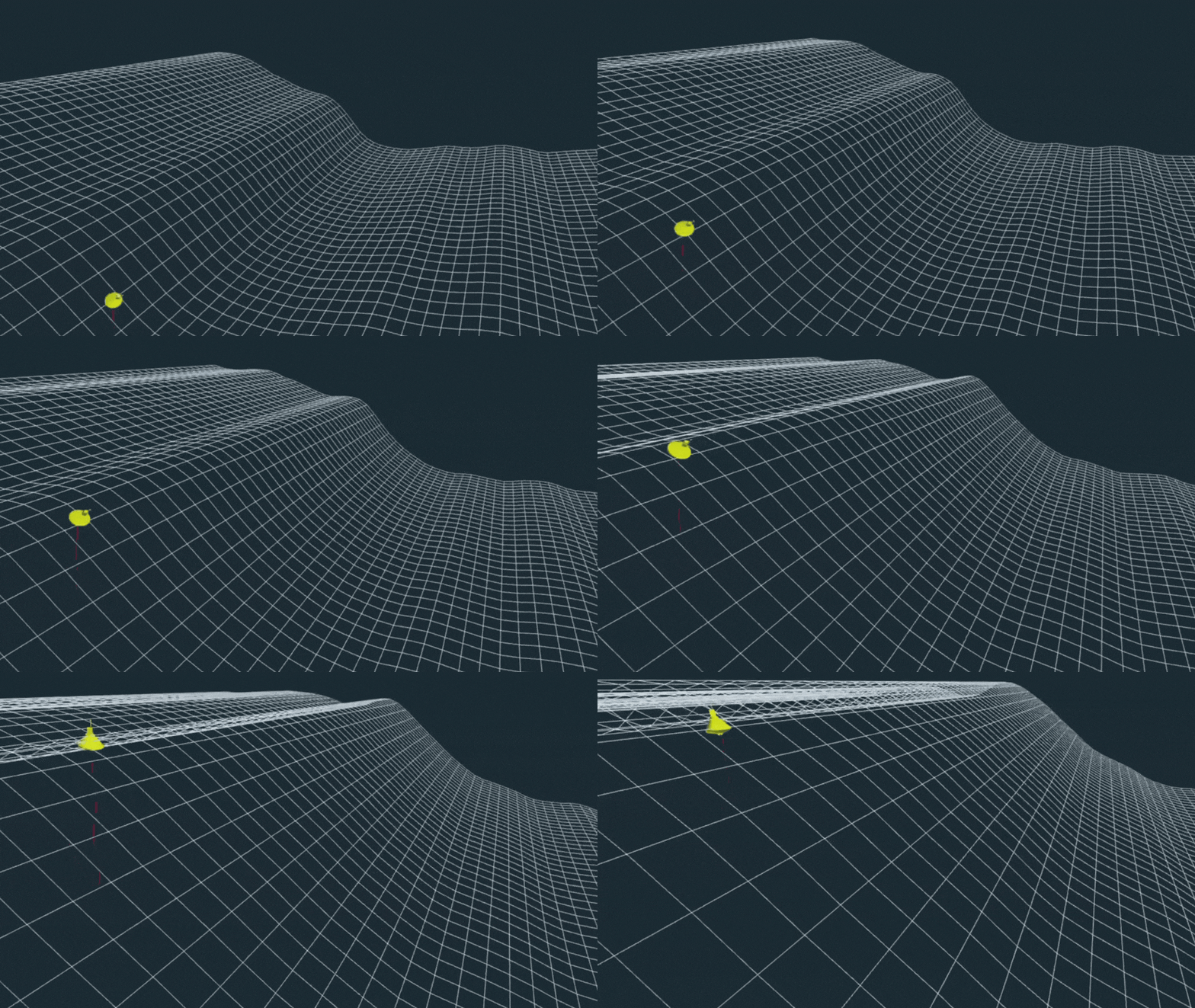
In November 2020, a freak wave appeared, lifting a lone buoy off the coast of British Columbia 17.6 meters (58 feet) high.
A few years later, the four-story wall of water was confirmed to be the most extreme rogue wave ever recorded.
Such an extraordinary event is thought to happen only once every 1,300 years. And if the buoy hadn’t been taken for a ride, we might never have known it had occurred.



Security vulnerabilities were uncovered in the popular open-source artificial intelligence (AI) framework Chainlit that could allow attackers to steal sensitive data, which may allow for lateral movement within a susceptible organization.
Zafran Security said the high-severity flaws, collectively dubbed ChainLeak, could be abused to leak cloud environment API keys and steal sensitive files, or perform server-side request forgery (SSRF) attacks against servers hosting AI applications.
Chainlit is a framework for creating conversational chatbots. According to statistics shared by the Python Software Foundation, the package has been downloaded over 220,000 times over the past week. It has attracted a total of 7.3 million downloads to date.

Microsoft shared a temporary workaround for customers experiencing Outlook freezes after installing this month’s Windows security updates.
As explained one week ago, when Microsoft acknowledged the issue, the bug causes the classic Outlook desktop client to hang for users with POP email accounts who have deployed the KB5074109 security update on Windows 11 25H2 and 24H2 systems.
Other symptoms include the inability to reopen Outlook without ending the process via Task Manager or restarting the device, Outlook redownloading emails, and emails not appearing in the Sent Items folder even though they were sent.

People worldwide are being targeted by a massive spam wave originating from unsecured Zendesk support systems, with victims reporting receiving hundreds of emails with strange and sometimes alarming subject lines.
The wave of spam messages started on January 18th, with people reporting on social media that they received hundreds of emails.
While the messages do not appear to contain malicious links or obvious phishing attempts, the sheer volume and chaotic nature of the emails have made them highly confusing and potentially alarming for recipients.