Elliptic says Telegram-based Tudou Guarantee has stopped public transactions after handling $12B, amid arrests and ongoing global crypto scam crackdow


A critical-severity vulnerability in the Advanced Custom Fields: Extended (ACF Extended) plugin for WordPress can be exploited remotely by unauthenticated attackers to obtain administrative permissions.
ACF Extended, currently active on 100,000 websites, is a specialized plugin that extends the capabilities of the Advanced Custom Fields (ACF) plugin with features for developers and advanced site builders.
The vulnerability, tracked as CVE-2025–14533, can be leveraged for admin privileges by abusing the plugin’s ‘Insert User / Update User’ form action, in versions of ACF Extended 0.9.2.1 and earlier.
The recently discovered cloud-focused VoidLink malware framework is believed to have been developed by a single person with the help of an artificial intelligence model.
Check Point Research published details about VoidLink last week, describing it as an advanced Linux malware framework that offers custom loaders, implants, rootkit modules for evasion, and dozens of plugins that expand its functionality.
The researchers highlighted the malware framework’s sophistication, assessing that it was likely the product of Chinese developers “with strong proficiency across multiple programming languages.”
Over 60? THIS Morning Habit TRIPLES Stroke Risk In Older Adults! | Senior Health Tips.
Most people don’t know this, but the first 90 minutes after waking are the most dangerous for adults over 60 — especially when it comes to stroke risk. 🧠⚠️ New studies from Harvard, Tokyo, and Toronto reveal that certain common morning habits can dramatically increase vascular stress, spike blood pressure, restrict blood flow to the brain, and trigger dangerous clotting patterns in older adults. These habits look harmless on the outside, but inside the body, they create the perfect storm for a stroke. 😳
In this video, we reveal the 6 morning habits that triple stroke risk in seniors, ranked from least to most dangerous. You’ll learn why the aging vascular system reacts differently in the morning, why certain actions overload the arteries, how sudden pressure changes affect the brain, and the specific morning routines neurologists now warn older adults to avoid. We also explain what the research discovered about Habit #1 — a behavior so strongly linked to stroke risk that scientists repeated the study twice to confirm the results. 🧬📊
If you or someone you love is over 60, this is essential information. These morning habits can quietly raise your risk without symptoms, but the good news is that simple changes can help protect your brain, improve circulation, and lower your chances of experiencing a life-altering event. ❤️🩹 Stay until the end — your brain health may depend on it.
⌛Timestamps:
⏱️ Intro – 00:00
⚠️ Habit No.5 – 02:36
⚠️ Habit No.4 – 05:57
⚠️ Habit No.3 – 09:24
⚠️ Habit No.2 – 13:30
⚠️ Habit No.1 – 17:54
#SeniorHealth #SeniorHealthTips #SeniorWellness #SeniorZone #StrokeRisk #StrokePrevention #MorningHabits #Over60Health #BrainHealth #HealthyAging #SeniorSafety #HighBloodPressure #CirculationHealth #AgingWell #UnitedStates #Wisdom #NeurologyTips #SeniorCare #VascularHealth #HealthyMorningRoutine #LongevityTips.
Microsoft just introduced OptiMind — a new AI system that turns plain English decision problems into solver-ready optimization models. Instead of needing an expert to manually convert business intent into MILP math, OptiMind generates the full mathematical formulation plus executable Python code using GurobiPy. The result: faster, cheaper optimization workflows for logistics, scheduling, manufacturing, and supply chains — with major accuracy gains on cleaned, expert-validated benchmarks.
📩 Brand Deals & Partnerships: [email protected].
✉ General Inquiries: [email protected].
🧠 What You’ll See.
0:00 What Microsoft OptiMind Really Is.
1:43 From Text to Optimization Code (MILP + Gurobi)
2:59 OptiMind Architecture: MoE and 128K Context.
3:34 Open Source Under MIT License.
4:28 Training With Expert Hints and Clean Data.
6:02 53 Optimization Problem Classes.
8:38 Multi-Stage Solver-in-the-Loop Inference.
9:11 Self-Consistency and Auto Error Correction.
9:55 Performance vs GPT-o4 Mini and GPT-5
10:32 Limits, Safety, and Human Oversight.
🚨 Why It Matters.
Optimization is already the hidden engine behind supply chains, factories, routing, and scheduling — the problem is the translation step. Converting messy real-world requirements into correct MILP constraints takes rare experts and days of work. OptiMind targets that exact gap: natural language in, solver-ready decisions out. This is why it’s going viral — it’s not just AI text generation, it’s AI generating decisions.
#AI #Microsoft #OptiMind
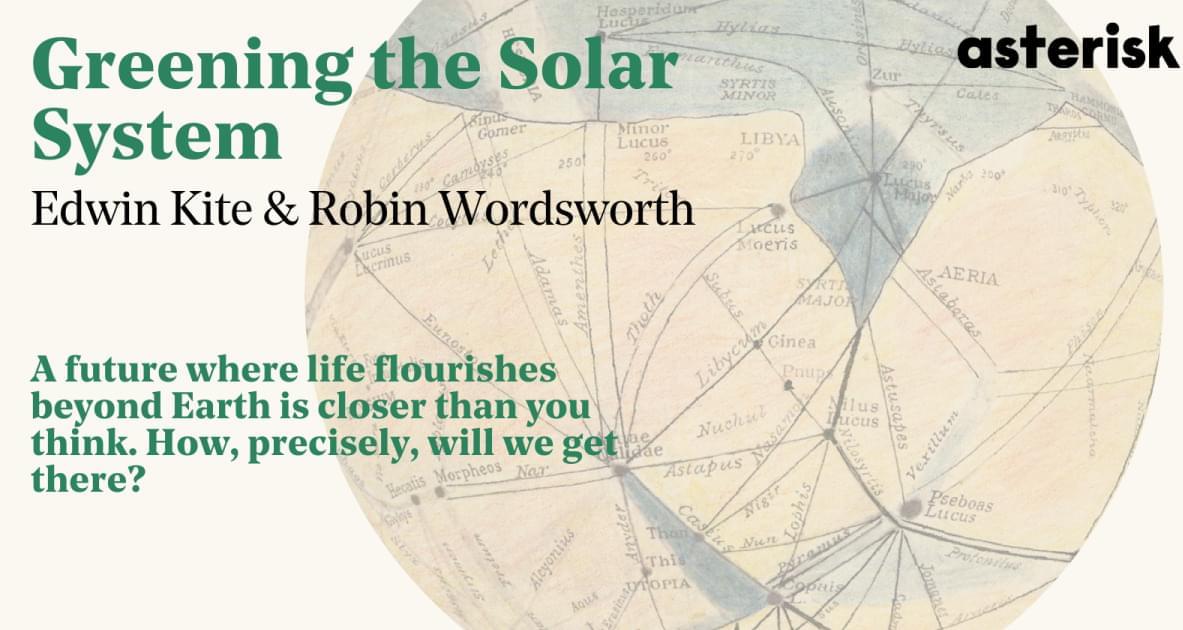
A lovely, thoughtful, and evidence-based essay on the technical prerequisites for terraforming Mars and other nearby planets and asteroids. While this will take a long time, I believe it ought to be one of the main priorities towards opening up a bright and beautiful future for humanity.
A future where life flourishes beyond Earth is closer than you think. How, precisely, will we get there?
The idea of bringing life to other worlds has captured the imagination of many scientists and thinkers, from the founding father of astronautics, Konstantin Tsiolkovsky, in the 1890s to Carl Sagan, Freeman Dyson and other visionaries in the 20th century. Today, we know much more about spaceflight, biology, and the nature of habitable environments. We are entering an era of rapid and cheap access to space, and with it, we find ourselves on the brink of being able to extend Earth’s biosphere across the solar system, billions of times beyond its current bounds.
The possibilities for how we might do this range widely, from terraforming Mars (and possibly other planets or moons) to generating habitable bubbles on free-floating asteroids. While technological challenges remain, many of these techniques appear surprisingly feasible — making a detailed assessment of their merits all the more important.

Meta Platforms is making one of its boldest moves yet in the global artificial intelligence race. The social media giant has agreed to acquire Manus, a fast-growing AI startup based in Singapore, as it looks to turn years of heavy spending on artificial intelligence into real, usable products and revenue.
For Meta founder and CEO Mark Zuckerberg, artificial intelligence is no longer just another technology experiment. It has become the company’s top priority. Meta is investing billions of dollars into hiring top researchers, building massive data centers, and developing powerful new AI models. The acquisition of Manus signals a clear shift from long-term research to tools that businesses and everyday users can start using now. Manus is best known for its AI agent, a type of software that can perform tasks on its own once given basic instructions. Unlike chatbots that need constant prompts, AI agents are designed to act more like digital employees. Manus’ agent can screen job resumes, plan travel itineraries, analyse stock data, and carry out research tasks with minimal human involvement.
This practical approach may be exactly what Meta needs. While the company has spent heavily on AI, investors have questioned when those investments would begin to generate meaningful returns. Manus already operates on a subscription model and had an annual revenue run rate of about 125 million dollars earlier this year. That gives Meta a ready-made product that can be sold to businesses almost immediately. The startup behind Manus is called Butterfly Effect. It was founded in China but later moved its headquarters to Singapore, a move that reflects a wider trend among Chinese tech companies seeking a more stable base amid rising tensions between China and the United States. Earlier this year, Butterfly Effect raised funding at a valuation close to 500 million dollars in a round led by US venture capital firm Benchmark. Meta has not disclosed the financial details of the acquisition.
Year 2025 bigsmile
In his COMPUTEX keynote, NVIDIA CEO Jensen Huang unveiled a vision for an AI-powered future, showcasing new platforms and partnerships.
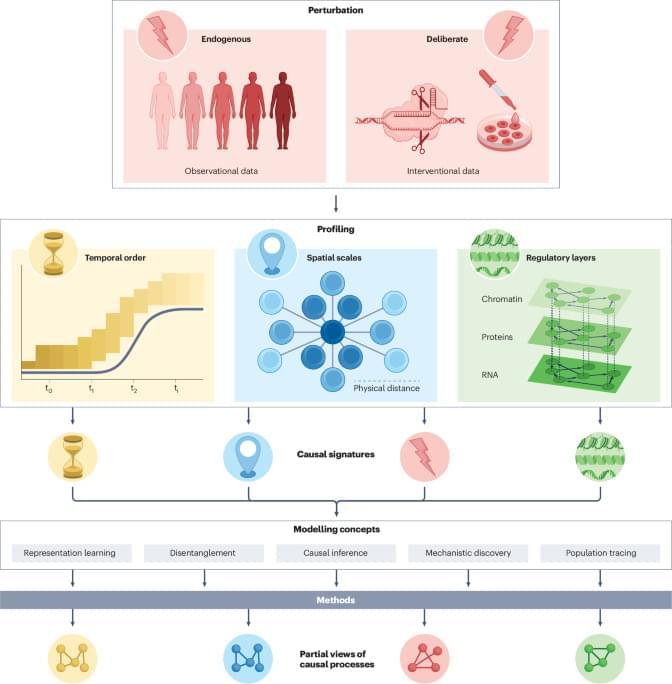
Causal and mechanistic modelling strategies, which aim to infer cause–effect relationships, provide insights into cellular responses to perturbations. The authors review computational approaches that harness machine learning and single-cell data to advance our understanding of cellular heterogeneity and causal mechanisms in biological systems.