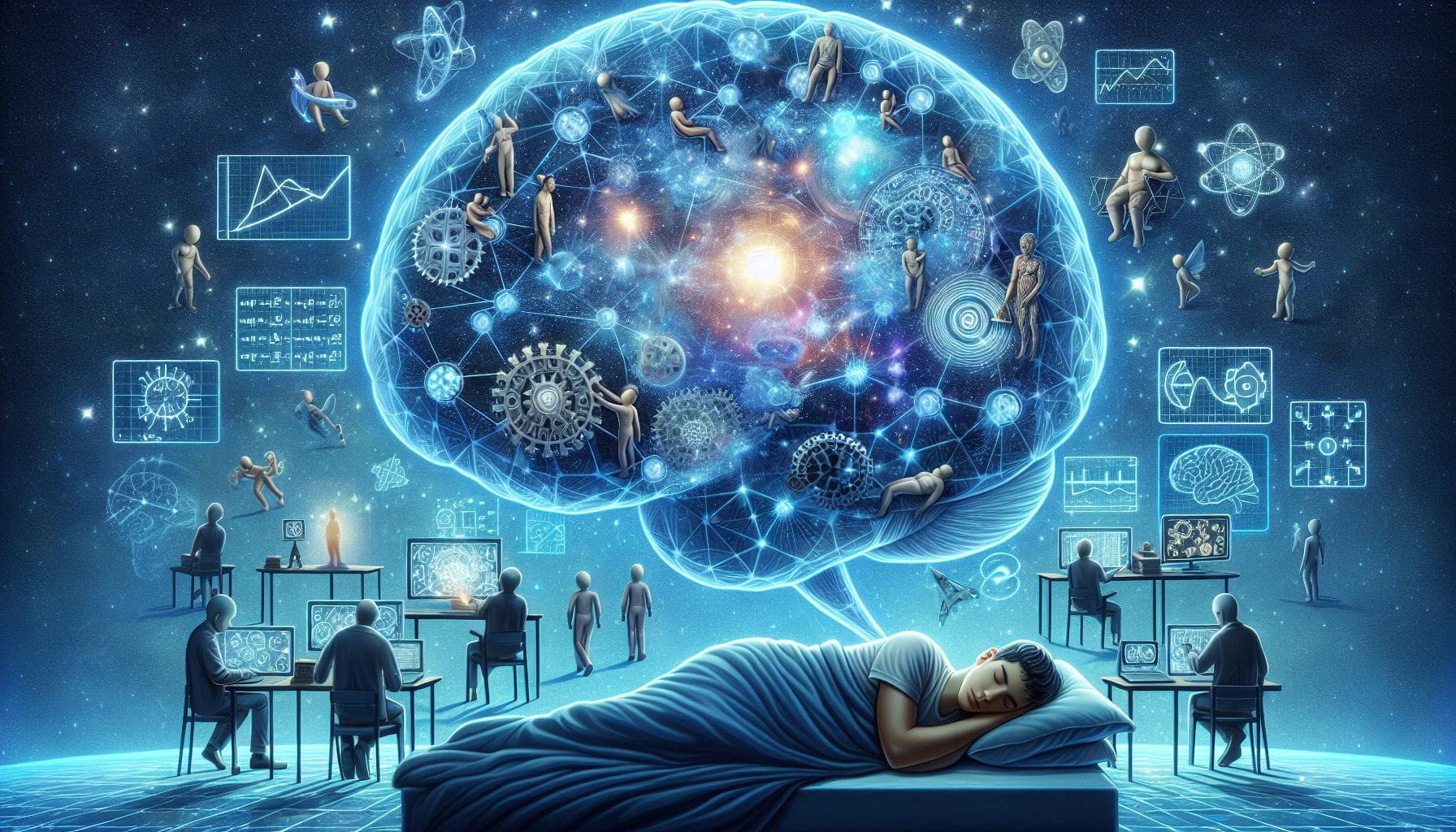
Recently, there has been convergence of thought by researchers in the fields of memory, perception, and neurology that the same neural circuitry that produces conscious memory of the past not only produces predictions of the future, but also conscious perception of the present.
In a new perspective in the Journal of Cognitive Neuroscience, researchers explain that although our conscious perception appears to simply mirror the external world, due to neural processing delays this intuitive feeling must be wrong. Instead, unconscious perceptual mechanisms represent a timeline that is then consciously remembered. Because the default mode network, along with the frontoparietal control and salience networks, are critical for simulation and memory, they are also critical for consciousness.
“The same simulation processes are used whether we are consciously remembering the past, experiencing the present or imagining the future. Perceptual mechanisms represent an ongoing, editable, ‘best estimate’ of our past, present, and future. There is no hard boundary between conscious perception and memory at milliseconds to seconds timescales,” explains corresponding author Andrew Budson, MD, professor of neurology at Boston University Chobanian & Avedisian School of Medicine.
Transformer-based LLMs are the most significant technology of the past decade. This is first in a series of posts exploring Transformers at various levels of abstraction, digging deeper with each post
Asynchronous firing and off states in working memory maintenance.
Mozumder, Wang et al. use high-density recordings in macaque prefrontal and parietal cortex to show that working memory is sustained by asynchronous spiking activity without prolonged silent periods. Off states are characterized by relatively decreased information decoding and are synchronized between areas. The balance between asynchronous firing and off states determines memory maintenance.
Leading The Way To A Water-Positive Future — Sami Tellatin — Head of Water & Climate Solutions, [Kilimo](https://www.facebook.com/agrokilimo?__cft__[0]=AZYVjPpsA2hiLM5-TRnxJRoTmkVIP8k9Hro7mpHQd6HkG9roy2B0jBJyWOF7RxuqTpjcE0BjwYcznt__ZsPQBKTYGtf5mRXVr0xUT7RzlbzkSECEuWuYt0aFqjGwwCAKMCXdjJofqt5U9mF08TfSYqYpa8pmedmmVDH3rTrwH4QaMQKi6UK55095pUIWFEwu4DM&__tn__=-]K-R)
Sami Tellatin is Head of Water & Climate Solutions at Kilimo (https://kilimo.com/en/), an organization that connects companies with farmers in the same watershed to implement water-positive practices, generate measurable water savings, and secure resources for both communities and companies.
Kilimo’s operations already span 7 countries, helping steward water resources across more than 500,000 acres of land and partnering with global leaders like Microsoft, Google, Amazon, and major CPGs.
In her role, Sami leads the design and deployment of scalable water-positive solutions that help companies, farmers, and communities address water scarcity through more efficient and sustainable irrigation practices.
Prior to this role, Sami co-founded FarmRaise, an enterprise that unlocks funding for farmers and ranchers seeking to invest in their profitability and sustainability, allowing farmers to learn which public and private funding opportunities they’re eligible for and streamlines the application process, moving the industry toward one common application that unlocks funding to drive conservation practice adoption.
This paper formalizes biological intelligence as search efficiency in multi-scale problem spaces, aiming to resolve epistemic deadlocks in the basal “cognition wars” unfolding in the Diverse Intelligence research program. It extends classical work on symbolic problem-solving to define a novel problem space lexicon and search efficiency metric. Construed as an operationalization of intelligence, this metric is the decimal logarithm of the ratio between the cost of a random walk and that of a biological agent. Thus, the search efficiency measures how many orders of magnitude of dissipative work an agentic policy saves relative to a maximal-entropy search strategy. Empirical models for amoeboid chemotaxis and barium-induced planarian head regeneration show that, under conservative (i.e.
🚀 The Universe Runs on Quantum Information (Like a Computer 💻🌌) https://lnkd.in/geGmy856 What if the universe didn’t start with matter or space… but with information?
Not particles. Not time. Not gravity.
Just pure quantum information, like a computer that’s powered on but hasn’t loaded anything yet.
Demand is booming for batteries that are faster, thinner and cheaper. We want electric cars and bikes that travel further, devices that last longer, charge quicker and cost less. Today, lithium-ion batteries (LIBs) set the benchmark. But after decades of research, this technology is approaching its limits, and each new gain is harder to achieve.
Lithium–sulfur (Li–S) batteries are a promising next-generation technology. They store far more energy than LIBs by weight and are made from cheap, readily available materials.
But here’s the catch. Current Li–S batteries take up around 1.5 to 2.0 times more space than LIBs. In other words, their volumetric capacities are much lower. That’s a serious bottleneck because in many real-world applications, space matters more than weight. From portable electronics, electric vehicles to aerospace systems, every inch of space matters.
Cancer and Alzheimer’s are two of the most common chronic diseases associated with aging. For years, doctors have known about a curious aspect of these two conditions: people who survive cancers are significantly less likely to develop Alzheimer’s. While this link has been observed in the data for some time, the biological reasons for it have remained a mystery. Now, a new study published in the journal Cell has discovered a possible explanation.
In the Alzheimer’s brain, abnormal levels of a naturally occurring protein called amyloid-beta clump together to form plaques. The plaques disrupt communication between brain cells, eventually leading to cognitive decline and memory loss. Current medicines struggle to remove these clumps, but this new research suggests that cancer might be sending in a biological cleanup crew.
To see whether and how cancer provides this protection, researchers at the Huazhong University of Science and Technology in China used advanced mouse models of Alzheimer’s disease. They transplanted three types of tumors (lung, colon and prostate cancer) into the mice and found that the amyloid plaques in their brains shrank significantly.