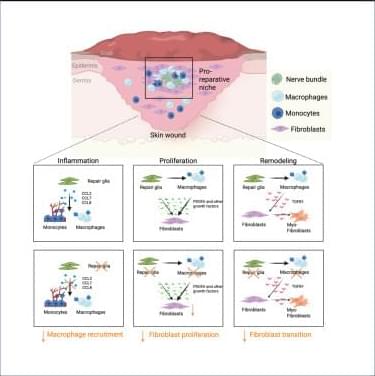
Tissue repair involves extensive communication between the different cellular components of the skin. Among them, nerve innervation is critical for a successful repair process.12,13,14,55 However, only in recent years has the pro-reparative contribution of peripheral glial cells been acknowledged.56,57 For instance, peripheral glia support progenitor cell proliferation by secreting growth factors such as newt anterior gradient protein in the amphibian blastema58 and oncostatin M (OSM) and PDGFα in the digit tip blastema.49 Previous work from our group and others has shown that peripheral glial cells promote skin repair, as depletion of these cells decreased dermal and epidermal cell proliferation,49 reduced myofibroblast numbers,18 and, ultimately, impaired skin wound healing.
Here, we found that peripheral glial cells, primarily residing in NBs, constitute a pro-reparative niche, enriched in inflammatory cells, fibroblasts, and high cell proliferation, essential for the healing process of acute skin wounds. Pro-reparative niches have previously been described in the skin epithelium and in the skeletal muscle, where local stem cell microenvironments support tissue homeostasis.59 In addition, non-myelinating glial cells were shown to be part of a stem cell niche sustaining hemopoietic stem cell dormancy by secreting TGF-β.60 Moreover, enteric glial cells were recently identified to regulate intestinal stem cell turnover by secreting wingless int-1 (WNTs) and were shown to envelop the intestinal stem cells by forming a web-like structure around the intestinal crypts.61,62 This close association of the enteric glia cells and the intestinal crypt also points toward the formation of a spatially organized niche critical for intestine homeostasis.