A new experimental treatment has shown encouraging results in a recent clinical trial, offering new hope against one of medicine’s most challenging conditions.





A quantum state of matter has appeared in a material where physicists thought it would be impossible, forcing a rethink on the conditions that govern the behaviors of electrons in certain materials.
The discovery, made by an international team of researchers, could inform advances in quantum computing, improve electronic efficiencies, and deliver enhanced sensing and imaging technologies.
The state, described as a topological semimetal phase, was theoretically predicted to appear at low temperatures in a material composed of cerium, ruthenium, and tin (CeRu4Sn6), before experiments verified its existence.

The scientist Stephen Hawking lived with amyotrophic lateral sclerosis (ALS), the most common type of motor neurone disease, for 55 years. He was one of the longest-surviving people with the condition.
However, most people with motor neurone disease are not as lucky. It often progresses quickly, and many pass away within two to five years of diagnosis.
There is still no cure. Genetics account for only about 10% of cases, and the rest of the causes are still largely a mystery.
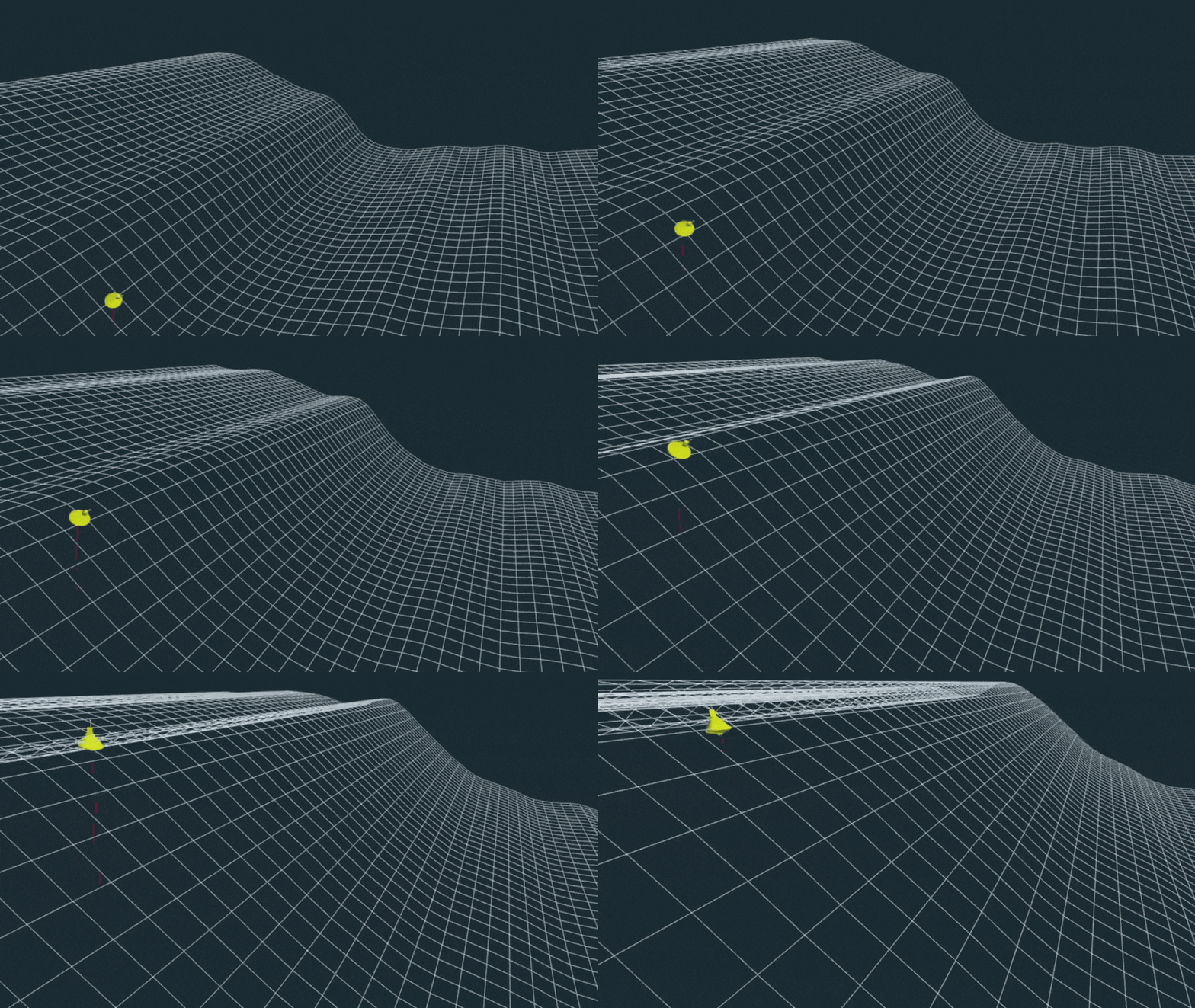
In November 2020, a freak wave appeared, lifting a lone buoy off the coast of British Columbia 17.6 meters (58 feet) high.
A few years later, the four-story wall of water was confirmed to be the most extreme rogue wave ever recorded.
Such an extraordinary event is thought to happen only once every 1,300 years. And if the buoy hadn’t been taken for a ride, we might never have known it had occurred.



Security vulnerabilities were uncovered in the popular open-source artificial intelligence (AI) framework Chainlit that could allow attackers to steal sensitive data, which may allow for lateral movement within a susceptible organization.
Zafran Security said the high-severity flaws, collectively dubbed ChainLeak, could be abused to leak cloud environment API keys and steal sensitive files, or perform server-side request forgery (SSRF) attacks against servers hosting AI applications.
Chainlit is a framework for creating conversational chatbots. According to statistics shared by the Python Software Foundation, the package has been downloaded over 220,000 times over the past week. It has attracted a total of 7.3 million downloads to date.