“WISPIT 2 gives us a critical laboratory not just to observe the formation of a single planet but an entire planetary system,” said Dr. Christian Ginski. [ https://www.labroots.com/trending/space/30349/astronomers-sp…r-system-2](https://www.labroots.com/trending/space/30349/astronomers-sp…r-system-2)
What can young planets in a far away star system teach astronomers about planetary formation and evolution? This is what a recent study published in The Astrophysical Journal Letters hopes to address as a team of scientists announced the discovery of two young planets orbiting a young star. This study has the potential to help scientists better understand the formation and evolution of planets, along with how solar systems like ours formed and evolved.
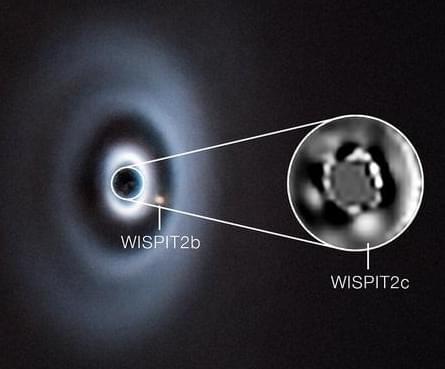
For the study, the researchers used the European Southern Observatory’s (ESO’s) Very Large Telescope (VLT) to confirm the existence of a second planet within the WISPIT 2 system, which is located approximately 440 light-years from Earth. The first planet, WISPIT 2b, was identified and confirmed in August 2025, and this new planet has been dubbed WISPIT 2c.
While both planets have been identified as gas giants, WISPIT 2b was confirmed to be approximately five times the mass of Jupiter and orbits at 60 astronomical units (AU) from its star and WISPIT 2c is estimated to be 15 AU from its star and is estimated to be twice the mass as WISPIT 2b. For context, Earth orbits 1 AU from our Sun while Jupiter and Saturn orbit 5.20 AU and 9.58 AU, respectively. Along with the two confirmed planets, the researchers have postulated that a third planet could exist in the system and is estimated to be approximately the mass of Saturn.