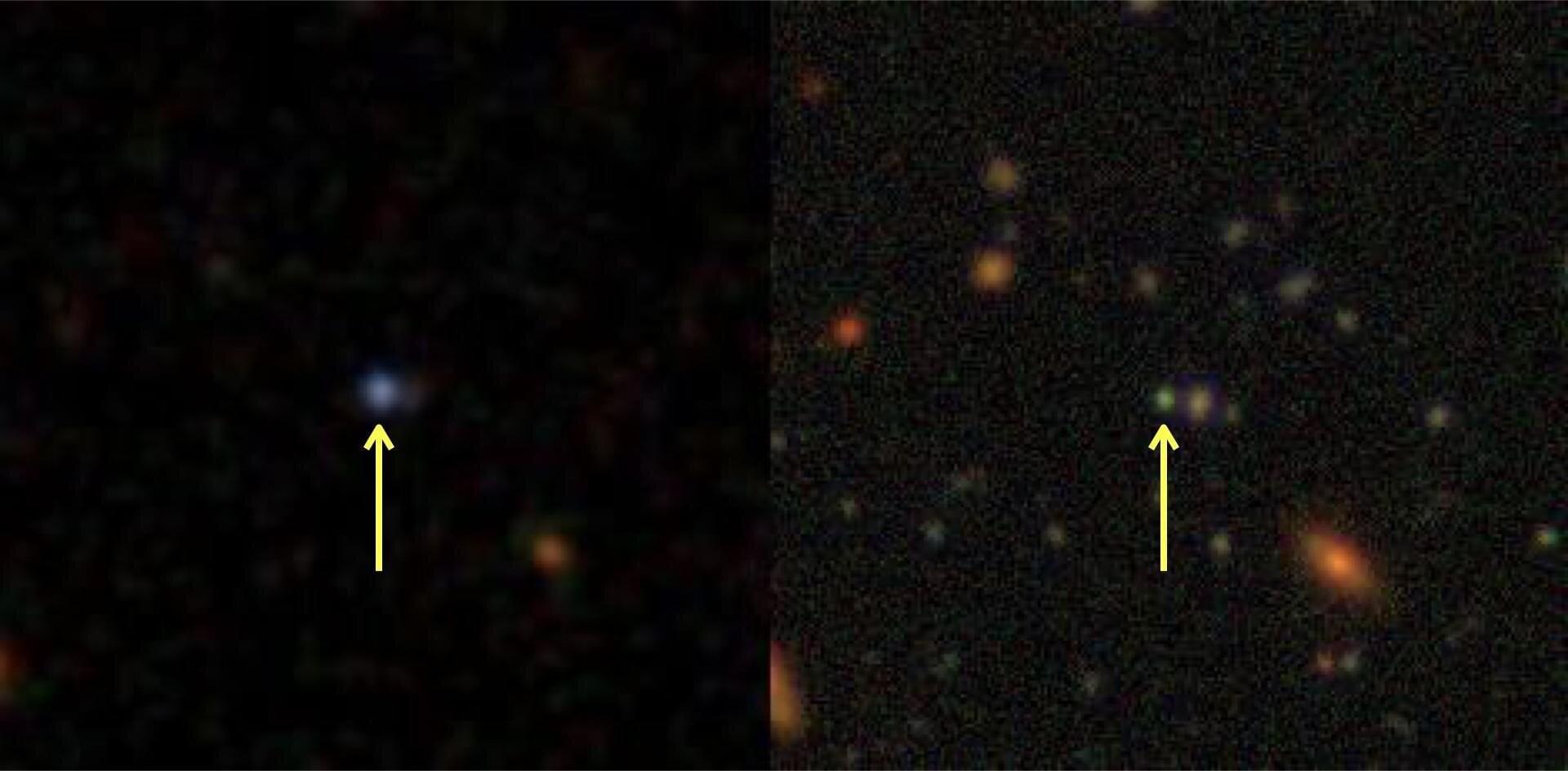
An international team led by a researcher at the Chiba Institute of Technology has discovered an extremely rare phenomenon: a galaxy about 10 billion light-years away whose brightness dropped to one-twentieth of its original level in just 20 years. By combining multiwavelength observations with archival data spanning several decades, the researchers concluded that the fading was caused by a rapid decrease in the gas flowing into the supermassive black hole at the galaxy’s center. The discovery shows that the activity of supermassive black holes can change dramatically on timescales short enough to be observed within a human lifetime.
Most galaxies host at their centers a supermassive black hole, with a mass hundreds of millions of times that of the sun. In some cases, surrounding gas is pulled inward by the black hole’s strong gravity. As the gas spirals toward the black hole, it forms a structure known as an accretion disk. Friction in the disk heats the gas to extremely high temperatures, producing enormous amounts of energy. As a result, the center of the galaxy shines very brightly (see left image below). Such luminous regions are known as active galactic nuclei (AGN).
However, if the flow of gas into the accretion disk weakens for some reason, the emitted radiation decreases and the galactic center becomes dimmer (see right image below). The new observations suggest that this galaxy has entered exactly such a phase—one in which the activity of its central black hole has rapidly declined.