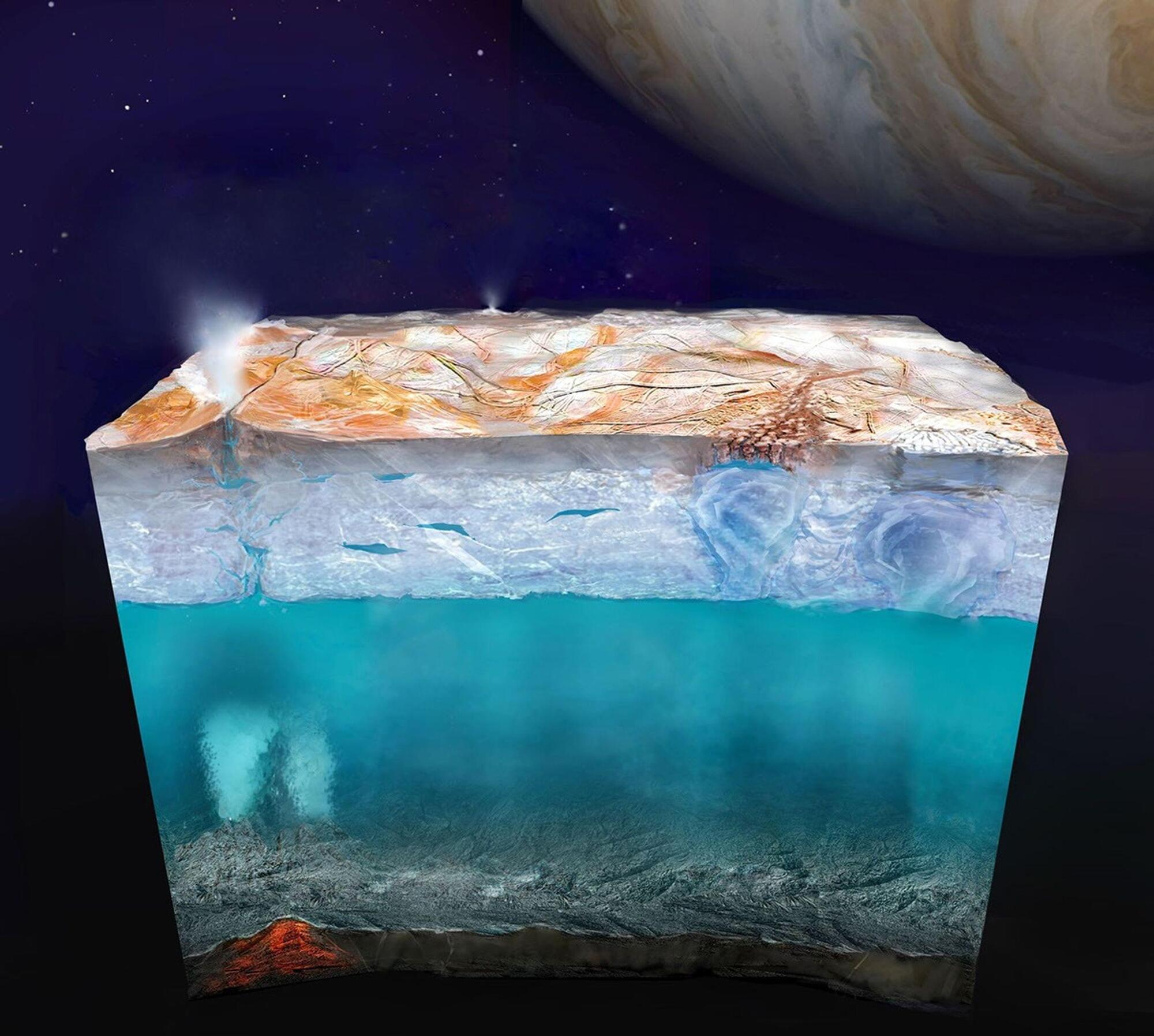
“If we could explore that ocean with a remote-control submarine, we predict we wouldn’t see any new fractures, active volcanoes or plumes of hot water on the seafloor,” said Dr. Paul Byrne.
Does Jupiter’s icy moon, Europa, contain the conditions for life as we know it? This is what a recent study published in Nature Communications hopes to address as a team of scientists from the United States and Canada investigated the likelihood of Europa’s subsurface ocean having the right conditions for life to exist. This study has the potential to help scientists better understand the necessary conditions for where life could exist, along with developing the methods for understanding them.
For the study, the researchers used a series of computer models to simulate potential tectonic activity on the seafloor of Europa’s subsurface ocean. The reason for studying tectonic activity on Europa is because this geological process is a key driver of life both existing and thriving on Earth. This is because plate tectonics are responsible for recycling nutrients to and from the Earth’s interior as it recycles materials like rocks and dust. This also enables the flow of water from the Earth’s interior to the seafloor. The researchers examined a myriad of mechanisms, including tidal forces, mantle convection, global contraction, and water-rock interactions (serpentinization).
In the end, the researchers found that Europa potentially does not exhibit these mechanisms to enable plate tectonics to be produced on Europa. They conclude that the liquid water making its way to the seafloor only occurs in the first few hundred feet, whereas plate tectonics occur over hundreds of miles. Finally, they conclude that is Europa does have life, they plate tectonics isn’t responsible for it.