Toggle light / dark theme

Get the latest international news and world events from around the world.

Log in for authorized contributors

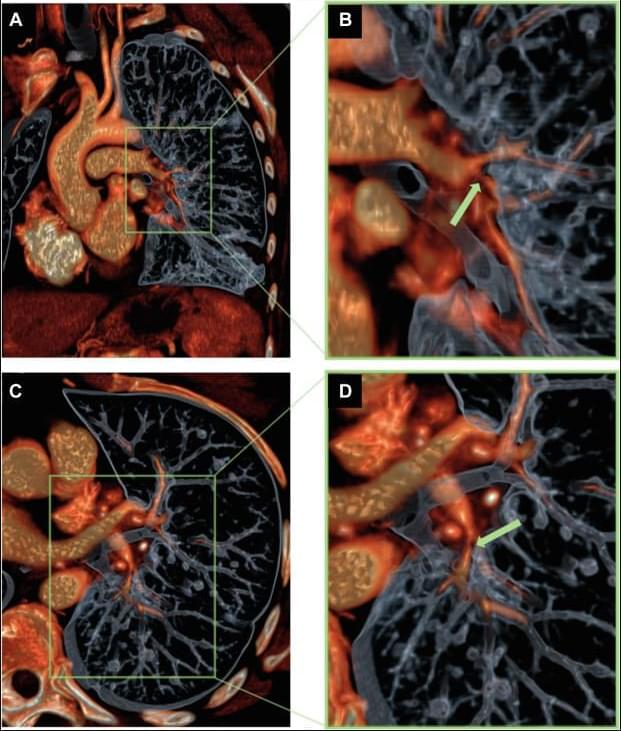
Arterial Stenosis From Sarcoidosis-Associated Adenopathy and Fibrosing Mediastinitis Leading to Pulmonary Infarction

Sarcoidosis is a systemic, granulomatous disorder commonly affecting the lungs that has the potential to cause numerous thoracic complications. We present a novel case of a 44-year-old woman with pulmonary sarcoidosis who demonstrated a large pulmonary infarction. The disease presentation ultimately was attributed to arterial stenosis resulting from sarcoidosis-associated fibrosing mediastinitis and compressive mediastinal adenopathy. The patient was treated with an extended course of prednisone and subsequently was transitioned to azathioprine with eventual resolution of symptoms, but persistence of imaging findings.

Post-Human Economics

With the rise of AGI, the need for Primal eye theory and the understanding of our form of sentience becomes greater than ever if we who are “Born of Nature” are to remain relevant.


Which is, of course, my doing. I’ve been working on a couple of big projects across the summer; time has been, to say the least, at a premium. The real point is: both projects have major implications for the future of this newsletter. I can’t wait to share more on all that in the coming weeks.

In the meantime, though, I’ve still been writing a whole lot. As most of you know, along with Raoul Pal I run The Exponentialist, a community focused on emerging technologies and their economic, social, and human implications.

In this special update, then, I’d like to share a recent essay from The Exponentialist. One that allows you a glimpse of the kind of work I do there. And that articulates an set of idea that are at the heart of my current thinking when it comes to our journey into the decades ahead.


Q&A: What do scientists need to learn next about blocking enzymes to treat disease?

Enzymes are the molecular machines that power life; they build and break down molecules, copy DNA, digest food, and drive virtually every chemical reaction in our cells. For decades, scientists have designed drugs to slow down or block enzymes, stopping infections or the growth of cancer by jamming these tiny machines. But what if tackling some diseases requires the opposite approach?

Speeding enzymes up, it turns out, is much harder than stopping them. Tarun Kapoor is the Pels Family Professor in Rockefeller’s Selma and Lawrence Ruben Laboratory of Chemistry and Cell Biology. Recently, he has shifted the focus of this lab to tackle the tricky question of how to make enzymes work faster.

Already, his lab has developed a chemical compound to speed up an enzyme that works too slowly in people with a rare form of neurodegeneration. The same approach could open new treatment possibilities for many other diseases where other enzymes have lost function, including some cancers and neurodegenerative disorders such as Alzheimer’s.

This is how I’m preparing for AI (and you can too)

As AI replaces traditional wage labor, individuals should prepare for an automated future by adapting their skills, investments, and lifestyle to focus on economic stability, personal growth, and self-directed living ## ## Questions to inspire discussion.

Capital Economy Participation.

A: Invest in dividend-producing ETFs for a hands-off approach to wealth building, as AI and robotics reduce labor demand and shift wealth distribution toward capital ownership rather than wages.

🏢 Q: What ownership structures should I explore beyond traditional employment?

A: Consider Employee Stock Ownership Plans (ESOPs) to become a part-owner of companies, but approach Decentralized Autonomous Organizations (DAOs) cautiously due to their high-risk nature despite offering ownership opportunities.

⚠️ Q: Should I rely on Bitcoin for income generation?

CES Reality Check: Are Humanoid Robots Getting Better or Just Flashier?

Here is the key idea of the video in a single sentence: Humanoid robots are rapidly advancing in design, capabilities, and functionality, but despite their impressive developments, they still face significant challenges and limitations that hinder their practical application and widespread adoption.

## Questions to inspire discussion.

Manis Glove Technology.

🖐️ Q: How does the Manis glove achieve accurate hand tracking? A: The glove tracks 25 degrees of freedom using inverse kinematics based on 6DOF per fingertip (position and orientation), enabling accurate motion capture even when fingertips are obscured.

🔌 Q: What hardware enables the Manis glove’s position tracking? A: The system uses transmitters at the base and receivers in fingertips to determine precise fingertip position relative to the transmitter, with simple calibration allowing different hand sizes as long as sensors stay in place.

📳 Q: How does the Manis glove provide haptic feedback? A: Haptic feedback at the PIP joints vibrates upon contact, enabling virtual world interaction and realistic surface contact simulation for teleoperation and clinical evaluations.

/* */