Toggle light / dark theme

Get the latest international news and world events from around the world.

Log in for authorized contributors

SYRIA UAP 2021 : Military-Filmed Footage / Apparent Instantaneous Acceleration

Investigative journalists Jeremy Corbell and George Knapp have obtained and are revealing, for the first time, military-filmed footage of a UAP (Unidentified Anomalous Phenomena), officially documented and cataloged within United States Intelligence Community investigations and examinations — as demonstrating “instantaneous acceleration” — one of the signature six observables associated with UAP flight performance. The official designation of UAP was established by the United States Intelligence Community and the Department of War. This designation is currently maintained.

DATE — 2021

LOCATION — Syria / imaged from the border of Jordan (32°05’39.2 N, 36°53’54.4 E)

IMAGING TYPE — Thermographic / Forward Looking Infrared (FLIR)

PLATFORM — MQ-9 Reaper / Multi-Spectral Targeting System (MTS-B)

EVENT DESCRIPTION — Filmed by a platform operating under the direction of the United States Air Force. The UAP was observed and actively tracked — the Reaper established a weapons-quality lock. The UAP appeared to demonstrate abrupt directional changes, instantaneous acceleration, and intelligent control. Absence of traditional propulsion or thermal signatures during performance — as well as an examination of shape and acceleration — were noted in documentation. Origin, intent, and capabilities remain unknown.

X-rays from SLAC’s synchrotron reveal star maps in a centuries-old manuscript

Pages from the Codex Climaci Rescriptus palimpsest from the Museum of the Bible in Washington, DC, were brought to the Stanford Synchrotron Radiation Lightsource to recover erased astronomical text, especially fragments from Hipparchus’ star catalog.

A mesoscale optogenetics system for precise and robust stimulation of the primate cortex

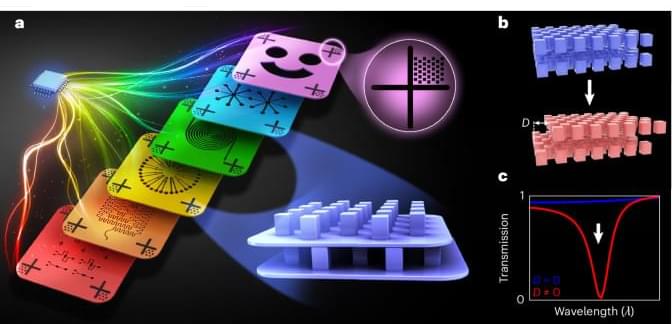
Li et al. present a microLED-based mesoscale optogenetic system for centimeter-scale, million-pixel primate cortical stimulation. Optogenetically evoked saccades with accurate retinotopic organization remain stable for over a year, demonstrating precise, robust, and durable neuromodulation and charting a path toward next-generation optical brain-computer interfaces and visual prostheses.

Supervised and unsupervised quantum machine learning models for the phase detection of the ANNNI spin model

Based on the paper Quantum phase detection generalization from marginal quantum neural network models, explore the phase diagram of the Axial Next-Nearest-Neighbor Ising (ANNNI) model using both supervised and unsupervised learning methods.

Breathing in the past: How museums can use biomolecular archaeology to bring ancient scents to life

Recent advances in biomolecular archaeology have revealed that ancient objects can retain the molecular fingerprints of past aromatic practices. These molecules provide unprecedented insight into ancient perfumery, medicine, ritual, and daily life.

In a publication in Frontiers in Environmental Archaeology, an interdisciplinary research team led by archaeo-chemist Barbara Huber (Max Planck Institute of Geoanthropology and the University of Tübingen), shows how museums can use this molecular evidence to engage audiences with the sensory worlds of the past. The team combined their expertise to create a new workflow for converting biomolecular data into accessible, visitor-ready olfactory recreations.

“This research represents a significant shift in how scientific results can be shared beyond academic publications,” explains Huber.

/* */