Toggle light / dark theme

Get the latest international news and world events from around the world.

Log in for authorized contributors

Convergent molecular pathways across distinct genetic forms of autism

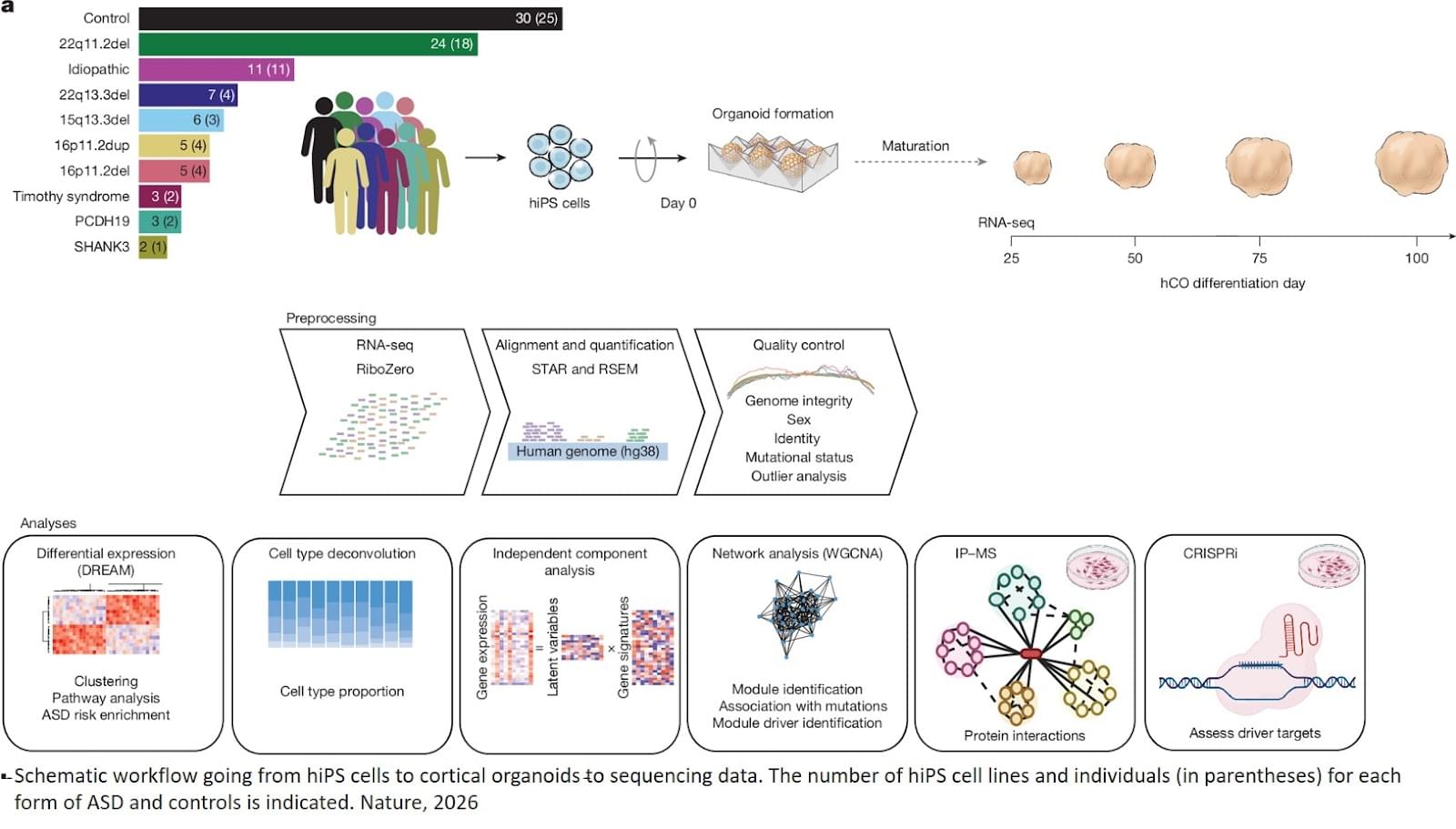
The new study, published in the journal Nature, provides new insights by demonstrating that while different mutations affect the developing brain in initially distinct ways, they increasingly impact overlapping molecular pathways as development progresses.

Researchers monitored the gene expression of the organoids over 100 days as they developed, which allowed researchers to observe how genetic changes affect brain during the critical early development windows.

Early in development, each genetic form showed distinct molecular signatures. However, as the organoids matured, these different mutations increasingly affected similar biological processes, particularly those involved in neuronal maturation and synapse formation.

The researchers identified a network of genes involved in regulating gene expression and chromatin remodeling, which is the process by which DNA is packaged and made accessible for reading. This network appears to play a central role in this convergence. Using CRISPR technology to individually reduce the activity of these regulatory genes in neural cells, the team confirmed that many of them control downstream pathways were previously linked to autism.

Notably, the study found few consistent molecular changes in organoids derived from individuals with idiopathic autism, likely reflecting the highly complex genetic architecture of autism that doesn’t involve major mutations. This finding underscores the need for much larger studies to understand the more common, polygenic forms of autism. ScienceMission sciencenewshighlights.


The researchers have created a comprehensive map showing how eight different genetic mutations associated with autism spectrum disorder affect early brain development, providing new insights into the ways diverse genetic causes may lead to shared features and symptoms of the disorder.
New biosensor technology could improve glucose monitoring

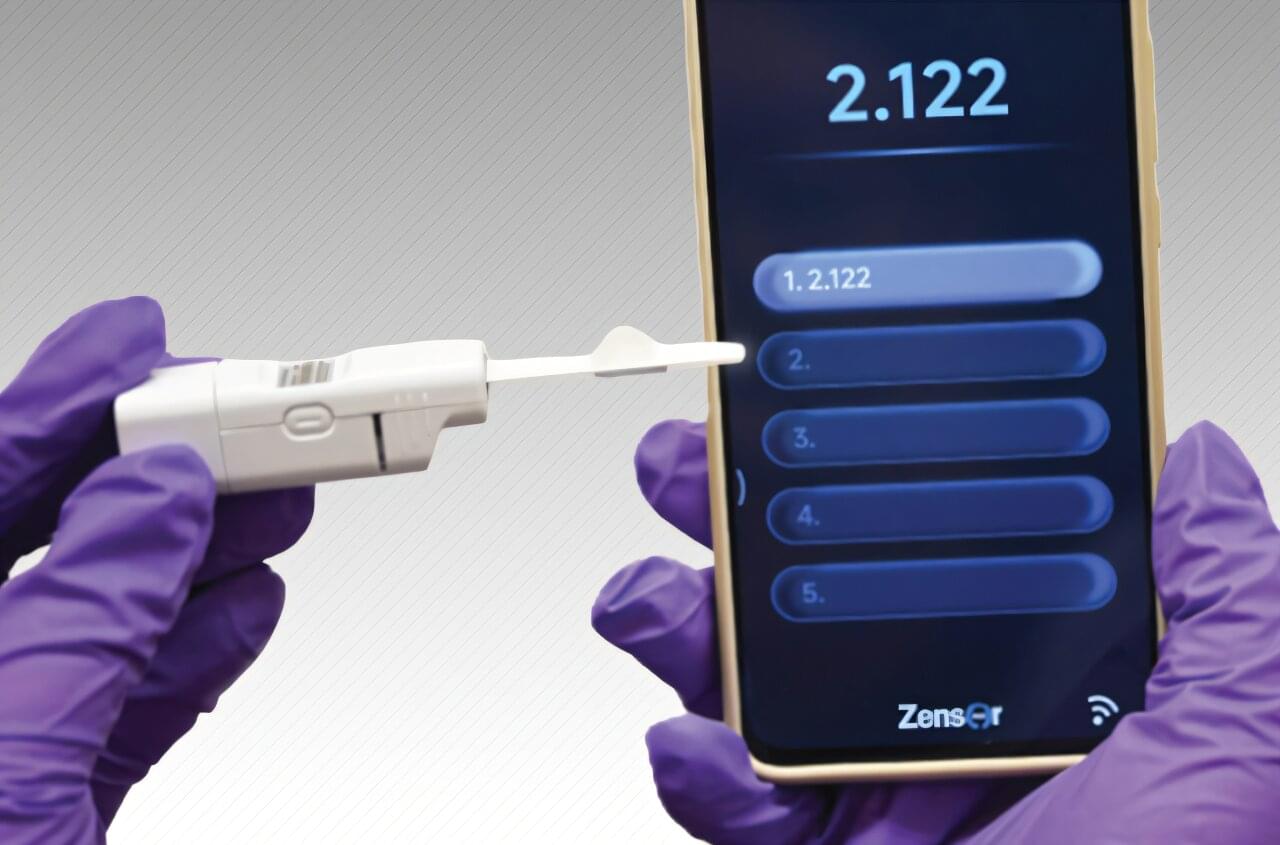
A wearable biosensor developed by Washington State University researchers could improve wireless glucose monitoring for people with diabetes, making it more cost-effective, accurate, and less invasive than current models. The WSU researchers have developed a wearable and user-friendly sensor that uses microneedles and sensors to measure sugar in the fluid around cells, providing an alternative to continuous glucose monitoring systems. Reporting in the journal The Analyst, the researchers were able to accurately detect sugar levels and wirelessly transmit the information to a smartphone in real time.

“We were able to amplify the signal through our new single-atom catalyst and make sensors that are smaller, smarter, and more sensitive,” said Annie Du, research professor in WSU’s College of Pharmacy and Pharmaceutical Sciences and co-corresponding author on the work. “This is the future and provides a foundation for being able to detect other disease biomarkers in the body.”

Measuring glucose levels is important for diabetes, helping to keep patients healthy and preventing complications. Continuous glucose monitors on the market require the use of small needles to insert the monitor, and people can get skin irritation or rashes from the chemical processes that are done under the skin. Furthermore, they’re not always sensitive enough.

Evaluation of Preexisting Humoral Immunity to Measles and Varicella Zoster in Patients With Multiple Sclerosis Initiating Anti-CD20 Therapy

This case report describes mogamulizumab-associated Kaposi sarcoma in 2 patients with primary cutaneous T-cell lymphomas.

📄Read the full report.


Corresponding Author: Emilie Holder, MD, Service de Dermatologie, Hospices Civils de Lyon, Hôpital Lyon Sud, F-69495 Oullins-Pierre-Bénite, France ([email protected]).

Published Online: February 11, 2026. doi:10.1001/jamadermatol.2025.

Conflict of Interest Disclosures: Dr Dalle reported grants from Bristol Myers Squibb, Merck Sharp & Dohme, Pierre Fabre, and Regeneron, and his spouse is an employee of Sanofi outside the submitted work. No other disclosures were reported.

Twisted 2D magnet creates skyrmions for ultra dense data storage

As data keeps exploding worldwide, scientists are racing to pack more information into smaller and smaller spaces — and a team at the University of Stuttgart may have just unlocked a powerful new trick. By slightly twisting ultra-thin layers of a magnetic material called chromium iodide, researchers created an entirely new magnetic state that hosts tiny, stable structures known as skyrmions — some of the smallest and toughest information carriers ever observed.

Dario Amodei — “We are near the end of the exponential”

Predicts significant advancements in AI capabilities within the next decade, which will have a profound impact on society, economy, and individuals, and emphasizes the need for careful governance, equitable distribution of benefits, and responsible development to mitigate risks and maximize benefits ## ## Questions to inspire discussion.

AI Scaling and Progress.

Q: What are the key factors driving AI progress according to the scaling hypothesis?

A: Compute, data quantity and quality, training duration, and objective functions that can scale massively drive AI progress, per Dario Amodei’s “Big Blob of Compute Hypothesis” from 2017.

Q: Why do AI models trained on broad data distributions perform better?

A: Models like GPT-2 generalize better when trained on wide variety of internet text rather than narrow datasets like fanfiction, leading to superior performance on diverse tasks.

Overtime with Bill Maher: Jonathan Haidt, Stephanie Ruhle, H.R. McMaster (HBO)

Artificial intelligence is rapidly advancing to the point where it may be able to write its own code, potentially leading to significant job displacement, societal problems, and concerns about unregulated use in areas like warfare.

## Questions to inspire discussion.

Career Adaptation.

🎯 Q: How should workers prepare for AI’s impact on employment? A: 20% of jobs including coders, medical, consulting, finance, and accounting roles will be affected in the next 5 years, requiring workers to actively learn and use large language models to enhance productivity or risk being left behind in the competitive landscape.

Economic Policy.

📊 Q: What systemic response is needed for AI-driven job displacement? A: Government planning is essential to manage massive economic transitions and job losses as AI’s exponential growth reaches a tipping point, extending beyond manufacturing into white-collar professions across multiple sectors.

Optimal Timing for Superintelligence: Mundane Considerations for Existing People

Nick Bostrom argues the case for doing the opposite of what Eliezer Yudkowsky recommends with regard to Artificial Intelligence. Yudkowsky says if anyone builds strong AI, everyone dies. To the contrary, Bostrom argues that if no one builds strong Artificial General Intelligence, everyone dies.

Cognitive scientist explains how we ‘see’ what isn’t real

Imagine this: A person walks into a room and knocks a ball off a table.

Did you imagine the gender of the person? The color of the ball? The position of the person relative to the ball?

Yes and no, says cognitive scientist Tomer Ullman, the Morris Kahn Associate Professor of Psychology, who with Halely Balaban recently published a paper titled “The Capacity Limits of Moving Objects in the Imagination.” If you’re like most people, you probably thought about some of these things, but not others. People build mental imagery hierarchically, starting with the ideas of “person,” “room,” “ball,” and “table,” then placing them in relation to one another in space, and only later filling in details like color.

“Our imaginations are actually patchwork and fuzzy and not filled in,” he said. His theory: Your mind’s eye might be lazier than you think. But that’s not necessarily a bad thing. “You leave things out until you need them.”

For the latest installment of “One Word Answer,” we asked Ullman to elaborate further on the current scientific thinking behind “imagination.”


Less like a picture, more like a video game? “Our imaginations are actually patchwork and fuzzy and not filled in,” says Tomer Ullman.

False alarm in newborn screening: How zebrafish can prevent unnecessary spinal muscular atrophy therapies

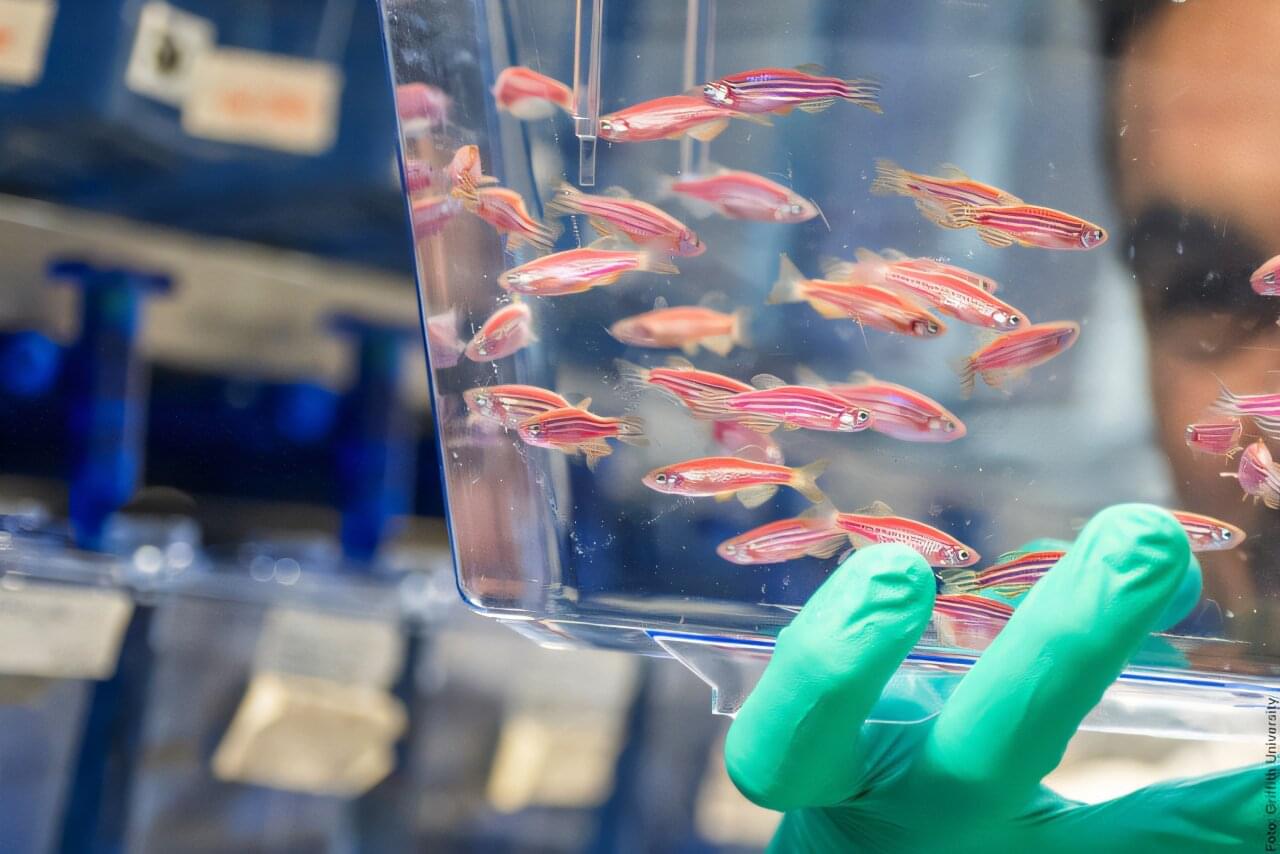
A positive newborn screening for spinal muscular atrophy (SMA) is currently considered a medical emergency. Without early treatment, severe disability or death in infancy are likely. However, research findings from Germany and Australia now show that in rare cases, a positive screening result can be a genetic false alarm. Researchers have discovered that functional tests in a zebrafish model may enable fast and reliable clinical decision-making in cases of unclear genetic findings.

The study “SMN1 variants identified by false positive SMA newborn screening tests: Therapeutic hurdles, and functional and epidemiological solutions” was published in the American Journal of Human Genetics and another study, “Clinical relevance of zebrafish for gene variants testing. Proof-of-principle with SMN1/SMA,” in EMBO Molecular Medicine. The collaborative research team was led by Professor Dr. Brunhilde Wirth, Director of the University of Cologne’s Institute of Human Genetics and Principal Investigator at the Center for Molecular Medicine Cologne (CMMC) and Dr. Jean Giacomotto from Griffith University’s Institute for Biomedicine and Glycomics, Brisbane, Australia.

The scientists examined two newborns—a girl from Germany and a boy from Australia—in whom routine screening initially failed to detect the SMN1 gene. A missing SMN1 gene is the main genetic trigger of SMA. This diagnosis would normally result in immediate treatment, as it would be assumed that the child’s life is in danger. However, further genetic analysis revealed a surprising finding: both children carried rare SMN1 variants that had not been detected by the screening test. It remains unclear whether these variants cause the disease.

/* */