Toggle light / dark theme

Get the latest international news and world events from around the world.

Log in for authorized contributors

A 3D-printed Christmas tree made entirely of ice

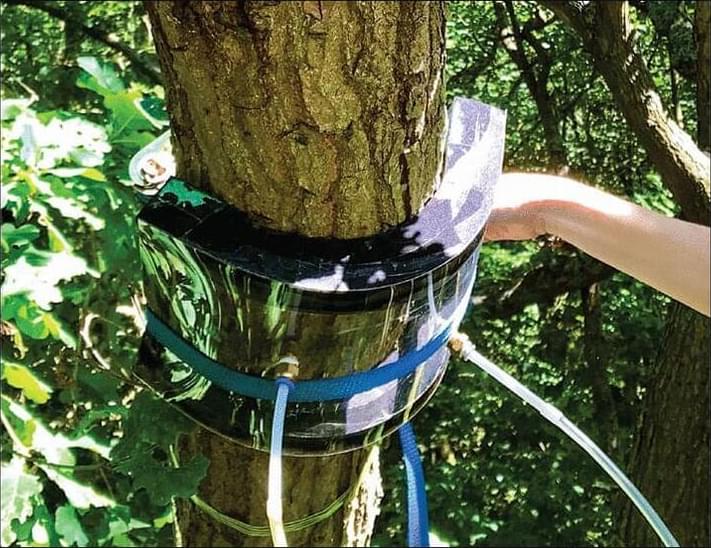
A team of physicists from the University of Amsterdam’s Institute of Physics has 3D-printed a Christmas tree made entirely of ice. Researchers Menno Demmenie, Stefan Kooij and Daniel Bonn used no freezing technology or refrigeration equipment—just water and a vacuum. In time-lapse videos, you can see how the Christmas tree is printed and how it melts again when the vacuum pump is turned off. The work is published on the arXiv preprint server.

The secret of the tree lies in so-called evaporative cooling. This is the same principle mammals use to regulate their body temperature.

In a low-pressure vacuum chamber, water evaporates rapidly at room temperature. As each water molecule evaporates, it takes with it a small amount of heat, causing the remaining water to become increasingly colder, eventually cooling to below 0°C. At that point, the water is still liquid, but supercooled. As soon as the ultra-thin stream (about as thin as a human hair: 16 micrometers) hits the already formed layer of ice, it freezes instantly.

Subsystem resetting: Researchers discover a new route to control phase transitions in complex systems

Researchers in the Department of Theoretical Physics at Tata Institute of Fundamental Research (TIFR), Mumbai, have discovered that instead of manipulating every component or modifying interactions in a many-body system, occasionally resetting just a small fraction can reshape how the entire system behaves, including how it transitions from one phase to another.

This counterintuitive approach, called subsystem resetting, offers a powerful, universal control strategy to tune collective behavior in complex systems ranging from magnets to neural networks.

This work by Anish Acharya, Rupak Majumder, and Prof. Shamik Gupta has been published in Physical Review Letters.

Cisco Warns of Active Attacks Exploiting Unpatched 0-Day in AsyncOS Email Security Appliances

Cisco has alerted users to a maximum-severity zero-day flaw in Cisco AsyncOS software that has been actively exploited by a China-nexus advanced persistent threat (APT) actor codenamed UAT-9686 in attacks targeting Cisco Secure Email Gateway and Cisco Secure Email and Web Manager.

The networking equipment major said it became aware of the intrusion campaign on December 10, 2025, and that it has singled out a “limited subset of appliances” with certain ports open to the internet. It’s currently not known how many customers are affected.

“This attack allows the threat actors to execute arbitrary commands with root privileges on the underlying operating system of an affected appliance,” Cisco said in an advisory. “The ongoing investigation has revealed evidence of a persistence mechanism planted by the threat actors to maintain a degree of control over compromised appliances.”

Kimwolf Botnet Hijacks 1.8 Million Android TVs, Launches Large-Scale DDoS Attacks

A new distributed denial-of-service (DDoS) botnet known as Kimwolf has enlisted a massive army of no less than 1.8 million infected devices comprising Android-based TVs, set-top boxes, and tablets, and may be associated with another botnet known as AISURU, according to findings from QiAnXin XLab.

“Kimwolf is a botnet compiled using the NDK [Native Development Kit],” the company said in a report published today. “In addition to typical DDoS attack capabilities, it integrates proxy forwarding, reverse shell, and file management functions.”

The hyper-scale botnet is estimated to have issued 1.7 billion DDoS attack commands within a three-day period between November 19 and 22, 2025, around the same time one of its command-and-control (C2) domains – 14emeliaterracewestroxburyma02132[.]su – came first in Cloudflare’s list of top 100 domains, briefly even surpassing Google.

/* */