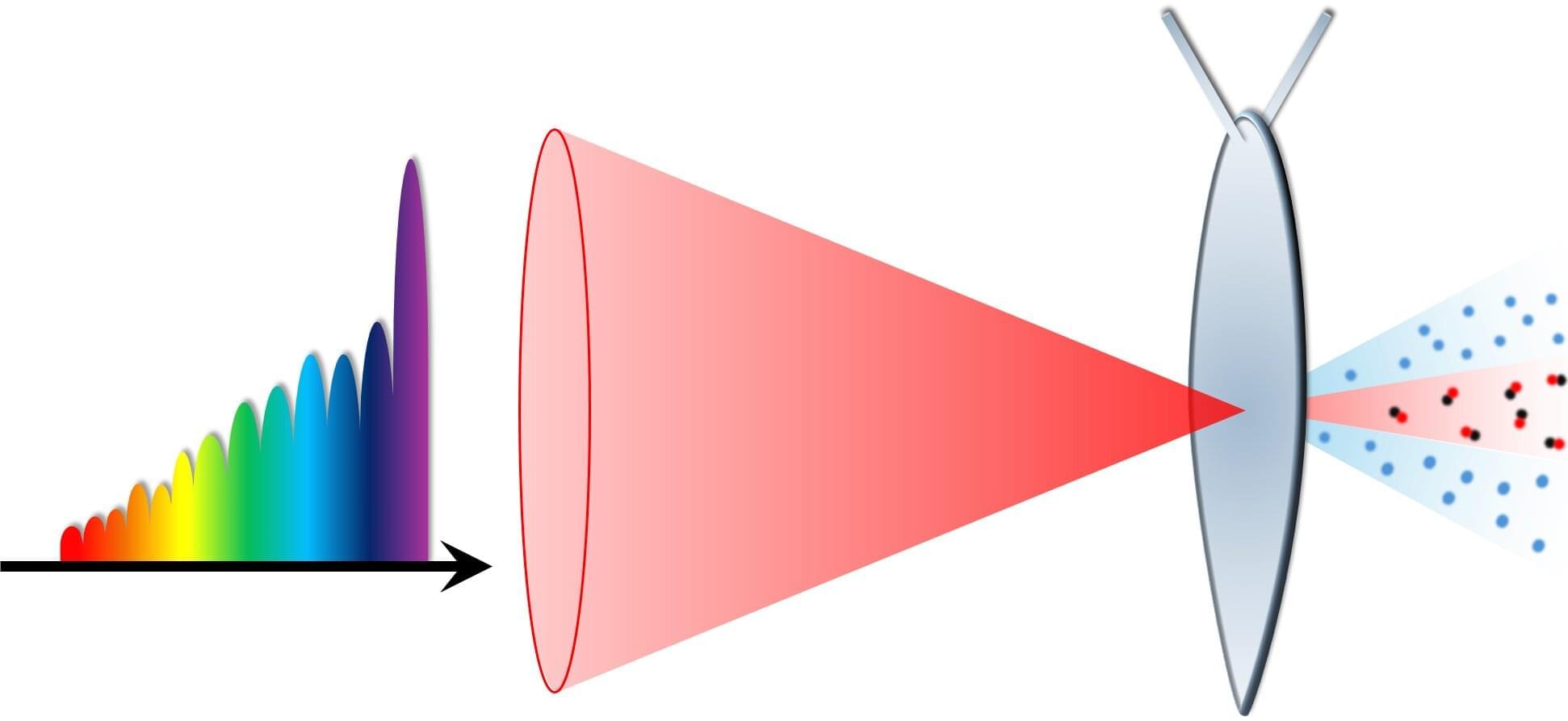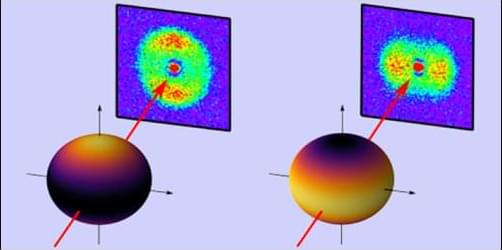
Over the past few decades, researchers have used ultracold atomic gases to simulate high-temperature superconductors and other materials in which electrons interact strongly. Frustratingly, these experiments have failed to uncover the temperature dependence of certain “p-wave” interactions relevant to some superconductors and superfluids. Now Kenta Nagase and his colleagues at the Institute of Science Tokyo have tracked how these interactions change as a cloud of lithium atoms is cooled toward absolute zero [1]. The results could help scientists better understand the behavior of certain exotic superconductors.
In a p-wave interaction, particles collide with each other in such a way that their interaction strength depends on their relative orientations. The inherent complexity of these interactions, such as their occurrence through three different scattering channels, meant that their predicted temperature dependence lacked experimental confirmation. To surmount this hurdle, Nagase and his colleagues isolated and analyzed the contributions to the interactions from each channel. They repeated their experiment at many temperatures, controlled by the strength of the optical trap confining the lithium cloud.
As they cooled the lithium cloud, Nagase and his colleagues saw that the strength of p-wave interactions increased, in agreement with predictions. These interactions caused the lithium atoms to briefly form fragile molecules, mimicking the pairing of electrons in a superconductor. The measured number, angular distribution, and behavior of such molecules were also consistent with expectations. These properties had been explored in the lab only partially, so the new work provides stronger support for current models of ultracold atomic gases.