Toggle light / dark theme

Get the latest international news and world events from around the world.

Log in for authorized contributors

A Very Stable Mirror

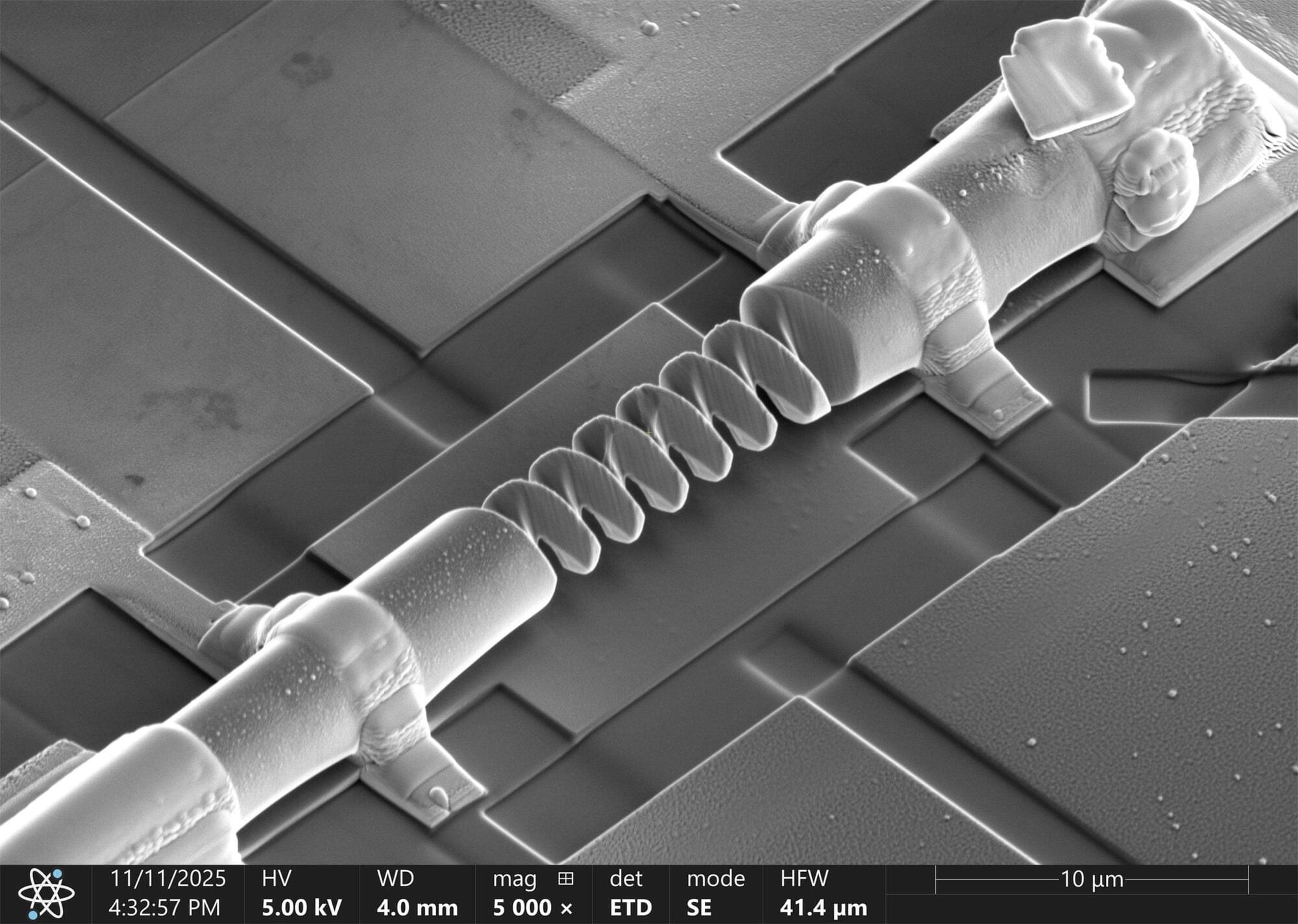
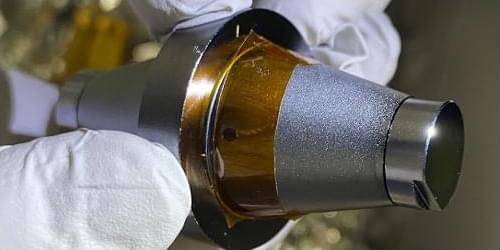
To make an ultrastable laser beam for applications such as gravitational-wave detectors, the frequency of a beam confined within an optical cavity is locked to the cavity’s resonant frequency. This frequency is determined by the cavity’s length. The stability of the laser beam’s frequency and the quality of the cavity’s resonance depend on the thermal noise of the mirrors that define that length. Dahyeon Lee at JILA and the University of Colorado Boulder and his colleagues have now demonstrated a crystalline mirror coating with superior thermomechanical properties compared to conventional coatings [1]. The new coating could lead to ultrastable cavities for optical clocks and next-generation interferometers.

Recently, mirrors coated with crystalline alloys of gallium arsenide (GaAs) have emerged as promising candidates to replace those with conventional amorphous dielectric coatings. GaAs-coated mirrors have excellent optical qualities and exhibit low thermal noise at room temperature. But previous studies found that these crystalline coatings suffer from additional noise contributions, which undermine their potential usefulness.

The origins of some of those noise contributions remain unclear. Nevertheless, Lee and colleagues have demonstrated that crystalline GaAs-based coatings can still be superior at cryogenic temperatures. The researchers constructed a 6-cm-long cavity bounded by two mirrors made of alternating layers of GaAs and aluminum gallium arsenide on silicon substrates. They used more layers compared to previous experiments, which reduced photon loss. Operating the cavity at 17 K, where the thermal expansion coefficient of the silicon substrate is zero, they achieved a frequency stability of 2.5 × 10⁻¹⁷. This stability is 4 times better than the expected limit for conventional coatings and sets a new record for cavity-stabilized lasers.

2.8 Days to Disaster: Low Earth Orbit Could Collapse Without Warning

A new analysis suggests modern satellite networks could suffer catastrophic collisions within days of losing control during a major solar storm. The phrase “House of Cards” is often associated today with a Netflix political drama, but its original meaning refers to a structure that is inherently

Scientists Discover Trigger of Achilles Pain, Tennis Elbow, and Jumper’s Knee

Scientists have uncovered a molecular trigger behind common overuse tendon injuries, revealing that HIF1 directly drives disease progression. Painful problems such as Achilles tendon pain, tennis elbow, swimmer’s shoulder, and jumper’s knee affect both young athletes and older adults. Despite the

Scientists Discover a New Quantum State of Matter Once Considered Impossible

A quantum state of matter has appeared in a material where physicists thought it would be impossible, forcing a rethink on the conditions that govern the behaviors of electrons in certain materials.

The discovery, made by an international team of researchers, could inform advances in quantum computing, improve electronic efficiencies, and deliver enhanced sensing and imaging technologies.

The state, described as a topological semimetal phase, was theoretically predicted to appear at low temperatures in a material composed of cerium, ruthenium, and tin (CeRu4Sn6), before experiments verified its existence.

Air Pollution Linked to Higher ALS Risk And Faster Decline

The scientist Stephen Hawking lived with amyotrophic lateral sclerosis (ALS), the most common type of motor neurone disease, for 55 years. He was one of the longest-surviving people with the condition.

However, most people with motor neurone disease are not as lucky. It often progresses quickly, and many pass away within two to five years of diagnosis.

There is still no cure. Genetics account for only about 10% of cases, and the rest of the causes are still largely a mystery.

/* */