Toggle light / dark theme

Get the latest international news and world events from around the world.

Log in for authorized contributors

Scientists find a mechanism showing how exercise protects the brain

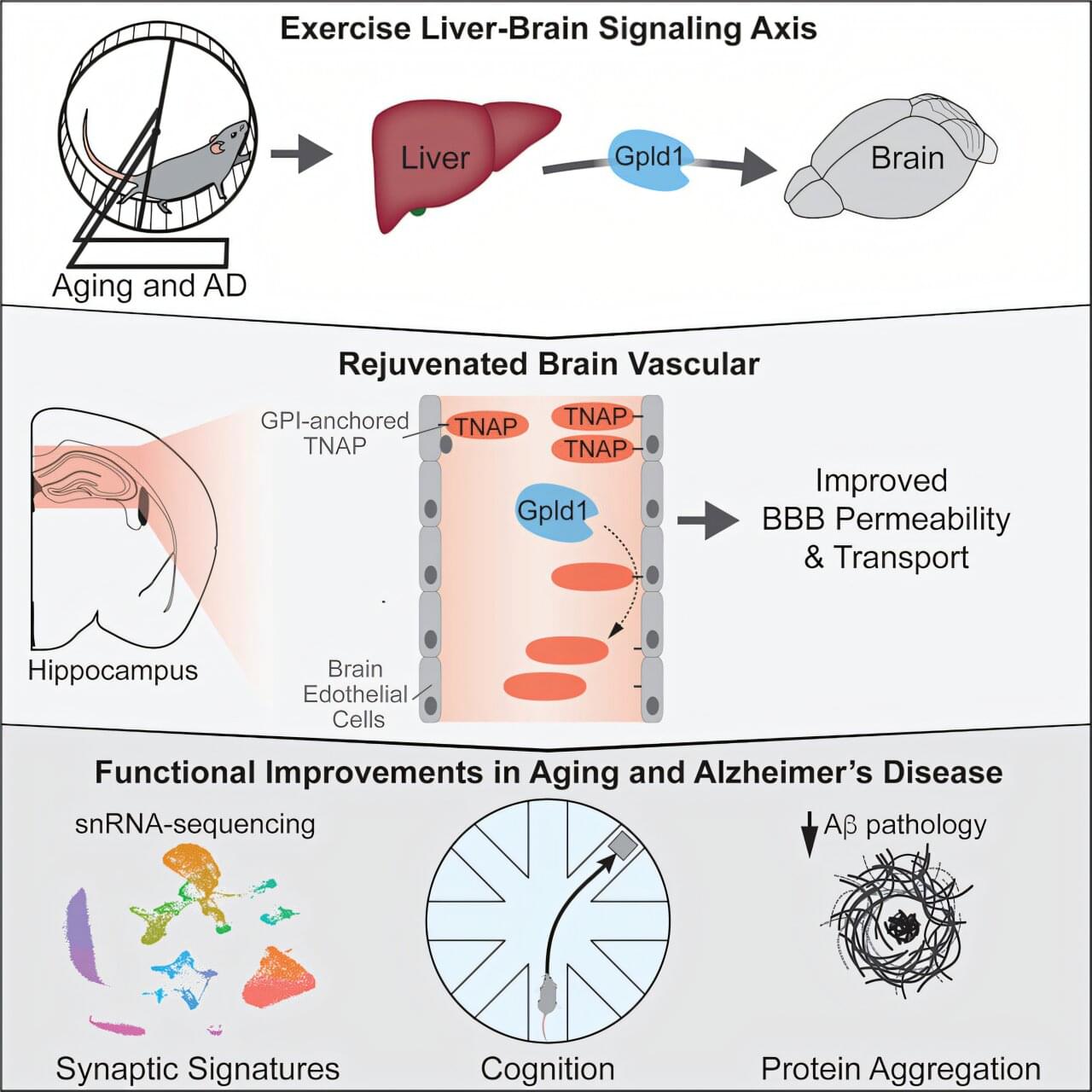
Researchers at UC San Francisco have discovered a mechanism that could explain how exercise improves cognition by shoring up the brain’s protective barrier. With age, the network of blood vessels—called the blood–brain barrier—gets leaky, letting harmful compounds enter the brain. This causes inflammation, which is associated with cognitive decline and is seen in conditions like Alzheimer’s disease. The research is published in the journal Cell.

Six years ago, the team identified a brain-rejuvenating enzyme called GPLD1 that mice produced in their livers when they exercised. But they couldn’t understand how it worked, because it cannot get into the brain.

The new study answers that question. Researchers discovered that GPLD1 was working through another protein called TNAP. As the mice age, the cells that form the blood-brain barrier accumulate TNAP, which makes it leaky. But when mice exercise, their livers produce GPLD1. It travels to the vessels that surround the brain and trims TNAP off the cells.


Pop-up-style 3D electrode array captures organoid-wide brain rhythms in real time

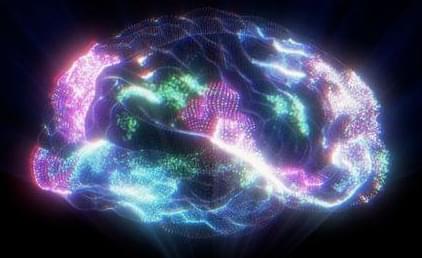
A team led by Northwestern University and Shirley Ryan AbilityLab scientists have developed a new technology that can eavesdrop on the hidden electrical dialogues unfolding inside miniature, lab-grown human brain-like tissues. Known as human neural organoids—and sometimes called “mini brains”—these millimeter-sized structures are powerful models of brain development and disease. But until now, scientists could only record and stimulate activity from a small fraction of their neurons—missing network-wide dynamics that give rise to coordinated rhythms, information processing and the complex patterns of activity that define brain function.

For the first time, the new technology overcomes that stubborn limitation. The soft, three-dimensional (3D) electronic framework wraps around an organoid like a breathable, high-tech mesh. Rather than sampling select regions, it delivers near-complete, shape-conforming coverage with hundreds of miniaturized electrodes. That dense, three-dimensional interfacing enables scientists to map and manipulate neural activity across almost the entire organoid.

By moving from localized probing to true whole-network mapping, the work brings organoid research closer to capturing how real human brains develop, function and even fail.

Homes in the fire zone: Why wildland-urban blazes create significantly more air pollution

A research team led by the U.S. National Science Foundation National Center for Atmospheric Research (NSF NCAR) has published a foundational inventory of emissions produced by structures destroyed by fires in the wildland-urban interface (WUI). Previously, researchers suspected that fires in WUI areas—spaces where human development and undeveloped wildland meet—produce emissions that are likely more harmful than those produced by forest or grass fires. However, the amount of emissions had not been quantified.

This new study, published in Nature Communications, provides the first inventory of emissions from structure fires in WUI areas. The results definitively reveal structure fires as a major source of air pollution.

WUI fires are becoming increasingly more common in the U.S. and have destroyed more than 100,000 homes since 2005. Because these events are intensely concentrated both in time and space, they can produce exceptionally high local pollution, which has important implications for the air quality and public health of nearby urban areas.

Senescent cells after pregnancy may fuel postpartum breast cancer spread

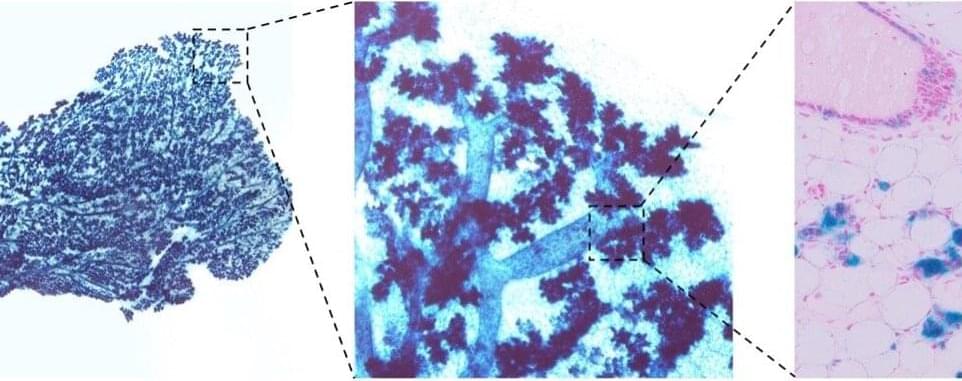
Postpartum breast cancer is diagnosed five to ten years after giving birth. It is associated with a higher risk of metastasis and a lower survival rate compared with women who have not been pregnant or those diagnosed during pregnancy. A team from the Institut Pasteur set out to understand the mammary gland mechanisms involved in tumor formation during involution, a major tissue remodeling process that occurs after pregnancy.

In a preclinical study, the scientists revealed how senescence, a cellular response inducing stable cell cycle arrest, plays an ambivalent role during mammary gland involution. While it is crucial for the normal tissue remodeling process in the mammary gland, senescence can also be hijacked by tumor cells to help them spread. This discovery, published in Nature Aging on February 18, 2026, suggests that targeting senescent cells during mammary gland involution could reduce the risk of postpartum breast cancer.

How Artificial Intelligence Is Creating New Job Opportunities

Artificial Intelligence (AI) has become a buzzword in recent years. We’ve heard countless stories about how AI could potentially eliminate jobs, particularly in the engineering and contracting realm. However, we tend to forget that AI is also capable of creating new opportunities for employment and growth. I’d like to explore exactly how AI can help create jobs for engineers and other professionals in the contracting industry.

AI Enhances Demand for Skilled Workers

One of the most significant ways that AI can create jobs is by enhancing efficiency and productivity. By reducing manual labor and streamlining processes, organizations are able to focus their energy on more complex tasks that require human expertise. This shift means a greater need for skilled labor, which means more job openings for engineers and other professionals. For example, AI can be used to automate mundane tasks such as data entry or administrative work, allowing humans to focus their attention on more technical projects – and this means engineers have more time to create solutions that change the world.

How ADHD Stimulants

In a large US-based brain imaging study, researchers found that these drugs do not primarily affect attention networks, but instead act on systems linked to arousal, sleep, and motivation.

The puzzle of ADHD stimulants

Prescription stimulants such as methylphenidate and amphetamines are among the most used psychoactive drugs in children and adolescents with ADHD, where they remain a first-line treatment. Estimates for receiving a prescription for ADHD medication among diagnosed children vary from 38–81%. Despite their widespread use, there is still disagreement about how these drugs work in the brain.

Sjögren Syndrome Candidate Autoantigen AQP5 Triggers AQP4 CNS Autoimmunity Through Self-Antigen Mimicry

Tumor-immune-neural circuit in cancer cachexia.

The mechanisms involved in cancer-mediated cachexia and anorexia are not well understood.

The researchers in this study delineate an interplay among tumor cells, immune cells, and the nervous system that drives cancer cachexia and anorexia.

The authors show thay loss of GDF15 protects against appetite loss, muscle wasting, and fat loss in pancreatic, lung, and skin cancers.

Disrupting this feedforward loop with GDF15-neutralizing antibody, anti-CSF1R antibody, or Rearranged during Transfection (RET) inhibitor alleviates cachexia and anorexia across cancer models. sciencenewshighlights ScienceMission https://sciencemission.com/Tumor-immune-neural-circuit


Shi et al. delineate an interplay among tumor cells, immune cells, and the nervous system that drives cancer cachexia and anorexia. Specifically, tumor-derived CSF1 induces macrophage GDF15, which signals through the GFRAL-RET neural axis to enhance β-adrenergic activity and systemic wasting. Disrupting this feedforward loop alleviates cachexia across cancer models.

/* */