Ex-ASML workers reverse engineered advanced machines for the country.
Sign up for a free Closer To Truth membership to receive exclusives like early access to new episodes: https://closertotruth.com/register/
To study consciousness comprehensively and rigorously, what kinds of data or information are relevant? Data/information for Materialism theories, which are subject to the scientific method, can be well defined. But what about non-Materialism theories?
This holiday, make a tax-deductible donation of any amount to help Closer To Truth continue making content like this: https://shorturl.at/OnyRq.
Anil Seth is Professor of Cognitive and Computational Neuroscience at the University of Sussex, where he is also Director of the Sussex Centre for Consciousness Science. Seth is also Co-Director of the Canadian Institute for Advanced Research (CIFAR) Program on Brain, Mind, and Consciousness. Seth’s mission is to advance the science of consciousness, and to use its insights for the benefit of society, technology, and medicine.
Closer To Truth, hosted by Robert Lawrence Kuhn and directed by Peter Getzels, presents the world’s greatest thinkers exploring humanity’s deepest questions. Discover fundamental issues of existence. Engage new and diverse ways of thinking. Appreciate intense debates. Share your own opinions. Seek your own answers.
Researchers in Sweden have unveiled a way to create high-performance electronic electrodes using nothing more than visible light and specially designed water-soluble monomers. This gentle, chemical-free approach lets conductive plastics form directly on surfaces ranging from glass to textiles to living skin, enabling surprisingly versatile electronic and medical applications.
A new ultra-sensitive imaging system can make cancer cells light up, paving the way for faster and earlier detection.
Researchers have created a compact Raman imaging system that can reliably tell tumor tissue apart from normal tissue. The goal is to support earlier cancer detection and make molecular imaging easier to use beyond specialized research labs.
How SERS nanoparticles help tumors stand out.
The Lorenz system is a three-dimensional classical dynamic system represented by three ordinary differential equations. It was first developed by the meteorologist Edward Lorenz and describes chaotic behavior of fluid movement when subjected to heating.
Although the Lorenz system is deterministic, its dynamics depend on the choice of initial parameters. For some ranges of parameters, the system is predictable as trajectories settle into fixed points or simple periodic orbits. In contrast, for other parameter ranges, the system becomes chaotic and the solutions never settle down but instead trace out the butterfly-shaped Lorenz attractor, popularly known as butterfly effect. In this regime, small differences in initial conditions grows exponentially making long-term prediction practically impossible.
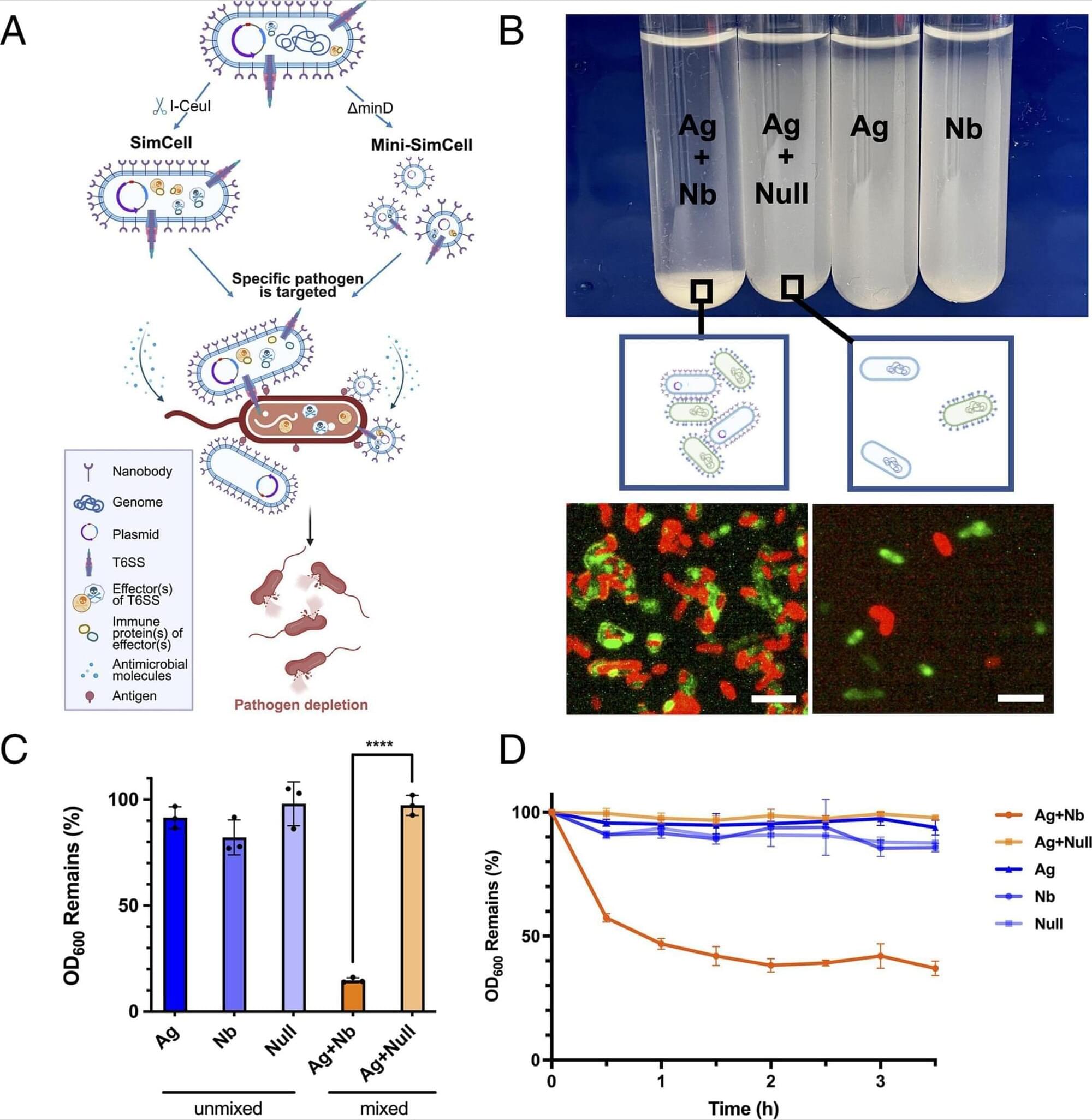
No one has yet created a fully functioning artificial cell. But a research team at Aarhus University has taken a step in that direction:
They have equipped artificial cells with tiny motors inspired by an unusual movement mechanism found in nature—specifically from the bacterium Listeria monocytogenes. The result: artificial cells that can form internal networks of protein filaments—a function otherwise unique to living cells.
The study is published in ACS Nano.
For Louis-Jan Pilaz, days spent with tools and wood began as simple home improvement projects. He soon found himself learning how to whittle scraps of wood. Then, as a neurobiologist, Pilaz noticed a striking parallel. “It made so much sense to use wood to render neurons…They look like trees, and they have this flow of energy that is just like in neurons.” Inspired, he began to shape wood into intricate neural forms, transforming casual whittling into science-inspired woodworking art.
When he first shared his artwork on X (then Twitter), the response was positive, and people expressed their interest in his work. Encouraged by his graduate student, Pilaz opened an Etsy shop in 2021 to sell his wood sculptures, and NeuroWoodworks was born.
Pilaz’s group at Sanford Research studies the development and dysfunction of the cerebral cortex and makes extensive use of microscopy, which fuels his research and serves as a source of inspiration for his wood art. “I’ve been obsessed with cell morphology since my PhD,” Pilaz said. “I experimented, just like I do in the lab, with the tools I have and tried to make [different cell] shapes.” He uses different types of wood, such as walnut and padauk, to create a variety of cell types and structures from Purkinje cells and radial glia to mitochondria.
YOU are invited to Perpetual Life Thursday, December 18th In Person or Online! Please share this notice with all those you LOVE! Our doors open at 6:00 PM…
As people age, their immune systems decline. But a new study suggests a way to rejuvenate immune function: Stimulating the liver to produce some signals ordinarily generated by the thymus can reverse age-related declines in T-cell populations.
MIT and Broad Institute researchers found a way to overcome age-related immune system decline by temporarily programming liver cells to take over the maturation of T cells. Using mRNA, the researchers were able to rejuvenate the immune system, in a study of mice.