Experts in artificial intelligence and economics say the technology could reshape the labor market, but how disruptive will it be?

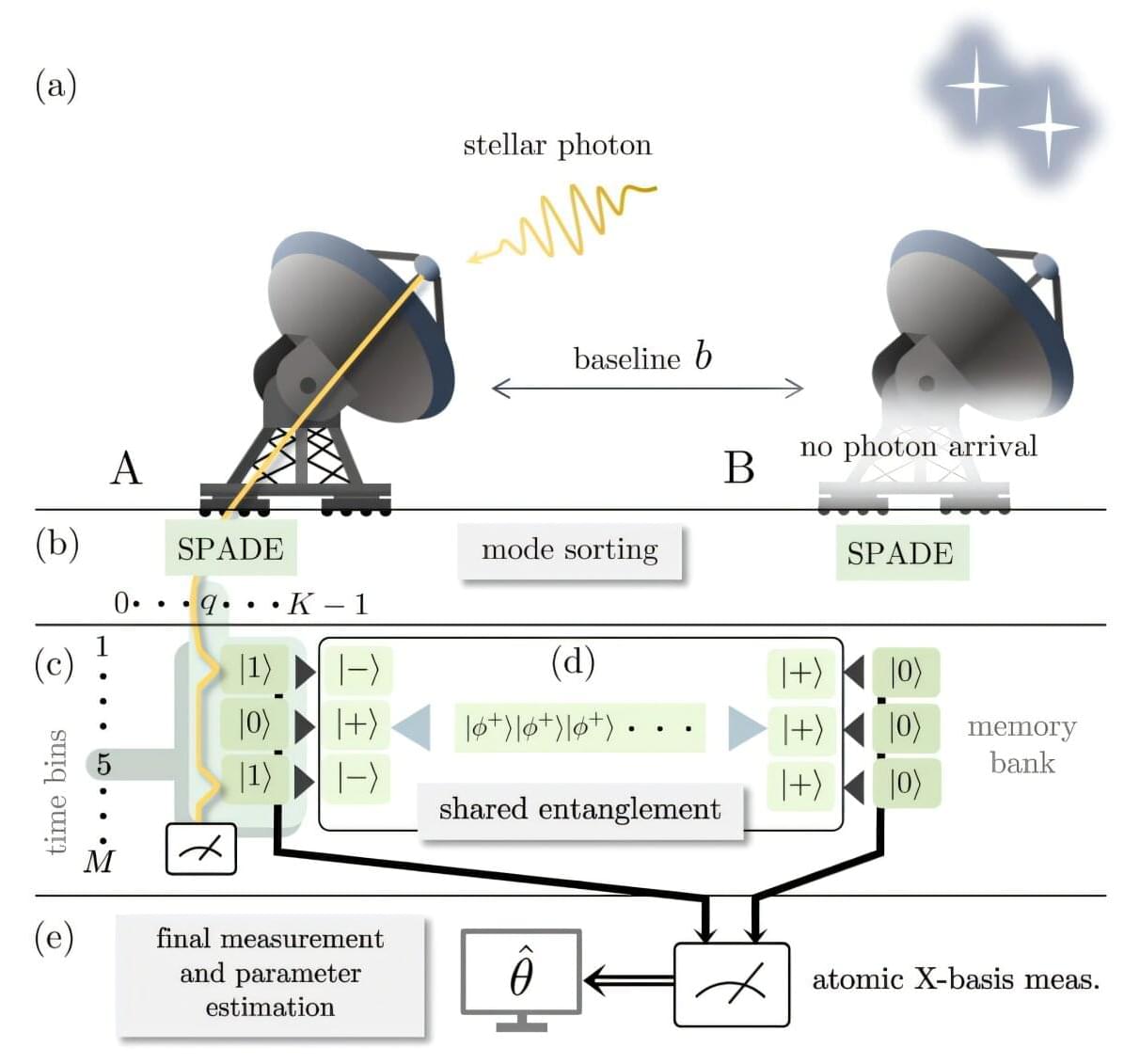
To capture higher-definition and sharper images of cosmological objects, astronomers sometimes combine the data collected by several telescopes. This approach, known as long-baseline interferometry, entails comparing the light signals originating from distant objects and picked up by different telescopes that are at different locations, then reconstructing images using computational techniques.
Conventional long-baseline interferometry methods combine the light signals collected by different telescopes using an interferometer. To do this, however, it relies on delicate optical links that bring light beams together and that are difficult to establish when telescopes are located at long distances from each other.
Researchers at University of Arizona, University of Maryland and NASA Goddard Space Flight Center recently proposed an alternative approach to achieve higher resolution telescopy images that leverages a quantum effect known as entanglement. Their proposed approach, outlined in a paper published in Physical Review Letters, allows distant entangled telescopes, which share a unified quantum state irrespective of how distant they are, to extract the same information about a given scene or cosmological image.


How Exactly does Panpsychism Help Explain Consciousness?
In this episode, we explore a provocative new theory in the philosophy of mind—hybrid cosmopsy-chism. This hybrid form of panpsychism claims that conscious experience is rooted in the universe itself and distributed through emergent subjects like humans. By combining strong and weak emergence, this view promises to overcome the limitations of both physicalism and dualism, offering a radical yet elegant solution to the hard problem of consciousness.
Disclaimer:
In this video, we use Google’s NotebookLM to assist in the analysis and understanding of complex doc-uments. NotebookLM is a research and writing tool that allows us to generate summaries directly from uploaded documents. The podcast like audio overview you will hear is generated by Google’s AI based on the content of the published paper on the topic.
Please note that the interpretations and summaries generated by NotebookLM are automated and may not capture every detail or nuance. They are intended to aid in understanding but should not be consid-ered a substitute for professional advice or a legal interpretation of the documents.
Patreon: https://bit.ly/3v8OhY7
Main Channel: https://www.youtube.com/@robinsonerhardt.
Full Episode: https://youtu.be/XcNlv9gp20o.
Robinson’s Podcast #219 — Consciousness, Artificial Intelligence, and the Threat of AI Apocalypse.
Joscha Bach is a computer scientist and artificial intelligence researcher currently working with Liquid AI. He has previously done research at Harvard, MIT, Intel, and the AI Foundation. In this episode, Joscha and Robinson discuss the nature of consciousness—both in humans and synthetic—various theories of consciousness like panpsychism, physicalism, dualism, and Roger Penrose’s, the distinction between intelligence and artificial intelligence, the next developments of ChatGPT and other LLMs, OpenAI, and whether advances in AI will spell the end of humankind.
Joscha’s X: https://twitter.com/Plinz
What do you think about the foregoing arguments?
Interview from the Conference “Emergence and Panpsychism” in Munich 2011.
More information and the complete list of videos here: http://www.geiststaub.de/
Is there something that it is like to be an electron? That sounds implausible. Yet Galen Strawson believes this is the best explanation of how things are.
Specifically, Galen offers his view on physicalistic panpsychism (though there are non-physicalistic panpsychisms as well). He argues something like this, it seems to me:
First, Galen assumes (very plausibly) that experiential phenomena are real phenomena, opposed to illusory. Now:
1. If radical emergentism is true, then experiential phenomena emerges from wholly and utterly non-experiential phenomena.
2. But experiential phenomena cannot emerge from wholly and utterly non-experiential pheneomena.
3. So radical emergentism is false. [1, 2]
4. If radical emergentism is false, then experiential phenomena must already exist in some sense and to some extent as a feature of physical stuff to give rise to experiential phenomena in an intelligible way.
5. So experiential phenomena must already exist in some sense and to some extent as a feature of physical stuff to give rise to experiential phenomena in an intelligible way. [3, 4]
In other words, consciousness has been a feature of the universe since the Big Bang.
For sustained and scholarly treatment of panpsychism, see Galen Strawson’s paper, \.
Chair, Microbiology & Immunology;
Walter schroeder professor in microbiology and immunology;
Medical College of Wisconsin.
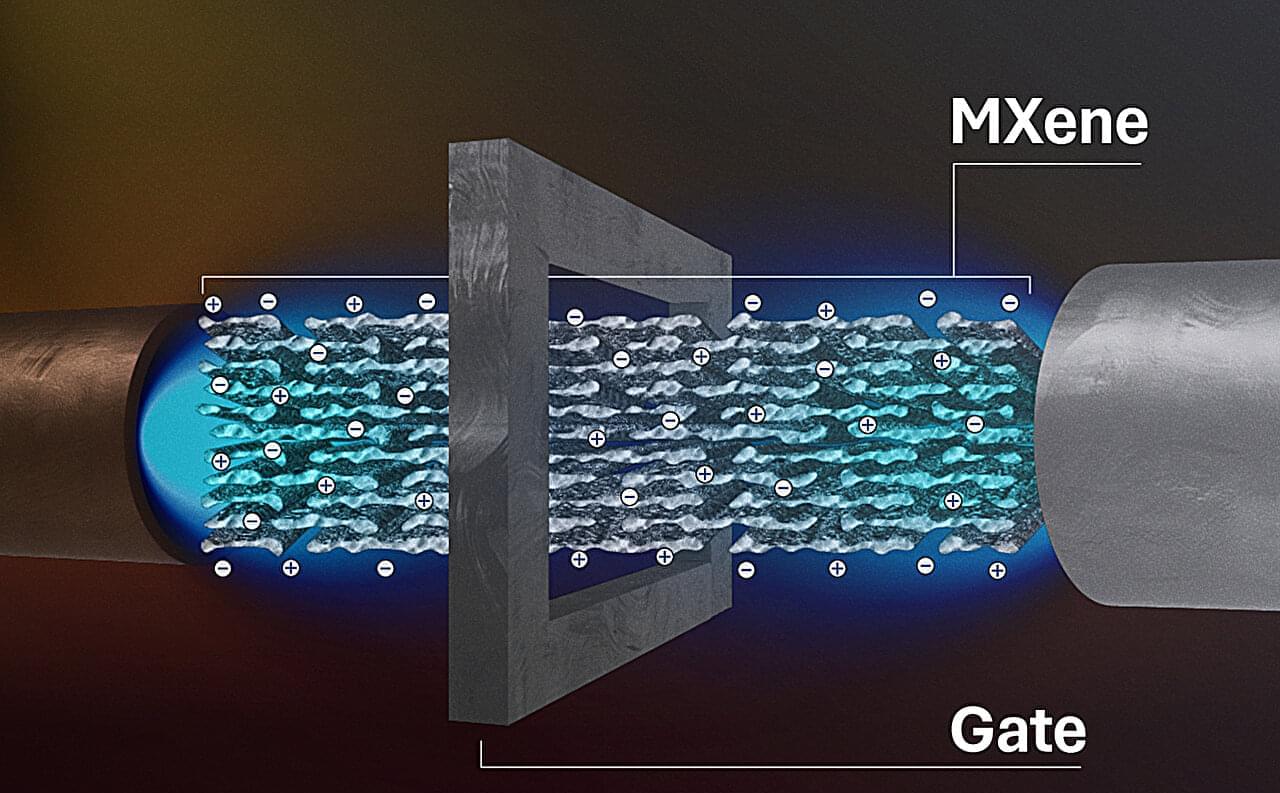
By applying voltage to electrically control a new “transistor” membrane, researchers at Lawrence Livermore National Laboratory (LLNL) achieved real-time tuning of ion separations—a capability previously thought impossible. The recent work, which could make precision separation processes like water treatment, drug delivery and rare earth element extraction more efficient, was published in Science Advances.
The membranes are made of stacks of MXenes —2D sheets that are only a few atoms thick. Ions squeeze through nanoscale channels formed in the gaps between the stacked MXene layers.
Until now, scientists thought MXene membrane properties were intrinsic and unchangeable once created. The rate of ion transport was thought to be baked in from the beginning.