Toggle light / dark theme

Get the latest international news and world events from around the world.

Log in for authorized contributors

‘Interstellar glaciers’: NASA’s SPHEREx maps vast galactic ice regions

NASA’s SPHEREx (Spectro-Photometer for the History of the Universe, Epoch of Reionization, and Ices Explorer) mission has mapped interstellar ice at an unprecedented scale. Covering regions in our Milky Way galaxy more than 600 light-years across, the ice was found inside giant molecular clouds—vast regions of gas and dust where dense clumps of matter collapse under gravity, giving birth to stars. A study describing these findings was published Wednesday in The Astrophysical Journal.

One of SPHEREx’s main goals is to map the chemical signatures of various types of interstellar ice. This ice includes molecules like water, carbon dioxide, and carbon monoxide, which are vital to the chemistry that allows life to develop. Researchers believe these ice reservoirs, attached to the surfaces of tiny dust grains, are where most of the universe’s water is formed and stored. The water in Earth’s oceans —and the ices in comets and on other planets and moons in our galaxy—originates from these regions.

“These vast frozen complexes are like ‘interstellar glaciers’ that could deliver a massive water supply to new solar systems that will be born in the region,” said study co-author Phil Korngut, the instrument scientist for SPHEREx at Caltech in Pasadena, California. “It’s a profound idea that we are looking at a map of material that could rain on nascent planets and potentially support future life.”

A monster black hole appeared first, then its galaxy began to grow around it

Using observations gathered by the James Webb Space Telescope (JWST), an international team of astronomers have revealed that one supermassive black hole in the early universe must have formed before a galaxy developed around it. Publishing their results in Monthly Notices of the Royal Astronomical Society, a team led by Roberto Maiolino at the University of Cambridge hope their results could lead to a better understanding of the origins of these immense objects.

Supermassive black holes (SMBH) are known to lurk at the centers of most galaxies, including our own Milky Way. Carrying up to billions of times the mass of the sun, they have presented a long-standing conundrum to astronomers.

According to our latest models, black holes form from the remnants of supernova explosions, which most often occur when massive stars reach the ends of their lives. Afterwards, they can grow by consuming gas from surrounding accretion disks—but their growth rate is restricted by a brightness threshold called the “Eddington limit.” Beyond this point, the outward pressure from radiation exceeds the gravitational pull, and material is ejected into space.

Astronomers crack a decades-old mystery, catching gas morphing into planet-building disks around newborn stars

An international team led by Dr. Indrani Das of Academia Sinica Institute of Astronomy and Astrophysics (ASIAA) has shown, for the first time, how infalling gas from star-forming cores gradually transitions into planet-forming disks. Their findings, combining numerical simulations with Atacama Large Millimeter/submillimeter Array (ALMA) observations, are published today in The Astrophysical Journal.

Protoplanetary disks form around young stars when dense molecular cloud cores collapse under their own gravity. An outer shroud of gas and dust, known as the envelope, surrounds and feeds both the young star and the forming disk. While it is well understood that planets eventually form within these disks and follow Keplerian orbits, the mechanism that transforms rapid infalling gas motion from the envelope into ordered Keplerian motion within the disk has remained a mystery for decades.

Based on both theoretical and observational evidence, the recent study discovered that there exists a distinct transition zone at the envelope-disk interface of a young star-disk system, which Das named ENDTRANZ (Envelope Disk Transition Zone). The findings have established that infalling gas motions gradually transition into Keplerian motions across this transition zone. Crucially, this transition is far from abrupt and contradicts earlier infall models that are based on classical test-particle dynamics.

Planets need more water to support life than scientists previously thought

Unfortunately for science fiction fans, desert worlds outside our solar system are unlikely to host life, according to new research from the University of Washington. Scientists show that an Earth-sized planet needs at least 20 to 50% of the water in Earth’s oceans to maintain a critical natural cycle that keeps water on the surface.

Scientists believe that there are billions of planets outside our solar system. More than 6,000 of these exoplanets are confirmed, but only some of them are candidates for life. The search for life has focused on planets in the “habitable zone,” a sweet spot that is neither too close nor too far from a central star. Planets in this zone are considered viable because they can maintain liquid surface water.

“When you are searching for life in the broad landscape of the universe with limited resources, you have to filter out some planets,” said lead author Haskelle White-Gianella, a UW doctoral student of Earth and space sciences.

Marine sponge bacterium enzyme reveals a two-part route to make terpenoids

The molecular structure of an enzyme from a marine bacterium with potential industrial uses has been determined by RIKEN researchers. The insights they have gained could help make a range of useful compounds through genetic modification. The research is published in the journal Chemical Science.

The class of natural compounds known as terpenoids is nothing if not versatile, being used in a wide assortment of products, from perfumes and insect repellents to pesticides and drugs. More than 100,000 terpenoids have been identified so far. They are produced by an impressive range of organisms spanning animals, plants, fungi, bacteria, and viruses.

Recently, marine organisms such as corals, sponges, and marine bacteria have been found to produce terpenoids with complex structures that show promise for fighting infectious diseases.

Dark matter could explain the earliest supermassive black holes

A growing mystery in astronomy is the presence of gargantuan black holes—some weighing as much as a billion suns—existing less than a billion years after the Big Bang. According to the standard theory of black hole formation, these black holes simply should not have had enough time to grow so large. A study led by University of California, Riverside graduate student Yash Aggarwal shows that dark matter decays could be the key to understanding the origin of these cosmic behemoths. Published in the Journal of Cosmology and Astroparticle Physics, the research shows that the energy released from dark matter decay could alter the chemistry of early galaxies enough to cause some of them to directly collapse into black holes rather than forming stars.

The result is timely, since NASA’s James Webb Space Telescope continues to observe unusually large black holes in the early universe that could have formed by direct collapse. Astronomers had believed this process requires a coincidence of nearby stars shining onto pre-stellar gas and so expected it to be rare.

Aggarwal’s team goes beyond the standard approach by using dark matter—the unknown 85% of the matter in the universe that helps form galaxies. They show that if dark matter decays, it can leak a small amount of its energy into the gas and supercharge the direct collapse rate. Each decaying dark matter particle would only need to inject an amount of energy that is a billion trillionths of the energy of a single AA battery.

Spatiotemporal light pulses could secure optical communication by masking data

Researchers at Ben-Gurion University of the Negev have developed a new approach to secure optical communication that hides information in the physical structure of light, making it difficult for unauthorized parties to intercept or decode. The study addresses a growing challenge: advances in quantum computing are expected to weaken many of today’s encryption methods. While most security solutions rely on complex mathematical algorithms, this research adds protection earlier in the process—during the transmission of the signal itself.

The research was led by Dr. Judith Kupferman and Prof. Shlomi Arnon from the School of Electrical and Computer Engineering at Ben-Gurion University of the Negev. The findings were published in Optical and Quantum Electronics.

The researchers propose a communication method based on specially shaped light pulses, known as spatiotemporal optical vortices. These light beams are designed so that their key features are not visible in standard measurements.

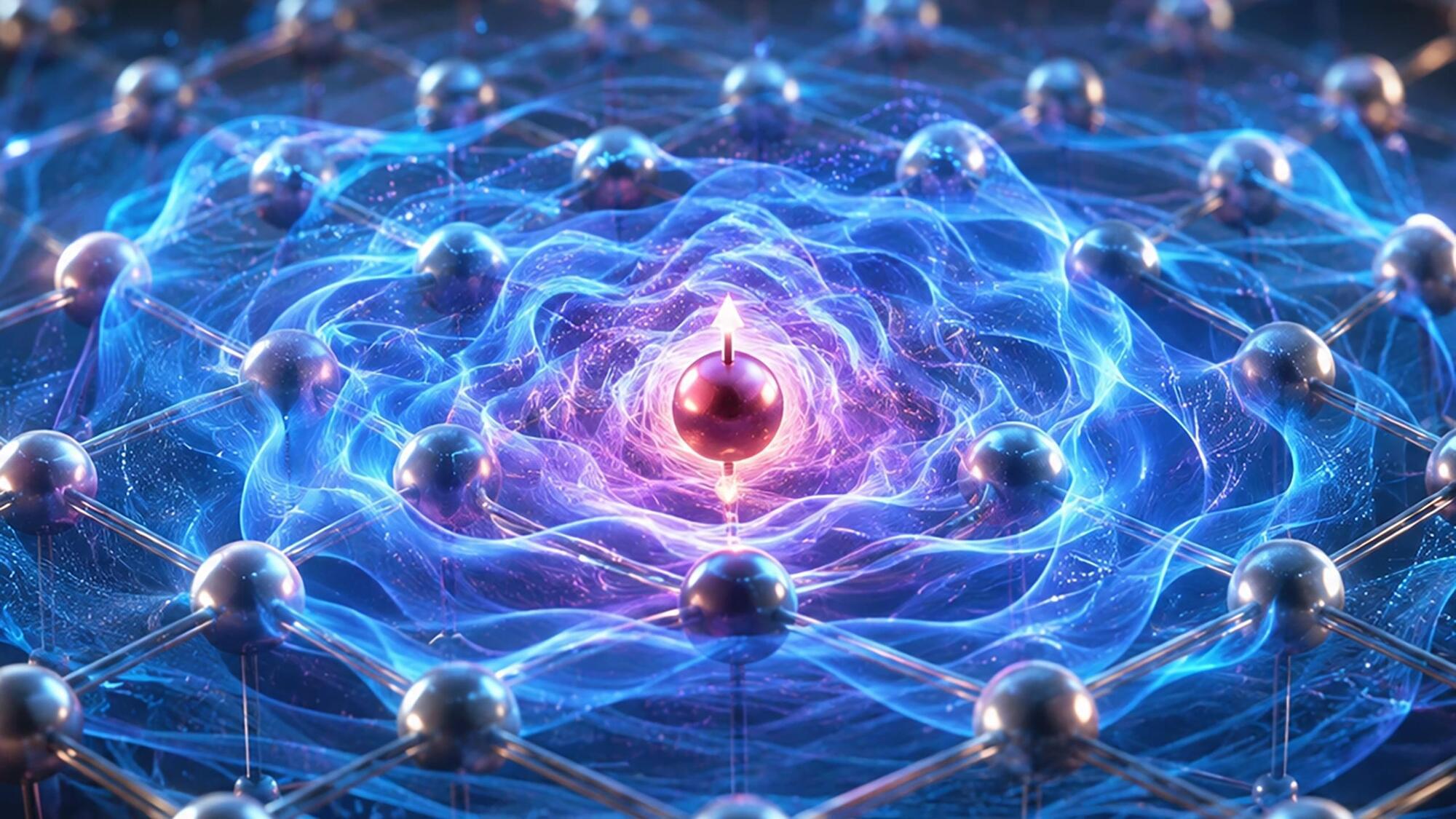
Quantum simulations reveal spin transport in 1D materials

Researchers from the Department of Energy’s Quantum Science Center (QSC) headquartered at Oak Ridge National Laboratory (ORNL) have achieved a significant milestone by demonstrating the first digital quantum simulations of how spin currents change over time in a 1-D model of a quantum spin material. The results, now published in Physical Review Letters, establish a new, programmable way to use quantum computers to study the transport of spin—a fundamental quantum variable—in materials.

Spin transport measurements are a cornerstone of condensed matter physics, providing important insight into how quantum materials carry energy and information. In this work, QSC researchers, led by Purdue University’s Arnab Banerjee, demonstrated how a quantum computer can simulate spin transport behavior across ballistic, diffusive, and superdiffusive—meaning a faster and farther spread than typical diffusion—motion.

These different cases of spin transport represent fundamental changes in how the material responds to experimental probes. The simulation results make a direct comparison with experimental materials and open new avenues for understanding complex quantum phenomena such as coherence and energy flow in quantum materials.

Any color you like: Scientists create ‘any wavelength’ lasers in tiny circuits for light

Computer chips that cram billions of electronic devices into a few square inches have powered the digital economy and transformed the world. Scientists may be on the cusp of launching a similar technological revolution—this time using light.

In a significant advance toward that goal, National Institute of Standards and Technology (NIST) scientists and collaborators have pioneered a way to make integrated circuits for light by depositing complex patterns of specialized materials onto silicon wafers. These so-called photonics chips use optical devices such as lasers, waveguides, filters and switches to shuttle light around and process information.

The new advance could provide a big boost for emerging technologies such as artificial intelligence, quantum computers and optical atomic clocks.

Self-propulsion or slow diffusion: How bacteria, cells, and colloids respond to stimuli

What physical processes govern the movement of microscopic structures capable of interacting with their environment? The answer lies in two mechanisms: self-propulsion, to escape unfavorable locations; and slow diffusion, to move toward more advantageous ones. This is the finding of scientists Jacopo Romano and Andrea Gambassi from SISSA-Scuola Internazionale Superiore di Studi Avanzati in their new study published in Physical Review Letters.

In their work, the researchers combined computer simulations with mathematical calculations, taking inspiration from nature. It is well known that feedback-driven motion underlies the behavior of various microorganisms, which analyze incoming and outgoing signals and adapt their direction of movement accordingly. The study reproduces the physical behavior of natural and synthetic agents in two distinct scenarios: when a specific destination must be avoided based on signals, and when it must instead be reached.

The researchers found that in the first case, a process of “superdiffusion” occurs, with accelerated motion, while in the second case a subdiffusive process takes place, with much slower movement. These findings provide important insights for the design of smart particles capable of moving at the microscale, with potential applications in medicine, particularly for more efficient drug delivery.

/* */