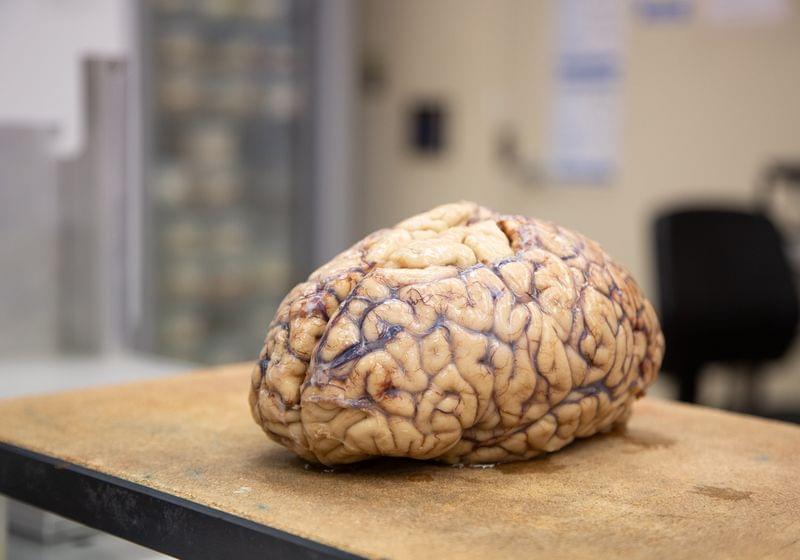
For decades, researchers across institutions have peered into microscopes and dived into data to try to understand how diseases like Alzheimer’s disease, Parkinson’s disease, and amyotrophic lateral sclerosis (ALS) affect the brain. While scientists have made many important insights into these conditions, breakthrough therapies to cure or even treat them remain out of reach.
To expedite understanding of and treatments for neurodegenerative diseases, the Allen Institute launched the Brain Health accelerator. The project, announced today, is a global initiative that will leverage cutting-edge technology with the goal of improving modeling, therapeutic development, and the understanding of disease mechanisms. With funding support from the Allen Institute, the Bezos family, Amazon Web Services, the National Institutes of Health, EverythingALS, and other partners, the project financial contribution is $400 million.
One of the challenges in studying diseases in the human brain and identifying treatment strategies has been the scale and complexity of the organ. The brain consists of many distinct parts, and studying disease mechanisms requires samples from large numbers of individuals. Additionally, while technological advancements in transcriptomics, proteomics, neuroimaging, and AI have helped researchers study the brain in finer detail, researchers have not always integrated many of these approaches into the same project.
Depression is an illness with a huge amount of people who suffer from it.
A lot of research has shown that low dosis of psychedelic drug can deliver a very quick improvement.
I have published since 2006 a complete explanation of the phenomenon ´Near-Death Experience´(NDE): In a NDE we can perceive LIVE + CONSCIOUS how the brain is working. e.g. we can perceive with NDEs a reactivation of experiences/memories since the 5th month of fetus-age in exactly the same order as the physical senses develop:
touch sense > acoustic sense > optical sense > birth(indirect) > EARLY SOCIAL-/ENVIRONMENTAL-EXPERIENCES **) > autobiographical experiences since the 2nd year of childhood up to the actual age.
It is very interesting that the use of psychedelic drugs can trigger identical ( ! ) experiences as we know it from NDEs as **) = early social-/environmental-experiences!
This does mean, that psychedelic drug reactivate SELECTIVE ( ! ) only a limited amount of our memory or mental states — of/from an age-period of the early childhood (when the depression was not yet active).
Therefore it will be a good idea to study the similarities of NDEs in comparison with those experiences who are reported after the use of psychedelic drugs. Maybe this could lead to a new understanding of the depression-illness which might allow to develop new strategies for treatment
A complete explanation of NDEs can be found in my book/e-book in German language: Kinseher Richard “Auflösung grosser Fragen: Was ist Bewusstsein? Was ist Zeit?”