Toggle light / dark theme

Get the latest international news and world events from around the world.
Log in for authorized contributors

Exercise induces sex-specific assembly of mitochondrial supercomplexes

Mitochondrial supercomplexes assembly in exercise.

The function of supercomplexes (SCs) formed from mitochondrial electron transport chain (ETC) is not well understood.

The researchers demonstrate that exercise dynamically modulates the assembly of mitochondrial respiratory complexes into supercomplexes (SCs) in human skeletal muscle, with this remodeling being sex dependent.

The authors found that males increased the assembly of complex III (CIII) into SCs, particularly high molecular weight SCs (HMWSCs), in an intensity-dependent manner within skeletal muscle. Females showed a stable content of both HMWSCs and I+III2 SCs during exercise.

This highlights the importance of accounting for biological sex when studying mitochondrial adaptations to exercise. sciencenewshighlights ScienceMission https://sciencemission.com/mitochondrial-supercomplexes-and-exercise


Huertas et al. demonstrate that exercise dynamically modulates the assembly of mitochondrial respiratory complexes into supercomplexes in human skeletal muscle, with this remodeling being sex dependent. This highlights the importance of accounting for biological sex when studying mitochondrial adaptations to exercise.

The global burden of childhood and adolescent cancer (age 0–19 years) from 1990 to 2023: a systematic analysis for the Global Burden of Disease Study 2023

Acute lymphoid leukemia and brain and central nervous system cancers were estimated to be the greatest contributors to new childhood cancer cases in 0–19-year-olds in 2023.

A new comprehensive study published in The Lancet from researchers at IHME and St. Jude Children’s Research Hospital — Science and Medicine examined the burden of childhood and adolescent cancer from 1990 to 2023, aiming to inform effective cancer policy planning around the globe.

Read the study.


Childhood cancer was the eighth-leading cause of childhood deaths and the ninth-leading cause of DALYs among all cancers in 2023. Globally, in 2023, there were an estimated 377 000 incident childhood cancer cases, 144 000 deaths, and 11·7 million DALYs due to childhood cancer.

Artificial intelligence in cardiovascular imaging: risks, mitigations and the path to safe implementation

Artificial intelligence (AI) is rapidly transforming cardiovascular imaging by automating tasks such as image segmentation, feature extraction, and risk prediction — leading to significant improvements in diagnostic precision and efficiency. However, the integration of AI into clinical workflows comes with critical risks that must be addressed to ensure safe and reliable patient care.

This review explores the technical, clinical, and ethical challenges of AI in cardiovascular imaging, particularly highlighting the risks of model errors, data drift and inappropriate usage. We also examine concerns about explainability, the potential for deskilling of healthcare professionals, generalisability across diverse populations, and accountability in AI implementation.

We present real-world examples of where these risks have been realised, along with attempts at mitigations, including the adoption of explainable AI techniques, rigorous validation frameworks to ensure fairness and broad applicability, continuous performance monitoring, and transparency at every stage of model development and deployment.

Why can’t humans regenerate limbs? New research offers a clue

Say you accidentally cut the tip of your finger off. Especially if this happened to you as a child, there’s a good chance it would regrow—skin, nail and all. The same is true for other mammals such as monkeys and mice. Unfortunately, however, our regenerative abilities stop there. While some other creatures, most notably salamanders and starfish, can regenerate entire limbs, mammals don’t have this evolutionary superpower.

Part of the reason why our cells only have a limited ability to regenerate may have to do with our genes. But according to new research, two key environmental mechanisms may be at play, too.


Oxygen and hyaluronic acid may play a role in tissue recovery and regeneration, two new studies suggest.

By Jackie Flynn Mogensen edited by Claire Cameron.

A Macroscopic Magnet Precesses

An isolated magnet’s intrinsic angular momentum induces gyroscopic motion, an observation that could lead to ultrasensitive magnetometers.

In 1861, physicist James Clerk Maxwell proposed that a magnet behaves to some extent like a spinning gyroscope [1], but his experiments never managed to demonstrate the effect. Since then, researchers have observed various manifestations of so-called gyromagnetism, mostly in specialized magnetic materials or with spinning magnets, but now a research team has detected signatures of gyroscopic motion corresponding to Maxwell’s original ideas [2]. The team used a microscopic magnetic sphere in a technique that, with improvements, could be employed for ultrasensitive magnetic-field detection, which could be useful for research on biological magnetism.

If you try to tilt a gyroscope spinning around a vertical axis, it will respond by tilting at 90° from the push direction, an effect that leads to precession in response to gravity—such as the slow loop executed by the axis of a spinning top. An electron in a magnetic field behaves like a gyroscope in a gravitational field because the electron has a magnetic moment, which is associated with intrinsic angular momentum, or spin. So you might expect that a material whose microscopic spins align—such as an ordinary ferromagnet—would have a macroscopic angular momentum and behave like a gyroscope.

Universal surface-growth law confirmed in two dimensions after 40 years

Crystals, bacterial colonies, flame fronts: the growth of surfaces was first described in the 1980s by the Kardar–Parisi–Zhang equation. Since then, it has been regarded as a fundamental model in physics, with implications for mathematics, biology, and computer science.

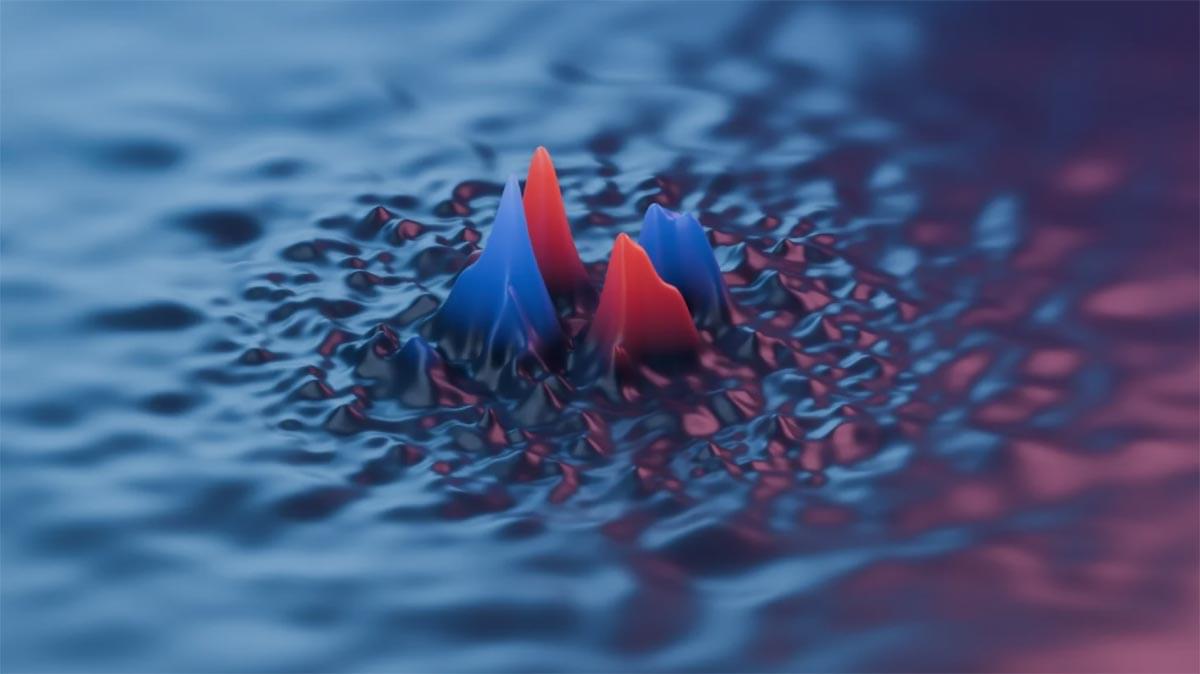
Now—40 years later—a Würzburg-based research team from the Cluster of Excellence ctd.qmat has achieved the first experimental demonstration of KPZ behavior on 2D surfaces in space and time.

This was made possible by sophisticated materials engineering and a bold experimental approach: researchers injected polaritons—hybrid particles composed of light and matter—into the material. The results have been published in Science.

Dual-frequency Paul trap shows potential for synthesizing antihydrogen outside of CERN

A new type of radiofrequency trap can capture particles with extremely different requirements and could theoretically hold both types of particles at the same time. Researchers in the group of Professor Dmitry Budker from the PRISMA++ Cluster of Excellence and the Helmholtz Institute at Johannes Gutenberg University Mainz (JGU) were able to trap calcium ions or electrons in the same apparatus.

The team’s findings, published in Physical Review A, show the potential of this technology for synthesizing antihydrogen.

“Radiofrequency traps, also called Paul traps, have long been used by physicists to trap specific particles,” Dr. Hendrik Bekker explained. “However, they are usually limited to a single frequency.”

Chang’e mission samples reveal how exogenous organic matter evolves on the moon

Elements essential to life, such as carbon, nitrogen, oxygen, phosphorus, and sulfur, were “delivered” to Earth and the moon during the early stages of the solar system via asteroids and comets impacting their surfaces. These exogenous materials may have provided the chemical building blocks necessary for the origin and early evolution of life on Earth. But extensive geological activity and biological processes on Earth have largely erased the direct records of these early inputs on our planet.

In contrast, the moon, with its relatively limited geological activity, serves as a natural “time capsule,” making it easier to unravel the history and evolution of extraterrestrial organic matter.

A recent study has, for the first time, systematically identified multiple nitrogen-bearing organic species on the surfaces of lunar soil grains returned by China’s Chang’e-5 and Chang’e-6 missions. The research further reveals an evolutionary pathway defined by exogenous delivery, impact modification, and continuous solar wind processing.

Underwater architects: Nest-building in cichlids reveals more than hardwired instinct

We associate nests with shelter, warmth, and a safe retreat—and usually picture a bird’s nest made out of twigs, grass and feathers. Yet many other animals take advantage of such refuges, with nests being built by a diversity of species ranging from termites to great apes, which impress with their hugely varied forms and the wide array of materials used to construct them.

For fish, nest-building comes with an added challenge as they must put together their underwater nests equipped with “only” their fins. Yet fish too have developed a remarkable variety of nest-building innovations, burrowing into sandy lake beds, creating masses of floating bubbles on the water’s surface, or setting up camp in abandoned snail shells repurposed as nests—as is the case with the shell-dwelling cichlid Lamprologus ocellatus.

Endemic to Lake Tanganyika in Africa, these cichlids use empty snail shells for shelter and to raise their young. To do so, the snail shell is positioned and covered in sand in a very specific way, leaving just the opening exposed—only then does it become the perfect home.

Scientists discover f-block metals yield new oxygen-binding chemistry

Iron and oxygen bind together throughout the body. Most famously, iron binds dioxygen, or two oxygens paired with each other, in hemoglobin that transports oxygen through blood. But iron-oxo compounds, as they’re called, are found in many other places throughout the body. For example, the highly reactive iron-oxo is used in liver enzymes that metabolize drugs.

Rice University chemist Raúl Hernández Sánchez was interested in how oxygen could react with other types of metals—ones that reside on the lowest section of the periodic table, known as f-block metals, with lanthanides on the upper row and actinides on the lower.

If lanthanides could bind with oxygen, he theorized, it would form a highly reactive lanthanide-oxo compound that potentially could be used as a synthetic replacement for iron-oxo, opening up a new toolbox for small molecule chemists interested in studying these biological reactions.

/* */