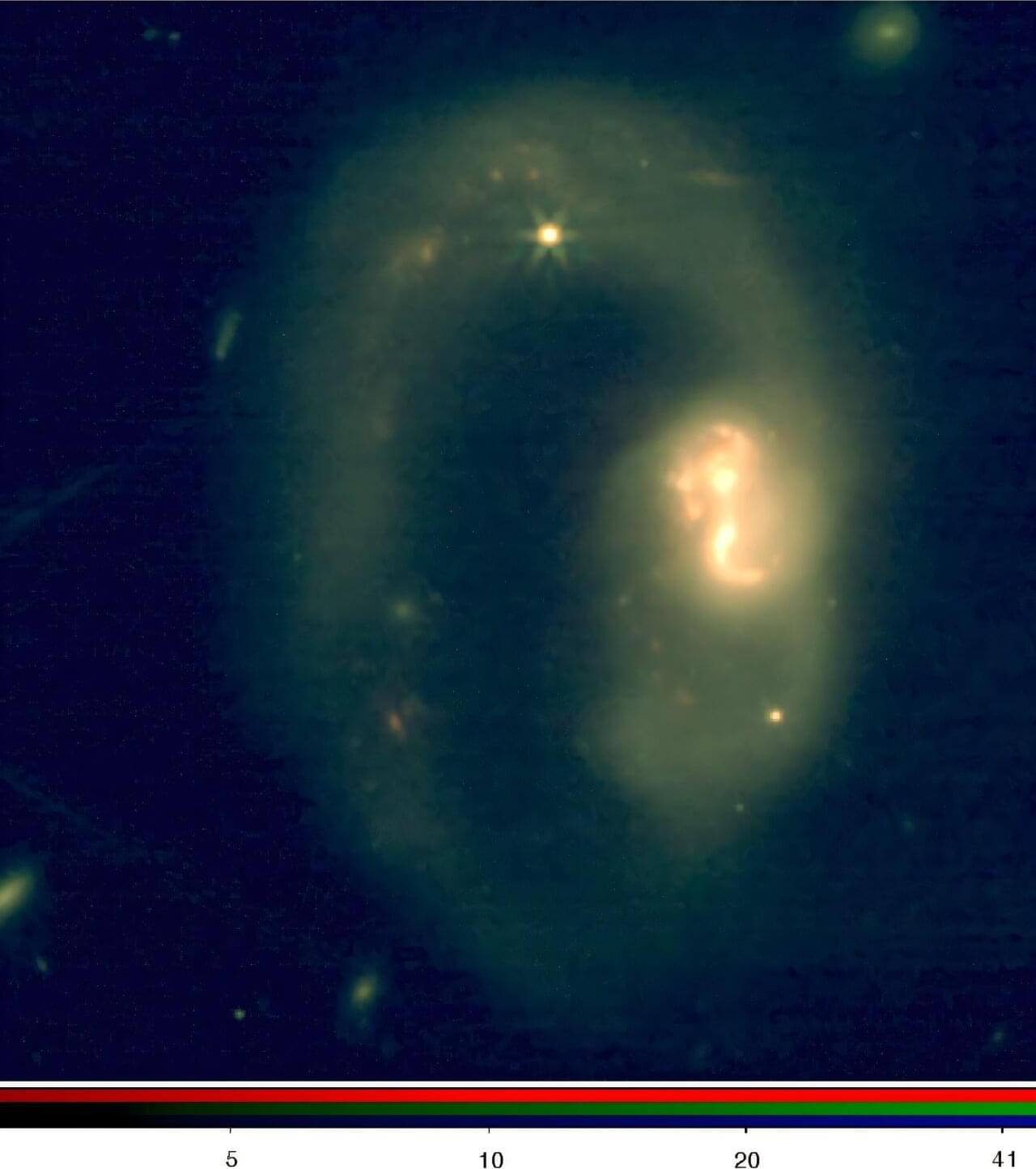
A study led by the Center for Astrobiology (CAB), CSIC-INTA, using modeling techniques developed at the University of Oxford, has uncovered an unprecedented richness of small organic molecules in the deeply obscured nucleus of a nearby galaxy, thanks to observations made with the James Webb Space Telescope (JWST).
The work, published in Nature Astronomy, provides new insights into how complex organic molecules and carbon are processed in some of the most extreme environments in the universe.
The study focuses on IRAS 07251–0248, an ultra-luminous infrared galaxy whose nucleus is hidden behind vast amounts of gas and dust. This material absorbs most of the radiation emitted by the central supermassive black hole, making it extremely difficult to study with conventional telescopes.