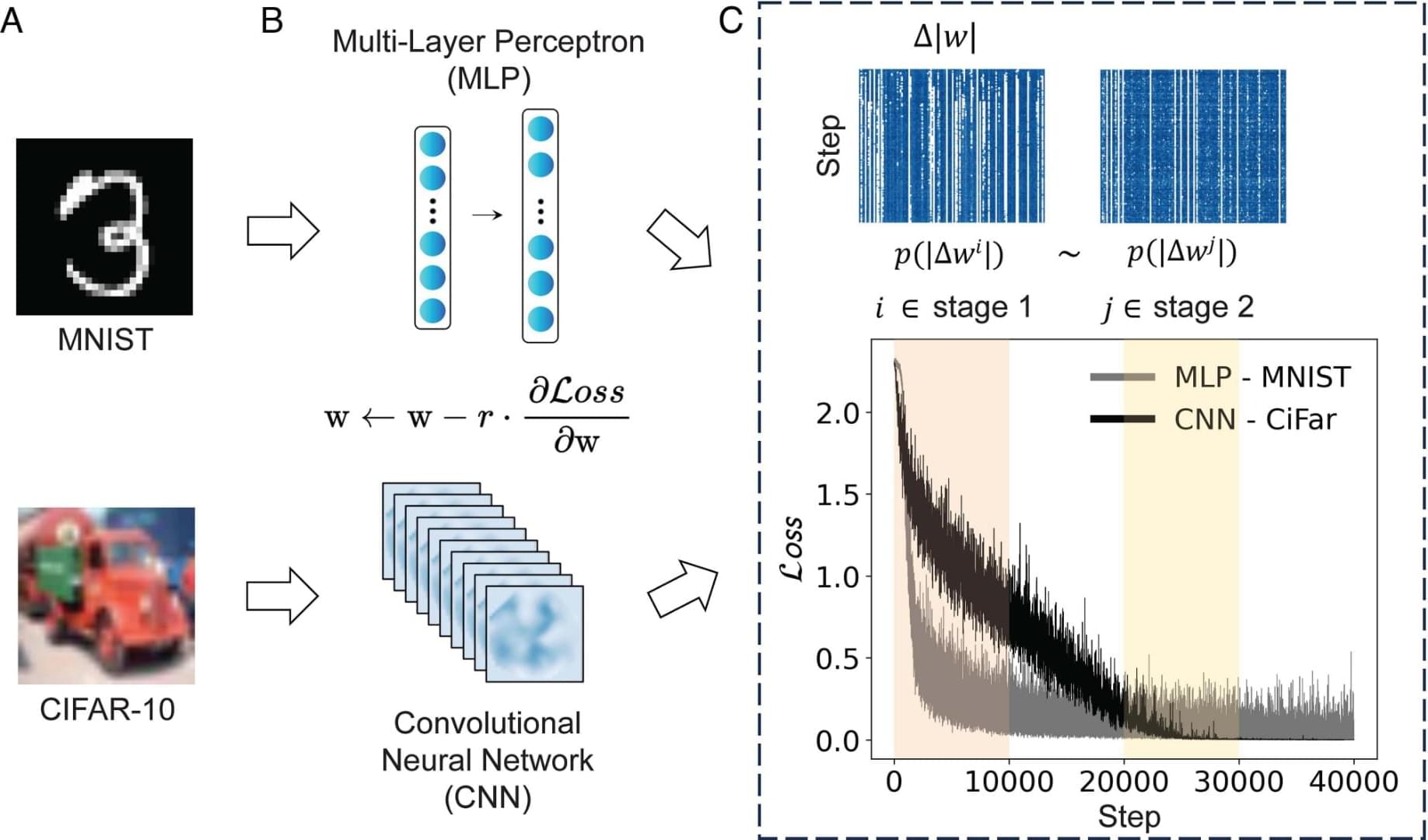
Like human decision-making under real-world constraints, artificial neural networks may balance free exploration in parameter space with task-relevant adaptation. In this study, we identify consistent signatures of criticality during neural network training and provide theoretical evidence that such scaling behavior arises naturally from information-driven self-organization: a dynamic balance between the maximum entropy principle that promotes unbiased exploration and mutual information constraint that relates updates with task objective. We numerically demonstrate that the power-law exponent of updates remains stable throughout training, supporting the presence of self-organized criticality.
The problem is not that top-down AI alignment strategies are wrong; it is that they are structurally insufficient once intelligence crosses certain thresholds of autonomy, generality, and self-reflection. Control is necessary in the early stages of artifi
Astronauts aboard the ISS have captured rare, invisible lightning phenomena hidden above Earth’s storms, revealing explosive secrets that could disrupt planes, satellites, and even our climate.
Go to https://ground.news/sabine to get 40% off the Vantage plan and see through sensationalized reporting. Stay fully informed on events around the world with Ground News.
Human brains are roughly 100,000 times more energy-efficient than current AI systems. So why don’t we build computers using human brain cells? Don’t worry, researchers are one step ahead of you there – different teams across the globe are racing to develop neuron computers; processors that integrate living brain neurons into their chips. Let’s take a look at how this technology is developing and when we might see brain cells chips in the future.
Weizmann Institute has made revolutionary discoveries in cancer research, technology, education, environment, health & medicine and exploring the physical world.