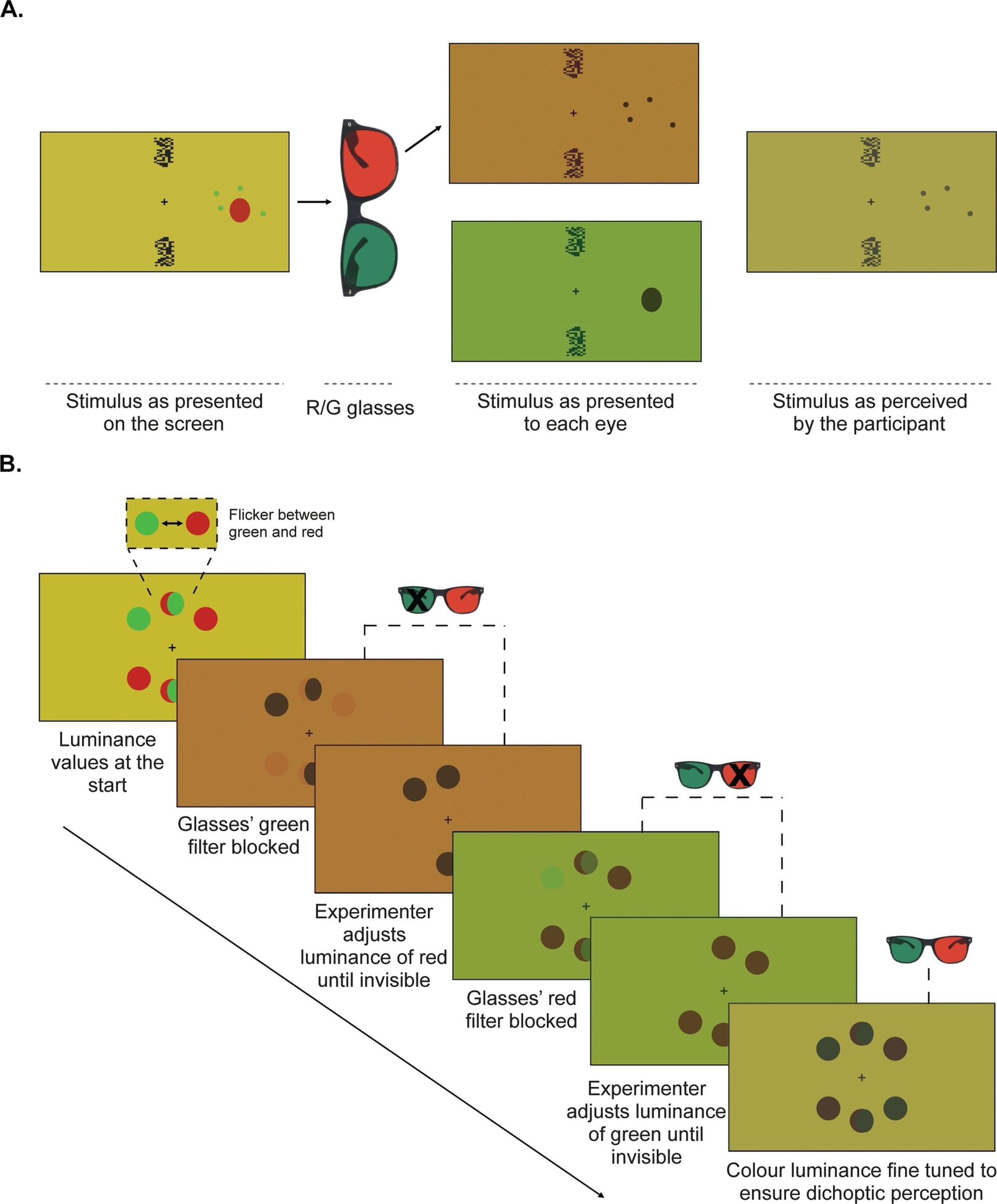
Although humans’ visual perception of the world appears complete, our eyes contain a visual blind spot where the optic nerve connects to the retina. Scientists are still uncertain whether the brain fully compensates for the blind spot or if it causes perceptual distortions in spatial experience. A new study protocol, published in PLOS One, seeks to compare different theoretical predictions on how we perceive space from three leading theories of consciousness using carefully controlled experiments.
The new protocol focuses on three contrasting theories of consciousness: Integrated Information Theory (IIT), Predictive Processing Active Inference (AI), and Predictive Processing Neurorepresentationalism (NREP). Each of the theories have different predictions about the effects that the blind spot’s structural features have on the conscious perception of space, compared to non-blind spot regions.
IIT argues that the quality of spatial consciousness is determined by the composition of a cause-effect structure, and that the perception of space involving the blind spot is altered. On the other hand, AI and NREP argue that perception relies on internal models that reduce prediction errors and that these models adapt to accommodate for the structural deviations resulting from the blind spot. Essentially, this means that perceptual distortions should either appear small or nonexistent in both theories. However, AI and NREP differ in some ways.