Toggle light / dark theme

Get the latest international news and world events from around the world.

Log in for authorized contributors

Leather gets a power upgrade with laser-written microsupercapacitors

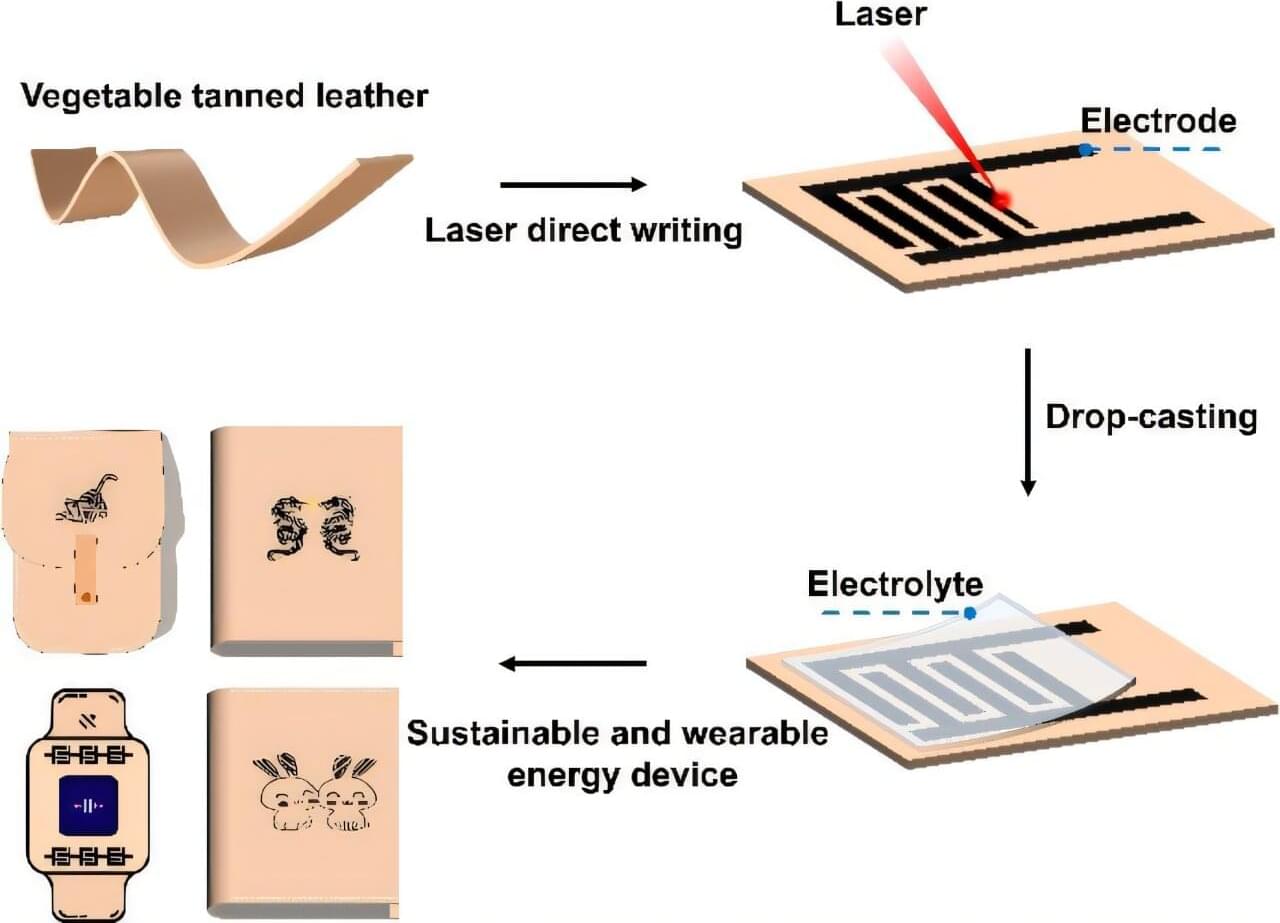
Researchers have developed a simple and eco-friendly way to use a laser to turn natural leather into flexible and wearable energy devices. The new approach could lay the groundwork for more sustainable wearable electronics. In a paper in Optics Letters, the researchers demonstrate the new technique by creating microsupercapacitors on leather in various patterns, including a tiger, dragon and rabbit.

“Using a laser, we directly write conductive patterns onto vegetable-tanned leather to create microsupercapacitors that can store energy and help smooth electrical signals so that wearable electronics run more reliably,” said the research team leader Dong-Dong Han from Jilin University in China.

Unlike conventional devices that rely on synthetic materials and complex, chemical-heavy processes, our approach uses a natural, skin-friendly material and a one-step fabrication method. The microsupercapacitors are well-suited for flexible and comfortable wearable electronics because they are built on soft materials and can be shaped freely and integrated directly into products.


Electron–atom scattering encodes the quantum state of electron wave packets

A new analysis reveals what happens when very short or narrow electron beams encounter a particle. The research is published in the New Journal of Physics. Scientists should be able to achieve a new level of control over high-energy electrons interacting with a particle, according to the theoretical analysis by a RIKEN physicist and two colleagues.

Electrons are particles, but according to quantum mechanics they also behave like waves under certain circumstances.

Electron microscopes exploit this wave-like nature of electrons to obtain high-resolution images of objects by imaging how an electron beam is scattered from an object.

Hackers use pixel-large SVG trick to hide credit card stealer

A massive campaign impacting nearly 100 online stores using the Magento e-commerce platform hides credit card-stealing code in a pixel-sized Scalable Vector Graphics (SVG) image.

When clicking the checkout button, the victim is shown a convincing overlay that can validate card details and billing data.

The campaign was discovered by eCommerce security company Sansec, whose researchers believe that the attacker likely gained access by exploiting the PolyShell vulnerability disclosed in mid-March.

New macOS stealer campaign uses Script Editor in ClickFix attack

A new campaign delivering the Atomic Stealer malware to macOS users abuses the Script Editor in a variation of the ClickFix attack that tricked users into executing commands in Terminal.

Script Editor is a built-in macOS application for writing and running scripts, primarily AppleScript and JXA, that can execute local scripts and shell commands. It is a trusted application pre-installed on macOS systems.

While this is not the first time it has been abused for malware delivery, the researchers note that, in the context of the ClickFix social engineering technique, it does not require the victim to manually interact with the Terminal and execute commands.

/* */