Turbulent flows, long thought to follow fixed rules of energy transfer, may be more flexible than previously believed.



That’s where things get shaky. A control exists, so it’s assumed to work. A detection rule is active, so it’s expected to catch something. But very few teams are consistently testing how all of this holds up when someone is actively trying to break through, step by step.
This is exactly the gap this webinar focuses on.
Exposure-Driven Resilience: Automate Testing to Validate & Improve Your Security Posture is a practical session built around one idea: stop guessing, start proving. Instead of relying on occasional testing or assumptions, it shows how to validate your security posture continuously using real attacker behavior.
Specifically, the XSS vulnerability enables the execution of arbitrary JavaScript code in the context of “a-cdn.claude[.]ai.” A threat actor could leverage this behavior to inject JavaScript that issues a prompt to the Claude extension.
The extension, for its part, allows the prompt to land in Claude’s sidebar as if it’s a legitimate user request simply because it comes from an allow-listed domain.
“The attacker’s page embeds the vulnerable Arkose component in a hidden, sends the XSS payload via postMessage, and the injected script fires the prompt to the extension,” Yomtov explained. “The victim sees nothing.”

Threat actors are targeting TikTok for Business accounts in a phishing campaign that prevents security bots from analyzing malicious pages.
TikTok Business accounts may be targeted due to their high potential for abuse in malvertising campaigns, ad fraud, and the distribution of malicious content.
Browser threat detection and response company Push Security links the campaign to one documented last year, which targeted Google Ad Manager accounts.

WhatsApp is rolling out multiple features designed to make the app easier to use, including AI-powered message replies and photo retouching, support for two accounts on iOS, and chat history transfer between iOS and Android devices.
Meta said that after the new updates, users will be able to touch up images in the chat before sharing them with contacts or in groups using Meta AI.
The Writing Help feature enables users to quickly draft a response based on the active conversation, with Meta saying it uses Private Processing to ensure messages are completely private.
A breakthrough holographic system uses AI and multidimensional light to store vastly more data in less space.

ADAMTS7 has been repeatedly associated with coronary artery disease.
https://doi.org/10.1172/JCI187451 In this Research Article, Robert C. Bauer & team use the largest human atherosclerosis carotid artery scRNA-seq dataset and new mouse models to demonstrate that ADAMTS7 is expressed across multiple vascular cell types and contributes to atherosclerosis by promoting lipid accumulation in smooth muscle cells.
The image shows smooth muscle cells labeled with ZsGreen and counterstained with DAPI (blue) for nuclei—indicating increased foam cells from a diet-induced mouse model of atherosclerosis with Adamts7-overexpressing SMCs were from SMC origin.
1Cardiometabolic Genomics Program, Division of Cardiology, Department of Medicine, Columbia University, New York, New York, USA.
2Department of Biostatistics, Epidemiology and Informatics, University of Pennsylvania Perelman School of Medicine, Philadelphia, Pennsylvania, USA.
Address correspondence to: Robert C. Bauer, Cardiometabolic Genomics Program, Division of Cardiology, Department of Medicine, Columbia University, 630 W. 168th Street, PS10-401, New York, New York 10,032, USA. Phone: 1.212.342.0952; Email: [email protected].
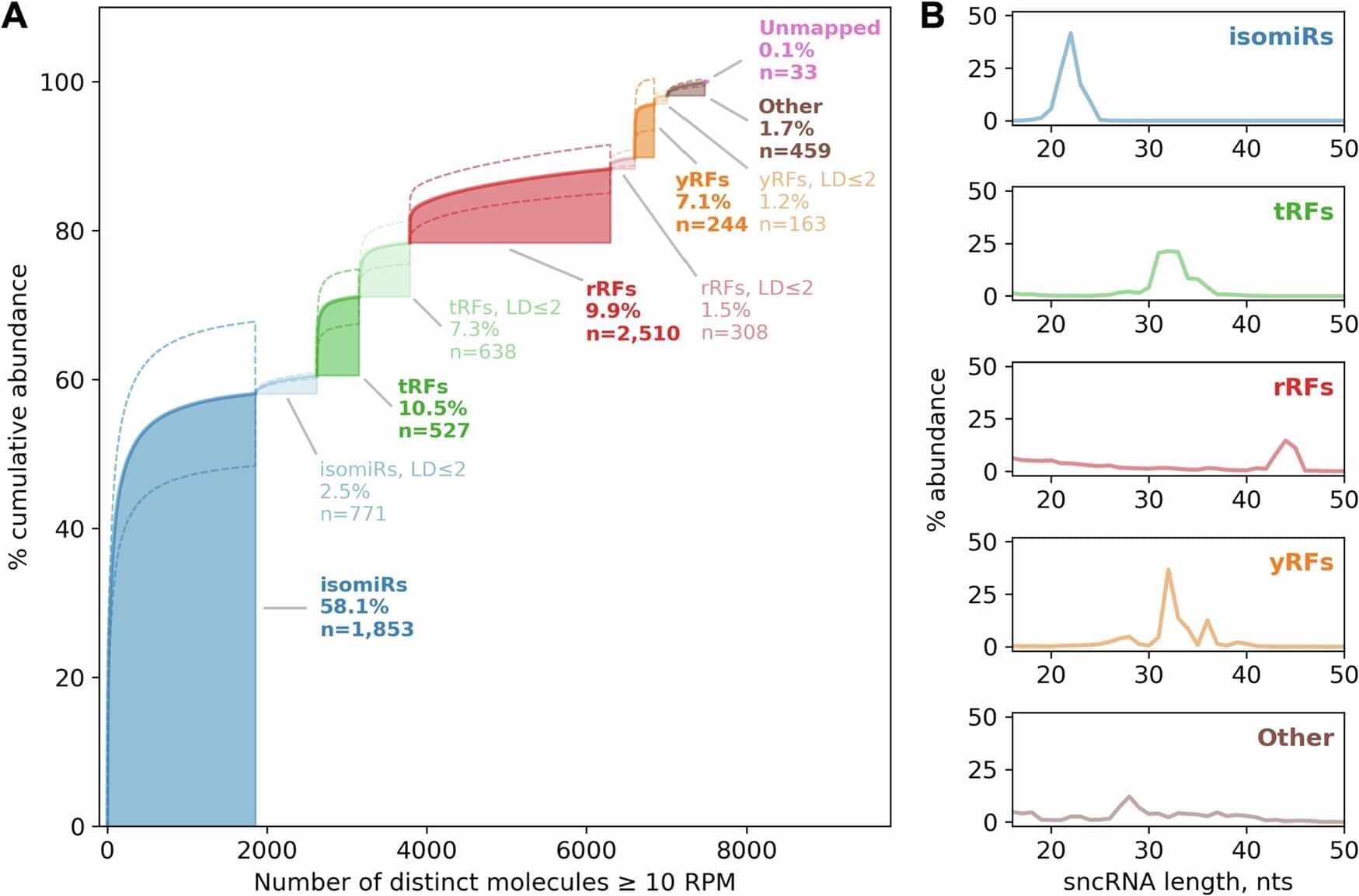
For decades, scientists studying brain disorders have focused almost exclusively on proteins and the genes encoding them. Now, research from Thomas Jefferson University’s Computational Medicine Center suggests that several classes of small regulatory molecules, fittingly known as small RNAs, may play a much larger role in schizophrenia and bipolar disorder, and in a healthy brain, than previously thought.
In a study recently published in Translational Psychiatry, a team led by Isidore Rigoutsos, Ph.D. took a comprehensive look at small RNAs in brain samples from people with schizophrenia, bipolar disorder and individuals without psychiatric illness. Their goal was to find out what kind of small RNAs are active in the brain, and whether their levels change in disease.
“Little attention had been paid to small RNAs in these disorders,” says Dr. Rigoutsos, “even though small RNAs help control numerous processes by modulating the abundance of genes.”