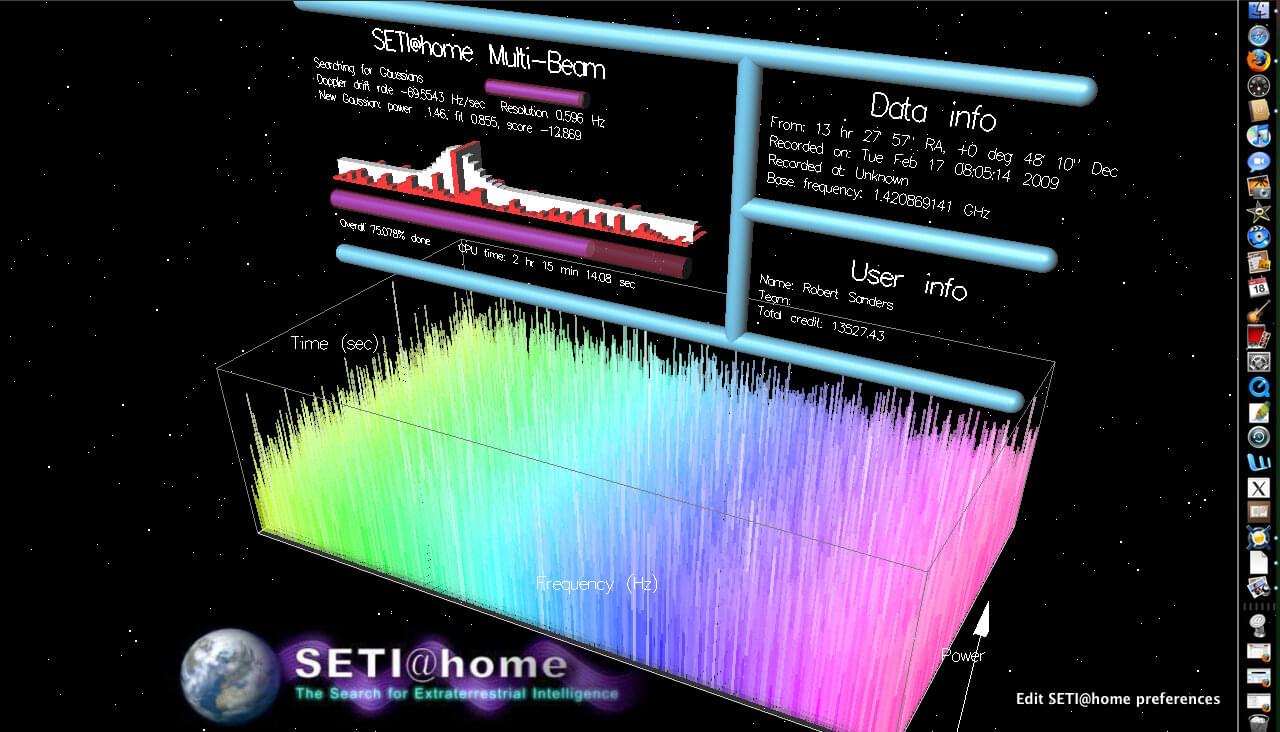
For 21 years, between 1999 and 2020, millions of people worldwide loaned UC Berkeley scientists their computers to search for signs of advanced civilizations in our galaxy.
The project—called SETI@home, after the Search for Extraterrestrial Intelligence (SETI)—generated a loyal following eager to participate in one of the most popular crowd-sourced projects in the early days of the internet. They downloaded the SETI@home software to their home computers and allowed it to analyze data recorded at the now-defunct Arecibo Observatory in Puerto Rico to find unusual radio signals from space.
All told, these computations produced 12 billion detections— momentary blips of energy at a particular frequency coming from a particular point in the sky, according to computer scientist and project co-founder David Anderson.