1 Department of Orthopaedics and Traumatology, Li Ka Shing Institute of Health Sciences, Chinese University of Hong Kong, Hong Kong SAR, China.
Linking epigenetics and metabolism in neurogenesis!
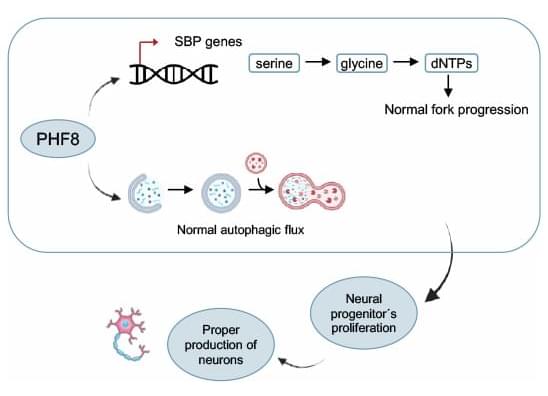
Epigenetic regulation and metabolism are tightly coordinated during progenitor cell growth but the processes linking this crosstalk is not well understood.
The researchers examined in neural stem cells the role of PHF8, a histone demethylase whose mutations are linked to Siderius-Hamel syndrome, a rare neurodevelopmental disorder.
The authors show that PHF8 regulates neural progenitor proliferation by coordinating epigenetic and metabolic programs and drives serine biosynthesis by maintaining chromatin accessibility of serine synthesis genes.
They also demonstrate that loss of PHF8 disrupts metabolism, autophagy, and vesicle formation and its deficiency leads to DNA damage and halts neurogenesis in vivo. sciencenewshighlights ScienceMission https://sciencemission.com/Epigenetic-regulation-of-serine-biosynthesis
Progenitor proliferation during neurodevelopment requires tight coordination of epigenetic regulation and metabolism. However, the crosstalk between these processes remains poorly understood. To investigate this, we examine in neural stem cells the role of PHF8, a histone demethylase whose mutations are linked to Siderius-Hamel syndrome, a rare neurodevelopmental disorder. Through an integrated multi-omics approach — combining transcriptomics, epigenomics, and metabolomics — we identify PHF8 as a key driver of the serine biosynthesis pathway, safeguarding the intracellular serine pool essential for neural progenitor proliferation. PHF8 fine-tunes chromatin accessibility at promoters of metabolic genes, ensuring their activation during development. Loss of PHF8 disrupts amino acid metabolism, blocks autophagy, and hinders vesicle formation.
Schwann cell-derived exosomes are powerful promoters of nerve repair, capable of enhancing axon regrowth, remyelination, and functional recovery in numerous models. These effects are mediated via multifactorial cargo (miRNAs, mRNAs, proteins) that modulate neurons, glia, endothelial, and immune cells. Importantly, what began as a novel biological insight is now rapidly moving toward therapeutic innovation. Schwann cell-derived exosomes thus represent both a novel mode of glia–neuron communication and a promising avenue for next-generation therapies for nerve regeneration.
Summary: Establishing Qualia Structure Paradigm
Do subjective conscious experience and objective brain matters belong to completely different worlds? How are qualia, the contents of consciousness, related to the brain? The question of consciousness and the brain is not only of scientific interest, but it is also directly related to the problems associated with difficulties in understanding human feelings in the real world. Because qualia are difficult to even define in objective terms, conventional studies of consciousness have attempted to explore their neural correlates by fixing perceptual stimuli and reducing experience to binary judgments, such as seen vs. not seen. Recently, we have established a new paradigm to characterize the structure of qualia by measuring the similarity between visual qualia on a large scale, and to reveal their neural correlates and their information structure.



Despite this reality, an excessive number of organizations, notably small and mid-sized businesses (SMBs), lack designated leadership in this crucial domain.
#cybersecurity #business #ciso #tech
By Chuck Brooks.
Cybersecurity is no longer an IT concern; it has become a fundamental business requirement. Viability, survivability, and ultimately commercial success are dependent on securing the devices and network for any business in the evolving digital era.