Toggle light / dark theme

Segway’s robot mower uses GPS to stay on your lawn

There’s no need to install a perimeter wire with the Navimow.


Is moving into the robot mower market with the Navimow. What sets this model apart from many others is that you don’t need to install a boundary wire. Instead, Navimow uses GPS and other sensors to stay within the perimeter of your lawn.

A so-called Exact Fusion Locating System can maintain Navimow’s position accurate to within two centimeters, according to Segway. If the GPS signal ever dips, the company says the device’s array of sensors and data ensure it will still work. You can tell Navimow where to mow, define the boundaries and instruct it to avoid certain parts of your garden via an app. Segway claims Navimow uses an algorithm to figure out a mowing path so it doesn’t have to criss-cross.

Segway says Navimow operates relatively quietly at 54 dB. There are offset blades to trim edges and corners, while the mower gradually cuts grass from above to reach the height you want (between three and six centimeters). The mower can handle 45-degree inclines and it has an IPX6 water resistance rating, according to Segway.

US states to accept driver’s licence on iPhones

Arizona, and Georgia will introduce the system first, with Connecticut, Iowa, Kentucky, Maryland, Oklahoma, and Utah also signed up.

The “first locations” to use the system will be airport security checkpoints run by the Transportation Security Administration (TSA), Apple says.

Americans usually need some form of state ID only to travel by air domestically, unlike other countries, in which a passport is widely used.

Tapping a phone at an identity reader at supported airports will prompt passengers to use their Face ID or fingerprint to authorise sending information to the machine.

“Users do not need to unlock, show, or hand over their device to present their ID,” Apple said.


Apple’s new ID system for its Wallet will be rolled out at airports to start.

Lotus Evija Aims to Be the World’s Most Powerful Electric Car

Lotus targets almost2000horsepower for its new hypercar.


Lotus is wary of corporate hubris these days, preferring to remain quiet when previously it would have shouted. Former boss Dany Bahar once introduced five sports-car concepts on the same auto-show stand, none of which made it even close to production. Lotus’s resources have grown massively since the thinly applied gild of the Bahar era; Chinese automaker Geely took a majority stake in the British sports-car maker two years ago. But although the company has recruited hundreds of new engineers, and is known to be working on several new models, few details have been shared so far.

Australian company unveils 1,340-horsepower electric motor for hypercar, hyperloop applications

An Australian company by the name of HyperPower Technologies has developed an electric motor that generates a mammoth 1,340 horsepower.

The electric motor, code-named the QFM-360-X, measures about 17 inches in diameter and is designed to be scalable. HyperPower said ten of them could be mounted on a common shaft to deliver 13,400 hp.

To demonstrate the performance, HyperPower teamed up with electric drag racers Top EV Racing and built a Top Fuel-style dragster powered by four of the motors for a combined output of 5,360 hp. Performance estimates for the electric beast include a 0–124 mph time of 0.8 seconds, a 0–330 mph time of 3.7 seconds, and a top speed of 380 mph.

World-first hydrogen helicopter to certify plug-and-play H2 powerplant

The two companies have raised an initial US$6.5 million toward what could genuinely be a revolutionary powertrain for electric aircraft; a fully FAA-certified hydrogen system would instantly allow electric aircraft to carry several times more energy on board, vastly boosting flight endurance while also enabling fast refueling instead of slow charging.

HyPoint claims its “turbo air-cooled” fuel cell system” will be able to achieve up to 2,000 watts per kilogram (2.2 lb) of specific power, which is more than triple the power-to-weight ratio of traditional (liquid-cooled) hydrogen fuel cells systems. It will also boast up to 1,500 watt-hours per kilogram of energy density, enabling longer-distance journeys.” For comparison, today’s commercially available lithium battery packs rarely break the 300-Wh/kg mark.

Apple announces first states that will let you keep a digital version of your driver’s license on your iPhone

Eight states will roll out a feature allowing users to add driver’s license and state IDs to Apple Wallet for iPhone and Apple Watch to use at security at participating airports, Apple announced Wednesday.

Arizona and Georgia are the first states to adopt the feature and Connecticut, Iowa, Kentucky, Maryland, Oklahoma and Utah will follow, though the company did not specify a timeline.

The news comes just months after Apple said at its Worldwide Developers Conference in June that it was working on the feature with the Transportation Security Administration. The update is a crucial step in Apple’s plan to replace physical wallets and will offer more convenience to travelers looking for a touchless airport experience, the company said.

Semiconductor Shortage Idles Four Stellantis North America Assembly Plants

The global semiconductor shortage has dealt another huge blow to Stellantis, with the automaker announcing new production issues. Semiconductors are the backbone of today’s automotive industry, controlling electronic features like driver-assist technologies, hybrid-electric systems, and even infotainment connectivity. This time, the shortage is affecting production for several of the company’s most popular vehicles in North America.

According to several United Auto Workers (UAW) local union websites and a report from the Automotive News, several Chrysler, Dodge, Jeep®, and Ram Truck vehicles will be affected by the latest shortage of semiconductor chips.

The biggest of those plants affected is the Sterling Heights Assembly Plant (SHAP) in Michigan, which is the only facility to manufacturer the highly successful Ram 1,500 pickup. The news comes as the plant is gearing up for the launch of its2022Ram 1,500 lineup later this month. SHAP’s 6,700+ hourly employees are temporarily laid off starting yesterday (August 30th) and will return the day after the Labor Day holiday (September 7th).

Russian Startup Develops Detection Technology for Face, Bodies and Vehicles

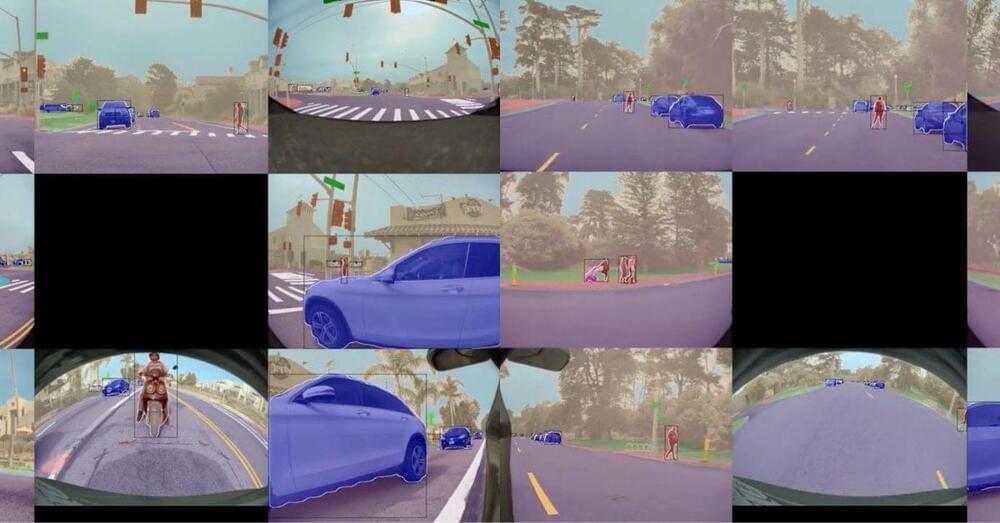
Russian start-up NTechLab has released FindFace Multi, a detection technology that uses an advanced algorithm to recognize not only faces, but also bodies of people and cars. This is an update to the company’s flagship product and is able to support numerous video streams and facial database entries.

Body recognition allows FindFace Multi users to count and search people moving through an environment as well as identifying individuals and tracking movements. The algorithm also takes into account markers such as height, color of clothes and accessories.

The vehicle recognition function determines the body type, color, manufacturer, and model of a car, as well as searching by license plate. Even if license plates, or parts of the vehicle are not visible or obscured, the system can still identify a car.

/* */