Toggle light / dark theme

A forgotten battery design from Thomas Edison—how scientists helped reimagine it

A little-known fact: In the year 1900, electric cars outnumbered gas-powered ones on the American road. The lead-acid auto battery of the time, courtesy of Thomas Edison, was expensive and had a range of only about 30 miles. Seeking to improve on this, Edison believed the nickel-iron battery was the future, with the promise of a 100-mile range, a long life and a recharge time of seven hours, fast for that era.

Alas, that promise never reached fruition. Early electric car batteries still suffered from serious limitations, and advances in the internal combustion engine won the day.

Now, an international research collaboration co-led by UCLA has taken a page from Edison’s book, developing nickel-iron battery technology that may be well-suited for storing energy generated at solar farms. The prototype was able to recharge in only seconds, instead of hours, and achieved over 12,000 cycles of draining and recharging—the equivalent of more than 30 years of daily recharges.

Supercomputer simulations test turbulence theories at record 35 trillion grid points

Using the Frontier supercomputer at the Department of Energy’s Oak Ridge National Laboratory, researchers from the Georgia Institute of Technology have performed the largest direct numerical simulation (DNS) of turbulence in three dimensions, attaining a record resolution of 35 trillion grid points. Tackling such a complex problem required the exascale (1 billion billion or more calculations per second) capabilities of Frontier, the world’s most powerful supercomputer for open science.

The team’s results offer new insights into the underlying properties of the turbulent fluid flows that govern the behaviors of a variety of natural and engineered phenomena—from ocean and air currents to combustion chambers and airfoils. Improving our understanding of turbulent fluctuations can lead to practical advancements in many areas, including more accurately predicting the weather and designing more efficient vehicles.

The work is published in the Journal of Fluid Mechanics.

Solar-powered seesaw extractor simultaneously extracts lithium and desalinates water

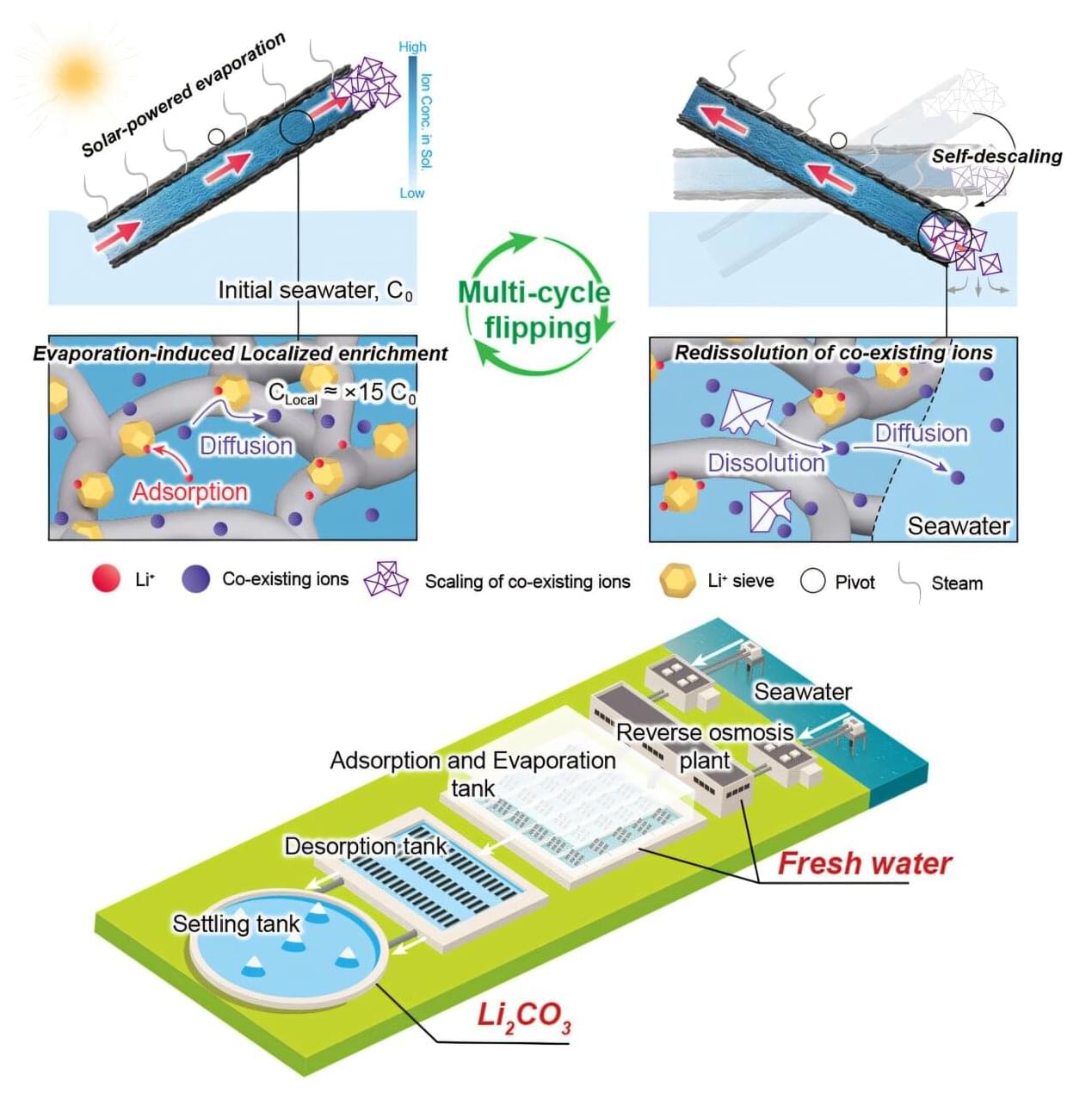
The global demand for lithium has skyrocketed over the last several years due to the rapid growth of the electric vehicle market and grid-storage solutions. Currently, production capacity is limited and unlikely to meet future needs. However, researchers are making headway in innovative lithium capture technologies. A new study, published in Device, describes one such technology that extracts lithium from seawater more efficiently than previous extraction methods, with an added benefit of seawater desalination.

3D ‘polar chiral bobbers’ identified in ferroelectric thin films

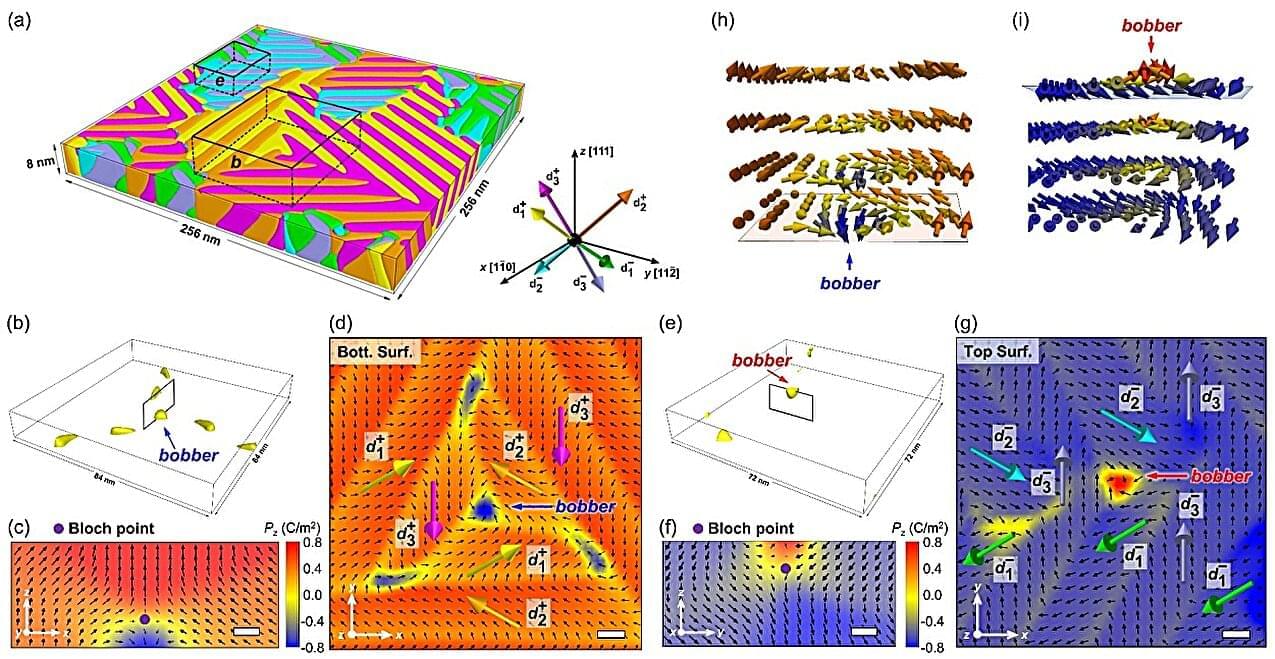
A novel type of three-dimensional (3D) polar topological structure, termed the “polar chiral bobber,” has been discovered in ferroelectric oxide thin films, demonstrating promising potential for high-density multistate non-volatile memory and logic devices. The result was achieved by a collaborative research team from the Institute of Metal Research (IMR) of the Chinese Academy of Sciences, the Songshan Lake Materials Laboratory, and other institutions. The findings were published in Advanced Materials on January 30.

Topological polar textures in ferroelectrics, such as flux-closures, vortices, skyrmions, merons, Bloch points, and high-order radial vortices discovered in recent years, have attracted wide interest for future electronic applications. However, most known polar states possess limited configurational degrees of freedom, constraining their potential for multilevel data storage.

In this study, the researchers used phase-field simulations and aberration-corrected transmission electron microscopy to predict and experimentally confirm the existence of polar chiral bobbers in (111)-oriented ultrathin PbTiO₃ ferroelectric films. This 3D topological structure is characterized by a nanoscale domain with out-of-plane polarization opposite to its surroundings, which starts from the film surface and terminates at a Bloch point inside the film.

How fast can a microlaser switch ‘modes?’ A simple rule reveals a power-law time scaling

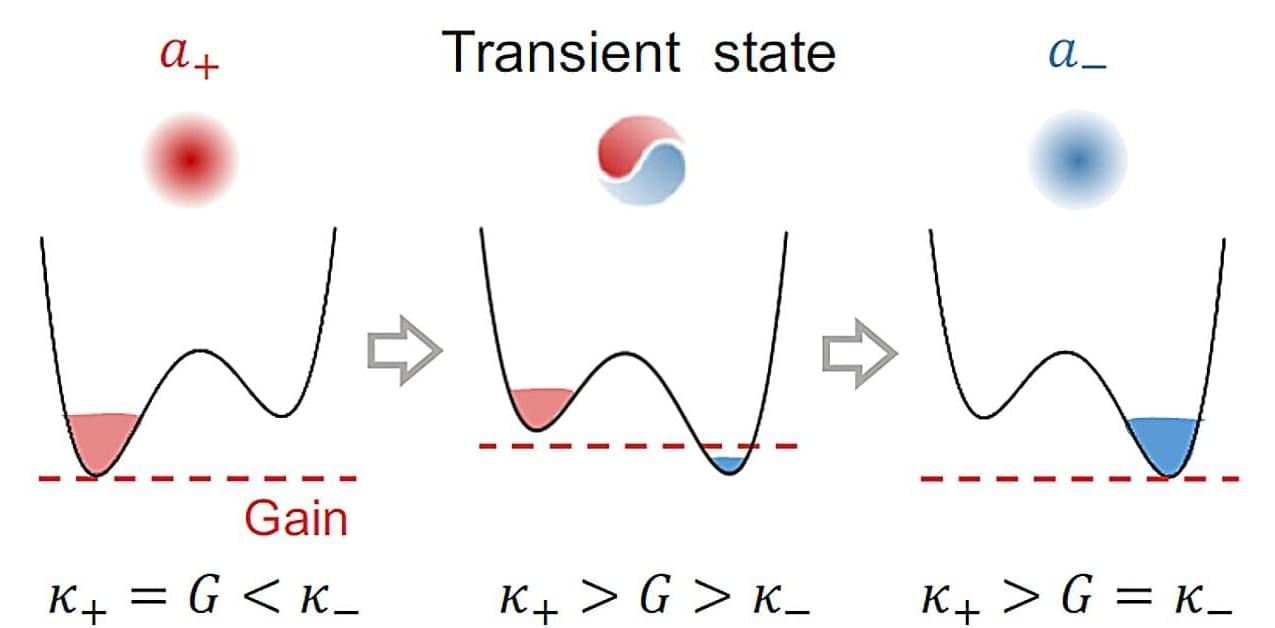
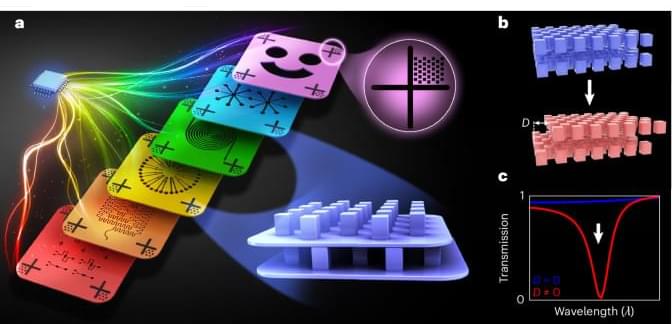
Modern technologies increasingly rely on light sources that can be reconfigured on demand. Think of microlasers that can quickly switch between different operating states—much like a car shifting gears—so that an optical chip can route signals, perform computations, or adapt to changing conditions in real time. The microlaser switching is not a smooth, leisurely process, but can be sudden and fast. Generally, nearly identical “candidate” lasing states compete with each other in a microcavity, and the laser may abruptly jump from one state to another when external conditions are tuned.

This raises a practical question: How fast can such a switch be, in principle? For physicists, it raises a deeper one: Does the switching follow a universal rule, like other phase transitions in nature?

A team at Peking University has now provided a clear picture of an ultrahigh-quality microcavity laser—the time the laser needs to complete a state switch follows a remarkably simple power-law rule. When the control knob is swept faster, the switch becomes faster—but not arbitrarily so. Instead, the switching time decreases with the square root of the sweep speed, corresponding to a robust exponent close to half. This result effectively sets a speed limit for how quickly such microlasers can “change gears.” The findings are published in Physical Review Letters.

Humidity-resistant hydrogen sensor can improve safety in large-scale clean energy

Wherever hydrogen is present, safety sensors are required to detect leaks and prevent the formation of flammable oxyhydrogen gas when hydrogen is mixed with air. It is therefore a challenge that today’s sensors do not work optimally in humid environments—because where there is hydrogen, there is very often humidity. Now, researchers at Chalmers University of Technology, Sweden, are presenting a new sensor that is well suited to humid environments—and actually performs better the more humid it gets.

“The performance of a hydrogen gas sensor can vary dramatically from environment to environment, and humidity is an important factor. An issue today is that many sensors become slower or perform less effectively in humid environments. When we tested our new sensor concept, we discovered that the more we increased the humidity, the stronger the response to hydrogen became. It took us a while to really understand how this could be possible,” says Chalmers doctoral student Athanasios Theodoridis, who is the lead author of the article published in the journal ACS Sensors.

Hydrogen is an increasingly important energy carrier in the transport sector and is used as a raw material in the chemical industry or for green steel manufacturing. In addition to water being constantly present in ambient air, it is also formed when hydrogen reacts with oxygen to generate energy, for example, in a fuel cell that can be used in hydrogen-powered vehicles and ships. Furthermore, fuel cells themselves require water to prevent the membranes that separate oxygen and hydrogen inside them from drying out.

Stabilized iron catalyst could replace platinum in hydrogen fuel cells

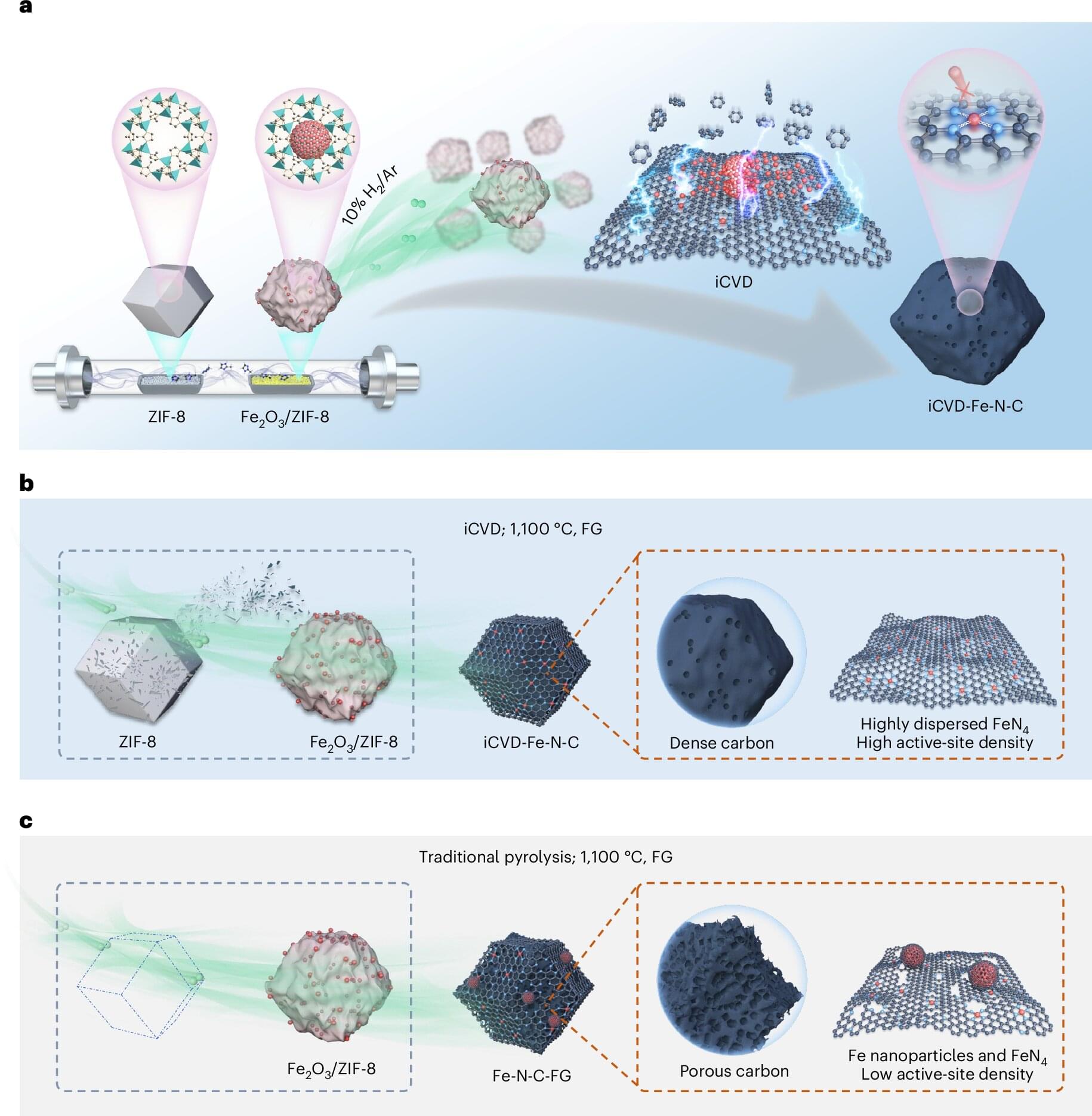
Japan and California have embraced hydrogen fuel-cell technologies, a form of renewable energy that can be used in vehicles and for supplying clean energy to manufacturing sectors. But the technology remains expensive due to its reliance on precious metals such as platinum. Engineers at Washington University in St. Louis are working on this challenge, finding ways to stabilize ubiquitous iron components for use in fuel cells to replace the expensive platinum metals, which would make hydrogen fuel-cell vehicles more affordable.

Cost challenges for fuel-cell vehicles

“The hydrogen fuel cell has been successfully commercialized in Japan and California in the U.S.,” said Gang Wu, a professor of energy, environmental and chemical engineering at the McKelvey School of Engineering. “But these vehicles struggle to compete with the battery vehicle and combustion engine vehicle, with cost being the main issue.”

Electronic Chirality Without Structural Chirality

The handedness or chirality of a golf club, a baseball glove, or certain crystal lattices is plain to see: Their structures are such that one cannot be overlaid on its mirror image. Now Takayuki Ishitobi of the Japan Atomic Energy Agency and Kazumasa Hattori of Tokyo Metropolitan University have discovered that a crystal whose atomic structure is achiral can still host a chiral electronic state, which they dub purely electronic chirality (PEC) [1].

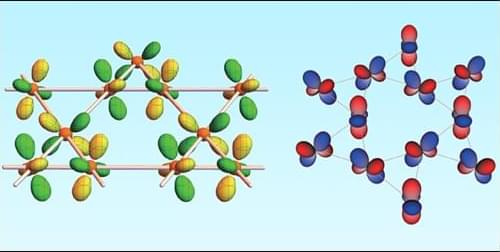
Four years ago, theorists found that the chirality of a crystalline structure can be quantified with a single number G0, which is given by the inner product of polar and axial vectors. The polar one is the electric dipole moment. The axial one is the electric toroidal dipole, which quantifies the geometric relationship between the electrons’ spin and orbital axes, and which is present in a few crystals with the requisite intricate arrangement of orbitals. Ishitobi and Hattori sought crystals whose atomic structures were achiral, but in which electronic interactions could induce an electric toroidal dipole and, therefore, a nonzero G0.

In some crystals, the conduction electrons occupy 2D planes. Ishitobi and Hattori realized that, if such a crystal also possesses atoms with electric quadrupole moments, the internal electric field could couple these quadrupoles to the electric toroidal dipole. A PEC would arise if the electric quadrupole has a specific arrangement and if the crystal has a certain lattice structure. From their calculations, the researchers determined that the intermetallic compound uranium rhodium stannide ticks all the boxes. They also found that the adoption of PEC by this material’s electrons could account for an unexplained phase transition at a temperature of 54 K.

/* */