Toggle light / dark theme

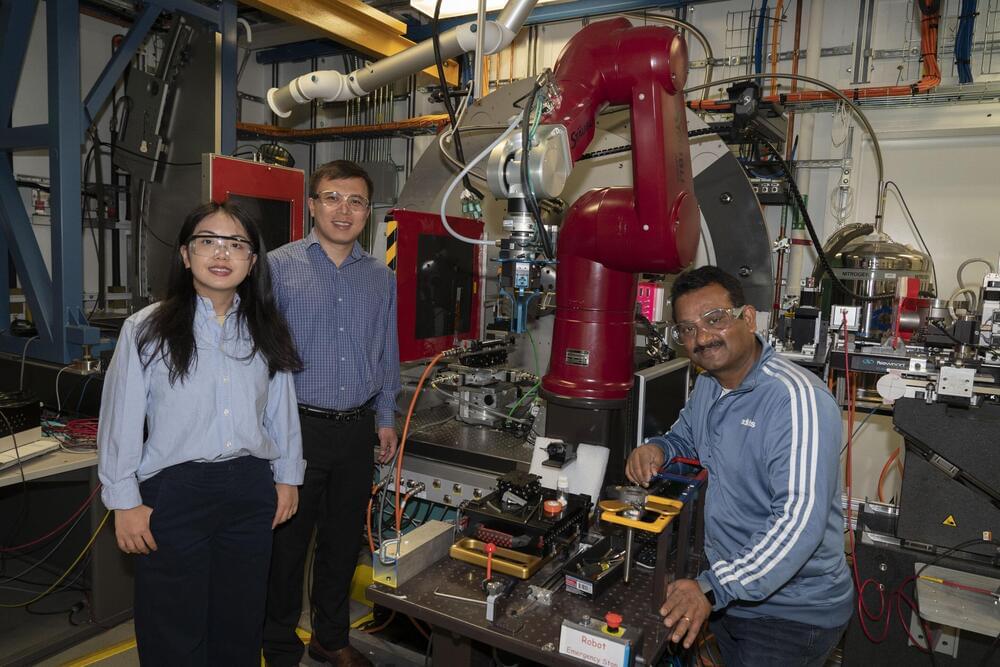
PIP-II transportation test frame is ready for action

Successful assembly was the result of a collaboration among three institutions in three countries.


Cryomodules are essential components for the U.S. Department of Energy’s Fermi National Accelerator Laboratory’s accelerator complex upgrade, known as the Proton Improvement Plan II, or PIP-II.

PIP-II features a brand-new, 800-million-electronvolt leading-edge superconducting radio-frequency linear accelerator, or linac for short, that will enable Fermilab to produce more than 1 megawatt of beam power, 60% higher than current capabilities. To achieve this groundbreaking feat, the linac will be made up of cryomodules, which are vessels containing niobium cavities.

The first particle accelerator on U.S. soil built with significant contributions from international partners, PIP-II will receive three assembled cryomodules from partners at the Science and Technology Facilities Council in the United Kingdom and nine assembled cryomodules from Commissariat à l’Énergie Atomique et aux Énergies Alternatives, or CEA, in France.

Enhancing the safety of autonomous vehicles in critical scenarios

Researchers at Ulm University in Germany have recently developed a new framework that could help to make self-driving cars safer in urban and highly dynamic environments. This framework, presented in a paper pre-published on arXiv, is designed to identify potential threats around the vehicle in real-time.

The team’s paper builds on one of their previous studies, featured in IEEE Transactions on Intelligent Vehicles earlier this year. This previous work was aimed at providing autonomous vehicles with situation-aware environment perception capabilities, thus making them more responsive in complex and dynamic unknown environments.

“The core idea behind our work is to allocate perception resources only to areas around an automated that are relevant in its current situation (e.g., its current driving task) instead of the naive 360° perception field,” Matti Henning, one of the researchers who carried out the study, told TechXplore. “In this way, computational resources can be saved to increase the efficiency of automated vehicles.”

Open source platform enables research on privacy-preserving machine learning

The biggest benchmarking data set to date for a machine learning technique designed with data privacy in mind has been released open source by researchers at the University of Michigan.

Called federated learning, the approach trains learning models on end-user devices, like smartphones and laptops, rather than requiring the transfer of private data to central servers.

“By training in-situ on data where it is generated, we can train on larger real-world data,” explained Fan Lai, U-M doctoral student in computer science and engineering, who presents the FedScale training environment at the International Conference on Machine Learning this week.

/* */