Just need to prevent brain hacking.
Eric Leuthardt believes that in the near future we will allow doctors to insert electrodes into our brains so we can communicate directly with computers and each other.

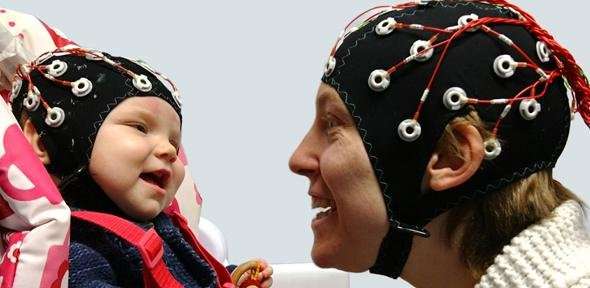
Making eye contact with an infant makes adults’ and babies’ brainwaves ‘get in sync’ with each other – which is likely to support communication and learning – according to researchers at the University of Cambridge.
When a parent and infant interact, various aspects of their behaviour can synchronise, including their gaze, emotions and heartrate, but little is known about whether their brain activity also synchronises – and what the consequences of this might be.
Brainwaves reflect the group-level activity of millions of neurons and are involved in information transfer between brain regions. Previous studies have shown that when two adults are talking to each other, communication is more successful if their brainwaves are in synchrony.


LTRP Note: The following news story is posted for informational purposes.
By Jean Twenge Business Insider
Around 2012, something started going wrong in the lives of teens.
In just the five years between 2010 and 2015, the number of U.S. teens who felt useless and joyless – classic symptoms of depression – surged 33 percent in large national surveys. Teen suicide attempts increased 23 percent. Even more troubling, the number of 13- to 18-year-olds who committed suicide jumped 31 percent.

Die Goethe-Universität ist eine forschungsstarke Hochschule in der europäischen Finanzmetropole Frankfurt. Lebendig, urban und weltoffen besitzt sie als Stiftungsuniversität ein einzigartiges Maß an Eigenständigkeit.

Furthermore, with advancements in quantum computing and machine learning, many notable public figures, including Stephen Hawking and Elon Musk, have indicated a growing concern with the imminent threat of AI surpassing human intelligence (Gosset, 2017). For instance, Darrell M. West, a political scientist, has proposed a protectionist framework that appeals to transhumanism, in which he restructures socioeconomic policy to account for changes in technology-induced unemployment. In particular, he posits that “Separating the dispersion of health care, disability, and pension benefits outside of employment offers workers with limited skills social benefits on a universal basis” (West, 2015). Expounding upon this equivocation, a more viable solution to potential unemployment is the realization of a multi-faceted policy which advocates the improvement of STEM-related education on a broad economic base, with habituation programs for the unskilled workforce. That is, with the implementation of appropriate and reformatory policies concerning the future development of AI technologies, this sector provides an economic incentive for new job creation, compatible with industrial development.
Prompt: What are the political implications of artificial intelligence technology and how should policy makers ensure this technology will benefit diverse sectors of society?
In recent years, the rapid development and mass proliferation of artificial intelligence have had various sociopolitical implications. It is a commonly held belief that the emergence of this technology will have an unprecedented impact on policies and political agendas. However, such discourse often lacks a geopolitical and social dimension, which limits the breadth of analysis. Further, little consideration has been given to potential employment and public policy reform. Growing concerns have been raised regarding the potential risk inherent in the evolution of strong AI, which provides the basis for transhumanism, whereby it is conjectured that AI will eventually be able to surpass human intelligence. As such, it is incumbent upon the upcoming generation of policymakers to implement and adopt necessary measures, which will provide a careful, multilateral framework, ultimately achieving market-oriented technological advancement with respect to employment and public policy.
Machine learning, the interplay of computer science and neuroscience, is a rapidly developing field that has been a source of much political controversy in recent years. While emerging technologies have significantly improved production quality and efficiency across industries, they have also raised concerns such as job displacement and other unfavourable socioeconomic implications (Karsten & West, 2015). In particular, the growing shortage of job opportunities has furnished increasing levels of unemployment and has, in various instances, lead to unwanted economic stagnation. On the subject of potential future unemployment, many policymakers have proposed an increase in Earned Income Tax Credit, which provides a collateral basic income and encourages profit-sharing (West, 2015).
This effects whole families and their emotional well being!
Bill Gates shares his thoughts on Alzheimer’s disease and his hopes for accelerating progress to find a breakthrough.
I always wondered if this was possible.
In a paper published, Science describes a team of neuroscientists striving to grasp the computational aspect of consciousness, and port it to a machine.