Toggle light / dark theme

Physicists create long-sought topological quantum states

The exotic particles are called non-Abelian anyons, or nonabelions for short, and their Borromean rings exist only as information inside the quantum computer. But their linking properties could help to make quantum computers less error-prone, or more ‘fault-tolerant’ — a key step to making them outperform even the best conventional computers. The results, revealed in a preprint on 9 May1, were obtained on a machine at Quantinuum, a quantum-computing company in Broomfield, Colorado, that formed as the result of a merger between the quantum computing unit of Honeywell and a start-up firm based in Cambridge, UK.

“This is the credible path to fault-tolerant quantum computing,” says Tony Uttley, Quantinuum’s president and chief operating officer.

Other researchers are less optimistic about the virtual nonabelions’ potential to revolutionize quantum computing, but creating them is seen as an achievement in itself. “There is enormous mathematical beauty in this type of physical system, and it’s incredible to see them realized for the first time, after a long time,” says Steven Simon, a theoretical physicist at the University of Oxford, UK.

A “Window Into Evolution” — Mathematicians Uncover Universal Explanatory Framework

Mathematicians have uncovered a universal explanatory framework that provides a “window into evolution.” This framework explains how molecules interact with each other in adapting to changing conditions while still maintaining tight control over essential properties that are crucial for survival.

According to Dr. Araujo from the QUT School of Mathematical Sciences, the research results provide a blueprint for the creation of signaling networks that are capable of adapting across all life forms and for the design of synthetic biological systems.

“Our study considers a process called robust perfect adaptation (RPA) whereby biological systems, from individual cells to entire organisms, maintain important molecules within narrow concentration ranges despite continually being bombarded with disturbances to the system,” Dr. Araujo said.

New study finds long-term musical training alters brain connectivity networks

A new study published in Human Brain Mapping revealed that long-term musical training can modify the connectivity networks in the brain’s white matter.

Previous research has shown that intense musical training induces structural neuroplasticity in different brain regions. However, previous studies mainly investigated brain changes in instrumental musicians, and little is known about how structural connectivity in non-instrumental musicians is affected by long-term training.

To examine how the connections between different parts of the brain might be affected by long-term vocal training, the researchers of the study used graph theory and diffusion-weighted images. Graph theory is a mathematical framework used to study the networks’ architecture in the human brain, while diffusion-weighted imaging is an MRI technique that measures the diffusion of water molecules in tissues, providing information on the structural connectivity of the brain.

Uncovering the Mystery of the Human Brain with Computational Neuroscience

Defining computational neuroscience The evolution of computational neuroscience Computational neuroscience in the twenty-first century Some examples of computational neuroscience The SpiNNaker supercomputer Frontiers in computational neuroscience References Further reading

The human brain is a complex and unfathomable supercomputer. How it works is one of the ultimate mysteries of our time. Scientists working in the exciting field of computational neuroscience seek to unravel this mystery and, in the process, help solve problems in diverse research fields, from Artificial Intelligence (AI) to psychiatry.

Computational neuroscience is a highly interdisciplinary and thriving branch of neuroscience that uses computational simulations and mathematical models to develop our understanding of the brain. Here we look at: what computational neuroscience is, how it has grown over the last thirty years, what its applications are, and where it is going.

Watch thousands of worms ‘explosively’ untangle themselves from a knotted ball in milliseconds

Worms can entangle themselves into a single, giant knot, only to quickly unravel themselves from the tightly wound mess within milliseconds. Now, math shows how they do it.

Researchers studied California blackworms (Lumbriculus variegatus) — thin worms that can grow to be 4 inches (10 centimeters) in length — in the lab, watching as the worms intertwined by the thousands. Even though it took the worms minutes to form into a ball-shaped blob akin to a snarled tangle of Christmas lights, they could untangle from the jumble in the blink of an eye when threatened, according to a study published April 28 in the journal Science (opens in new tab).

Physicists identify new quantum state called “magic”

It was Arthur C. Clarke who famously said that “Any sufficiently advanced technology is indistinguishable from magic” (although I’d argue that Jack Kirby and Jim Starlin rather perfected the idea). Now, a group of real-life scientists at the RIKEN Interdisciplinary Theoretical and Mathematical Sciences in Japan have taken it a step further: by identifying a new quantum property to measure the weirdness of spacetime, and officially calling it “magic.” From the scientific paper “Probing chaos by magic monotones,” recently published in the journal Physical Review D:

Solving computationally complex problems with probabilistic computing

😗


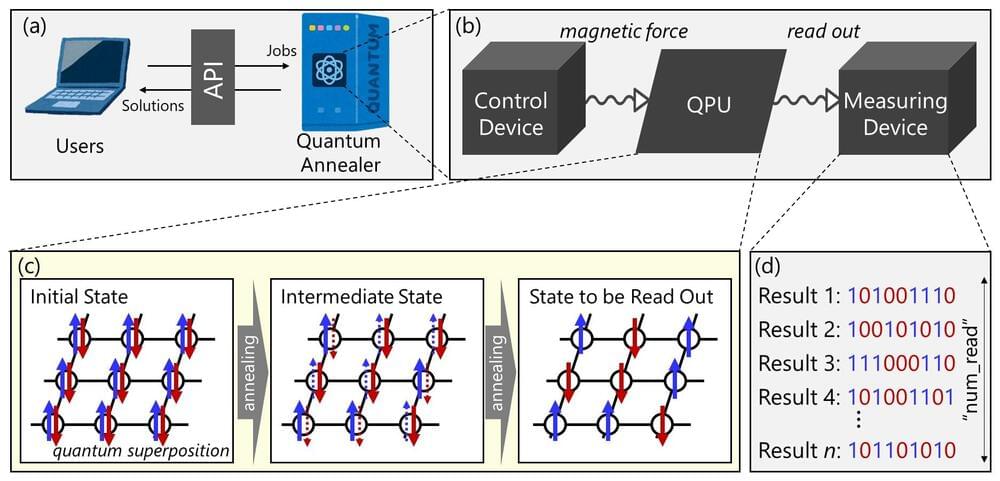
According to computational complexity theory, mathematical problems have different levels of difficulty in the context of their solvability. While a classical computer can solve some problems ℗ in polynomial time—i.e., the time required for solving P is a polynomial function of the input size—it often fails to solve NP problems that scale exponentially with the problem size and thus cannot be solved in polynomial time. Classical computers based on semiconductor devices are, therefore, inadequate for solving sufficiently large NP problems.

In this regard, quantum computers are considered promising as they can perform a large number of operations in parallel. This, in turn, speeds up the NP problem-solving process. However, many physical implementations are highly sensitive to thermal fluctuations. As a result, quantum computers often demand stringent experimental conditions such extremely low temperatures for their implementation, making their fabrication complicated and expensive.

Fortunately, there is a lesser-known and as-yet underexplored alternative to quantum computing, known as probabilistic computing. Probabilistic computing utilizes what are called “stochastic nanodevices,” whose operations rely on thermal fluctuations, to solve NP problems efficiently. Unlike in the case of quantum computers, thermal fluctuations facilitate problem solving in probabilistic computing. As a result, probabilistic computing is, in fact, easier to implement in real life.

/* */