Could we interest you in a humanoid vessel to transfer your consciousness into?
Humans have always been fascinated with the concept of immortality but what seems to be even more exciting to some is the thought of using technology to make immortality a real-world application. A movement called transhumanism is even devoted to using science and technology to augment our bodies and our minds, and to allow humans to merge with machines, eradicating old age as a cause of death. So the big question is — can we really evade death?
From Hans Moravec’s classic book Mind Children to Gene Roddenberry’s iconic TV series Star Trek: The Next Generation, the idea of uploading a person’s feelings, memories, and experiences onto a machine, has been explored in many popular non-fiction and fiction works. However, whether or not mind uploading could become a reality, like 3D printers, robots, and driverless cars? We are yet to find out.
Transhumanism, briefly explained, means the modification of human beings through technology and engineering. It employs a variety of methods used to cure ailments, or upgrading humans just for the sake of it. Creating people that are smarter, stronger, healthier, or more productive.
It comes with plenty of social and ethical implications and challenges. How will we face this future? Let’s find out today.
Notes and References: [1] Harari, N.Y. (2017). Homo Deus: A Brief History of Tomorrow. HarperCollins Publishing: New York, NY [2] Niller, E. (2018, August 10). Why Gene Editing Is the Next Food Revolution. Time. Retrieved from https://www.nationalgeographic.com/environment/article/food-…ne-editing. [3] Epstein, L.R., Lee, S.S., Miller, M.F., & Lombardi, H.A. (2021). CRISPR, animals, and FDA oversight: Building a path to success. Proceedings of the National Academy of Sciences, 118(22) e2004831117, doi:10.1073/pnas.2004831117 [4] Park, A. (2019, August 6). CRISPR Gene Editing Is Being Tested in Human Patients, and the Results Could Revolutionize Health Care. Time. Retrieved from https://time.com/5642755/crispr-gene-editing-humans/ [5][Neuralink]. (2021, April 8). Monkey MindPong[Video]. YouTube. Retrieved from https://www.youtube.com/watch?v=rsCul1sp4hQ [6] Ritchie, H., Ortiz-Ospina E. & Roser, M. (2013). Life Expectancy. OurWorldInData.org. Retrieved from https://ourworldindata.org/life-expectancy. [7] Sinclair, D.A. & LaPlante, M.D. (2019). Lifespan: Why We Age and Why We Don’t Have To. Atria Books: New York, NY. [8] Kharpal, A. (2017, February 13). Elon Musk: Humans must merge with machines or become irrelevant in AI age. CNBC. https://www.cnbc.com/2017/02/13/elon-musk-humans-merge-machi…obots.html. [9] Humanity+ —World Transhumanist Association. (n.d.). Retrieved from https://humanityplus.org.
Do you want to learn more about Transhumanism? Check out these sources! [Kurzgesagt – In a Nutshell]. (2020, December 10). Can You Upload Your Mind & Live Forever?[Video]. YouTube. Retrieved from https://www.youtube.com/watch?v=4b33NTAuF5E. [Kurzgesagt – In a Nutshell]. (2017, October 20). Why Age? Should We End Aging Forever?[Video]. YouTube. Retrieved from https://www.youtube.com/watch?v=GoJsr4IwCm4&t=1s. [Kurzgesagt – In a Nutshell]. (2017, November 3). How to Cure Aging – During Your Lifetime?[Video]. YouTube. Retrieved from https://www.youtube.com/watch?v=MjdpR-TY6QU [BBC Ideas]. (2019, December 31). Transhumanism: Will humans evolve to something smarter? | A-Z of ISMs Episode 20 — BBC Ideas[Video]. YouTube. https://www.youtube.com/watch?v=RVmuU04-X5E
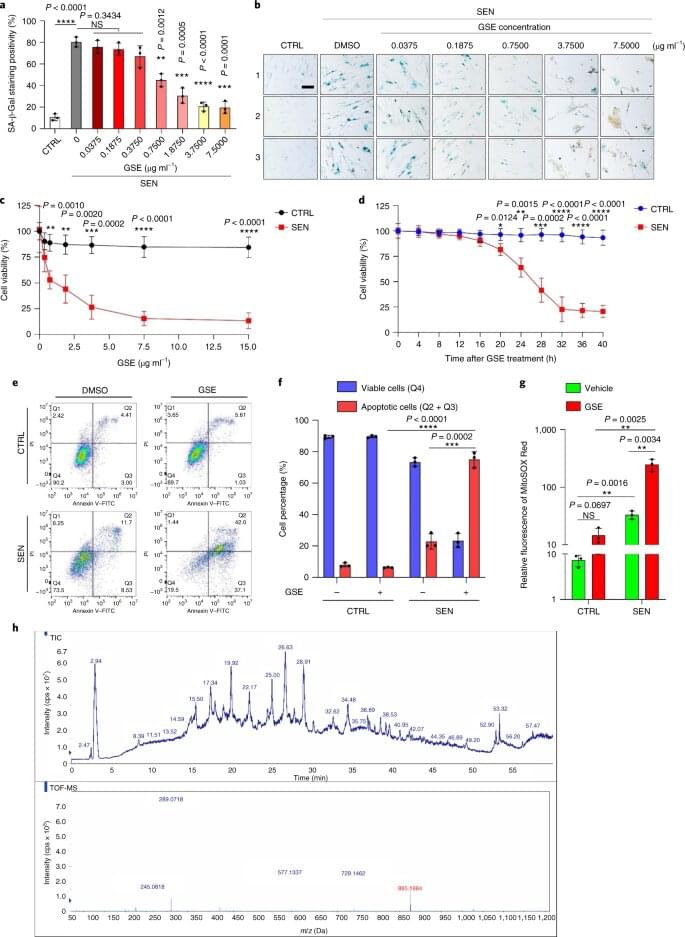
A team of researchers affiliated with a host of institutions in China and the U.S. has found that injecting procyanidin C1 (PCC1), a chemical found in grape seed extract, into older mice extended their lifespan. In their paper published in the journal Nature Metabolism, the group describes the link between PCC1 and extended lifespan in mice and the experiments they carried out with the material.
Scientists have been trying for many years to understand the aging process. The hope is that once it is understood, mitigation efforts can slow or stop the process to allow people to live longer or to live in a more healthy way as they age. In this new effort, the researchers screened 46 plant extracts looking for anti-aging capabilities. They came across PCC1. Initial tests during screening showed it reduced the number of senescent cells in the human prostate. Such cells are known to contribute to aging. Intrigued with their results, the researchers tested it further. They found that at low doses it prevented senescent cells from contributing to inflammation, and at higher doses killed them outright without harming other cells.
The team then injected 171 mice with PCC1, 91 of whom were considered to be old. They found that this increased the overall lifespan of the mice by 9 percent and their remaining lifespans by 60 percent, on average. The researchers also injected younger mice with the extract chemical over a period of four months and found it improved their physical fitness. They then injected mice that had cancerous tumors with the chemical and found that doing so helped to shrink tumors when given in conjunction with chemotherapy. They also found it did the same with human tumor cells implanted into mice.
Very technical and it’s from the usually secretive Calico.
Jacob Kimmel of Calico Labs discusses how cells can be reprogrammed to restore youthful expression through transient suppression of cell identity at Lifespan.io’s 2021 EARD conference.
Jacob Kimmel is a Principal Investigator at Calico Life Sciences leading a research program focused on repurposing developmental programs to address aging and age-related disease. His recent work has revealed the influence of cell identity on aging trajectories, discovered mechanisms of age-related impairment in muscle stem cells and developed machine learning methods for the analysis of single-cell genomics data. Prior to Calico, Jacob completed Ph.D. training with Wallace Marshall and Andrew Brack at the University of California San Francisco where he developed methods to measure cell state transitions with timelapse microscopy techniques.
Calico (Calico Life Sciences LLC) is an Alphabet-founded research and development company whose mission is to harness advanced technologies and model systems to increase our understanding of the biology that controls human aging.
As we age, our muscles gradually become smaller, weaker and less able to heal after injury. In a new study, UPMC and University of Pittsburgh researchers pinpoint an important mediator of youthfulness in mouse muscle, a discovery that could advance muscle regeneration therapies for older people.
Published today in Nature Aging, the study demonstrates that circulating shuttles called extracellular vesicles, or EVs, deliver genetic instructions for the longevity protein known as Klotho to muscle cells. Loss of muscle function and impaired muscle repair in old mice may be driven by aged EVs, which carry fewer copies of these instructions than those in young animals.
The findings are an important advance in understanding why the capacity for muscles to regenerate dwindles with age.
In addition to our film, Gitcoin is also hosting several different longevity projects via Lifespan.io / Lifespan Extension Advocacy Foundation, all of which you can support by clicking below 🧬
Projects put forth by the Lifespan Extension Advocacy Foundation (LEAF) — aka Lifespan.io — and projects fiscally sponsored by LEAF.
Combining knowledge of chemistry, physics, biology, and engineering, scientists from McGill University develop a biomaterial tough enough to repair the heart, muscles, and vocal cords, representing a major advance in regenerative medicine.
“People recovering from heart damage often face a long and tricky journey. Healing is challenging because of the constant movement tissues must withstand as the heart beats. The same is true for vocal cords. Until now there was no injectable material strong enough for the job,” says Guangyu Bao, a PhD candidate in the Department of Mechanical Engineering at McGill University.
The team, led by Professor Luc Mongeau and Assistant Professor Jianyu Li, developed a new injectable hydrogel for wound repair. The hydrogel is a type of biomaterial that provides room for cells to live and grow. Once injected into the body, the biomaterial forms a stable, porous structure allowing live cells to grow or pass through to repair the injured organs.
Due to last years success, I am back with an updated list of my 5 most promising anti-aging compounds.
There are more than 200 different geroprotective compounds. Some of these are already available as supplements, some are in clinical trials and some have FDA approval. Which are my top 5 that I think i most promising in terms of their anti-aging effects (so focusing more on healthspan than lifespan). And note the use of “promising” — there is still much work to be done to better investigate the long-term safety, dose and timings of different supplements which you should always bear in mind.
Anyway, I made this video more for a bit of fun and to make a longer summary video to pull ideas together from multiple previous videos with some new info too! So hope you like it! And disclaimer — this is not recommendation or health advise — i am not a medical doctor!!