Thin films made of carbon nanotubes hold a lot of promise for advanced optoelectronics, energy and medicine, however with their manufacturing process subject to close supervision and stringent standardization requirements, they are unlikely to become ubiquitous anytime soon.
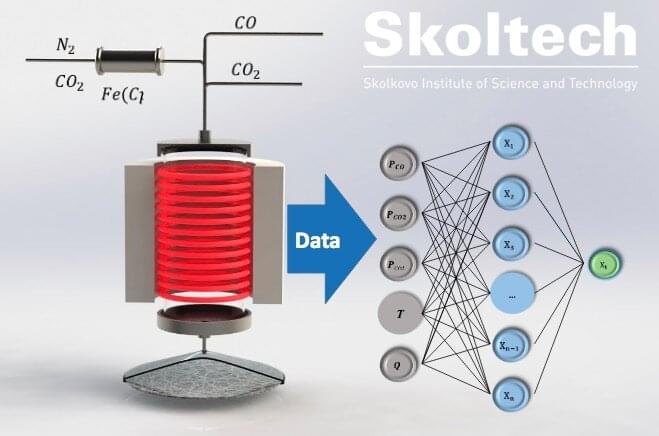
“A major hindrance to unlocking the vast potential of nanotubes is their multiphase manufacturing process which is extremely difficult to manage. We have suggested using artificial neural networks (ANN) to analyze experimental data and predict the efficiency of single-walled carbon nanotubes synthesis,” explains one of the authors of the study and Skoltech researcher, Dmitry Krasnikov.
In their work published in the prestigious Carbon journal, the authors show that machine learning methods, and, in particular, ANN trained on experimental parameters, such as temperature, gas pressure and flow rate, can help monitor the properties of the carbon nanotube films produced.
Responsive material changes its behavior based on earlier conditions.
Inspired by living systems, a new material has been developed that changes its electrical behavior based on previous experience, effectively giving it a basic form of adaptive memory. Such adaptive materials could play a vital role in the next generation of medical and environmental sensors, as well as in soft robots or active surfaces. The breakthrough was achieved by researchers at Aalto University in Finland.
Responsive materials have become common in a range of applications, from glasses that darken in sunlight to drug delivery systems. However, existing materials always react in the same way each time. Their response to a change doesn’t depend on their history, nor do they adapt based on their past.
In a new study published by Alzheimer’s & Dementia, scientists from Rush University and Tufts University were the first to compare cognitive decline factors to vitamin D concentrations not only in the blood, but in the brain as well.
Researchers analyzed participants of the Rush Memory and Aging Project (MAP)—an ongoing longitudinal study that aims to identify risk factors for Alzheimer’s disease and other cognitive decline disorders—before and after death to see how their vitamin D levels impacted cognitive function in their later years.
Free of known dementia at the time of enrollment, all MAP participants agreed to participate in annual evaluations and organ donation when they died. In this study, the average age of participants was 92 at the time of death.
Discusses the possibility of Femtotech and the technological possibilities it may unlock. Not long ago nanotechnology was a fringe topic; now it’s a flourishing engineering field, and fairly mainstream. For example, while writing this article, I happened to receive an email advertisement for the “Second World Conference on Nanomedicine and Drug Delivery,” in Kerala, India. It wasn’t so long ago that nanomedicine seemed merely a flicker in the eyes of Robert Freitas and a few other visionaries!
But nano is not as small as the world goes. A nanometer is 10–9 meters – the scale of atoms and molecules. A water molecule is a bit less than one nanometer long, and a germ is around a thousand nanometers across. On the other hand, a proton has a diameter of a couple femtometers – where a femtometer, at 10–15 meters, makes a nanometer seem positively gargantuan. Now that the viability of nanotech is widely accepted (in spite of some ongoing heated debates about the details), it’s time to ask: what about femtotech? Picotech or other technologies at the scales between nano and femto seem relatively uninteresting, because we don’t know any basic constituents of matter that exist at those scales. But femtotech, based on engineering structures from subatomic particles, makes perfect conceptual sense, though it’s certainly difficult given current technology.
The nanotech field was arguably launched by Richard Feynman’s 1959 talk “There’s Plenty of Room at the Bottom.” As Feynman wrote there.
“It is a staggeringly small world that is below. In the year 2000, when they look back at this age, they will wonder why it was not until the year 1960 that anybody began seriously to move in this direction.
Why cannot we write the entire 24 volumes of the Encyclopedia Brittanica on the head of a pin? ”
Bio: Hugo de Garis (born 1947, Sydney, Australia) is a researcher in the sub-field of artificial intelligence (AI) known as evolvable hardware. He became known in the 1990s for his research on the use of genetic algorithms to evolve neural networks using three dimensional cellular automata inside field programmable gate arrays. He claimed that this approach would enable the creation of what he terms “artificial brains” which would quickly surpass human levels of intelligence.
Finally, there’s a solution for the hard-to-reach small intestine.
Imagine if we could power devices inside the body. This would lead to major developments in biomedical research and much potential for new applications in chemical sensors, drug-delivery systems and electrical stimulation devices.
Now, Binghamton University researchers have invented a capsule-sized biobattery they believe may be a solution for the hard-to-reach small intestine, according to a press release by the institution published on Thursday.
A new study from Tel Aviv University proposes a novel AIDS treatment that could be turned into a vaccine or a one-time treatment for HIV patients. The research explored modifying type B white blood cells in the patient’s body to release anti-HIV antibodies in response to the virus. Dr. Adi Barzel and Ph.D. student Alessio Nehmad led the study, which was conducted in partnership with the Sourasky Medical Center (Ichilov), the George S. Wise department of life sciences, and the Dotan Center for Advanced Therapies. The study was carried out in cooperation with other researchers from Israel and the United States. The findings were published recently in the renowned journal Nature Biotechnology.
Many AIDS patients’ lives have improved during the past two decades as a result of the administration of medicines that have transformed the condition from fatal to chronic. However, we have a long way to go before finding a medication that can offer patients a permanent cure. Dr. Barzel’s laboratory pioneered one feasible method, a one-time injection. His team devised a technology that employs type B white blood cells that are genetically altered within the patient’s body to release neutralizing antibodies against the HIV virus, which causes the disease.
B cells are white blood cells that produce antibodies against viruses, bacteria, and other pathogens. Bone marrow is where B cells are formed. When they mature, B cells move into the blood and lymphatic system and from there to the different body parts.
Highly active antiretroviral therapy (HAART) successfully suppresses human immunodeficiency virus (HIV) replication and improves the quality of life of patients living with HIV. However, current HAART does not eradicate HIV infection because an HIV reservoir is established in latently infected cells and is not recognized by the immune system. The successful curative treatment of the Berlin and London patients following bone marrow transplantation inspired researchers to identify an approach for the functional cure of HIV. As a promising technology, gene editing-based strategies have attracted considerable attention and sparked much debate. Herein, we discuss the development of different gene editing strategies in the functional cure of HIV and highlight the potential for clinical applications prospects. Graphical Abstract.
Cambridge scientists have created a comprehensive tool for predicting an individual’s risk of developing prostate cancer, which they say could help ensure that those men at greatest risk will receive the appropriate testing while reducing unnecessary—and potentially invasive—testing for those at very low risk.
CanRisk-Prostate, developed by researchers at the University of Cambridge and The Institute of Cancer Research, London, will be incorporated into the group’s CanRisk web tool, which has now recorded almost 1.2 million risk predictions. The free tool is already used by health care professionals worldwide to help predict the risk of developing breast and ovarian cancers.
Prostate cancer is the most common type of cancer in men. According to Cancer Research UK, more than 52,000 men are diagnosed with the disease each year and there are more than 12,000 deaths. Over three-quarters (78%) of men diagnosed with prostate cancer survive for over ten years, but this proportion has barely changed over the past decade in the U.K.
Methylation tests have proven themselves to be the world’s most accurate form of biological age tests, along with being the most accurate form of life expectancy prediction to date. Unfortunately up until very recently these tests have largely been confirmed to only be available to those in the scientific community, or those with especially deep pockets. However, this is no longer the case, as this Christmas Steve Horvath’s Clock Foundation is offering a DNA methylation age test (often referred to as a GrimAge test) for the unbelievably low price of $175. This is a remarkably low price considering that last year these tests would normally be at least $450, and were not widely available at the best of times.
Research has shown that people with shorter genes age faster, die sooner and are more prone to disease, and this applies to all animals — scientists found that longer and shorter genes linked to longer and shorter lifespans, respectively Scientists have discovered a “single concise” phenomenon that will be able to determine how long you will live, according to new research.