Toggle light / dark theme

Get the latest international news and world events from around the world.

Log in for authorized contributors

Normal oxygen levels can miss severe breathlessness driven by carbon dioxide

A study led by biomedical scientist Erica Heinrich at the University of California, Riverside, highlights a critical gap in how clinicians detect and treat breathing distress (dyspnea), particularly in patients on ventilators. The research is published in the journal Respiratory Physiology & Neurobiology.

Dyspnea, the medical term for breathing discomfort or shortness of breath, is often hard to recognize. According to Heinrich, “it’s often very difficult to tell when a patient is experiencing breathing discomfort,” and current clinical approaches may be overlooking it.

Randomly mixed atoms arranged in rows and columns for sustainable catalysis

The energy system of the future will require sustainable catalysts that, for example, enable the efficient production of green hydrogen. Materials consisting of mixtures of five chemical elements show great promise for enabling ideal catalysts in the future.

PlateletActivating AntiPlatelet Factor 4 Disorders

Platelet-activating antibodies against platelet factor 4 (PF4) cause highly prothrombotic disorders with reduced platelet counts. In heparin-induced thrombocytopenia (HIT), these antibodies bind PF4–heparin complexes, causing heparin-dependent platelet activation. Less common autoimmune and spontaneous HIT variants that are triggered by heparin and nonpharmacologic polyanions, respectively, have atypical clinical features and antibodies with additional heparin-independent platelet-activating properties. Vaccine-induced immune thrombocytopenia and thrombosis (VITT) antibodies directly target PF4. Initially, VITT was linked to adenoviral vector–based coronavirus disease 2019 vaccines, but in rare cases, an immune thrombocytopenia and thrombosis disorder that is clinically nearly identical to VITT can be caused by infection resulting from natural exposure to viruses, especially adenovirus.

Socially shared emotions shape the activity of the medial prefrontal cortex during inference of others’ emotional states

People differ in how they interpret social situations and infer others’ emotions. This fMRI study shows that the medial prefrontal cortex integrates this social variability to infer others’ emotional states, and indicates how aging affects this process.

This Retro LCD Game Will Have You Playing as a Robot and Its Tumor

It’s a bizarre and crazy adventure where you’ll have to travel 8 hours into the past to stop the leader of the cult from erasing humanity’s memory. Each hour, you’ll have to ruin whatever the lady has scheduled, from walking in the park to her meal at a buffet.

You’ll create a fighting strategy between the robot and its tumor, switching them constantly. The levels will alternate between horizontal and vertical environments, with chaotic physics and deadly elements.

The game is being developed by Aeternum Game Studios and Studio Koba; they explained it’s inspired by the Satoshi Kon films and it has an unsettling aesthetic that blends the adorable with the grotesque.

Predicted Noncrystalline Structures Have Bonus Properties

Simulations reveal disordered structures that are also surprisingly resistant to impacts and cracks.

Metamaterials derive their unique properties from their tailored, macroscale structures, not from their chemical compositions or atomic-scale structures. Although designers often rely on regular, repeating architectures, many of nature’s toughest materials—from bone to spider silk—owe their resilience to structural disorder. Now, inspired by those biological examples, researchers have used machine learning to find new designs for disordered metamaterials [1]. These structures not only have the properties for which they were optimized, but they also resist deformation and fracture. The researchers have built a prototype car bumper based on their designs, and they propose uses in ballistic shields, helmets, and other protective equipment.

The design of functional metamaterials has conventionally focused on ordered structures, where the repeating nature of the patterns allows predictions of macroscopic behavior. Amorphous structures lack that periodicity, leaving an enormous number of possible disordered arrangements that are difficult to explore systematically. Yet disorder can also be an asset, enabling mechanical behaviors that are otherwise difficult or impossible to achieve. The main challenge has been to search the large number of potential structures efficiently enough to identify the rare ones that combine useful functionality with physical stability.

Two independent studies push semiconductor qubits towards practical scales

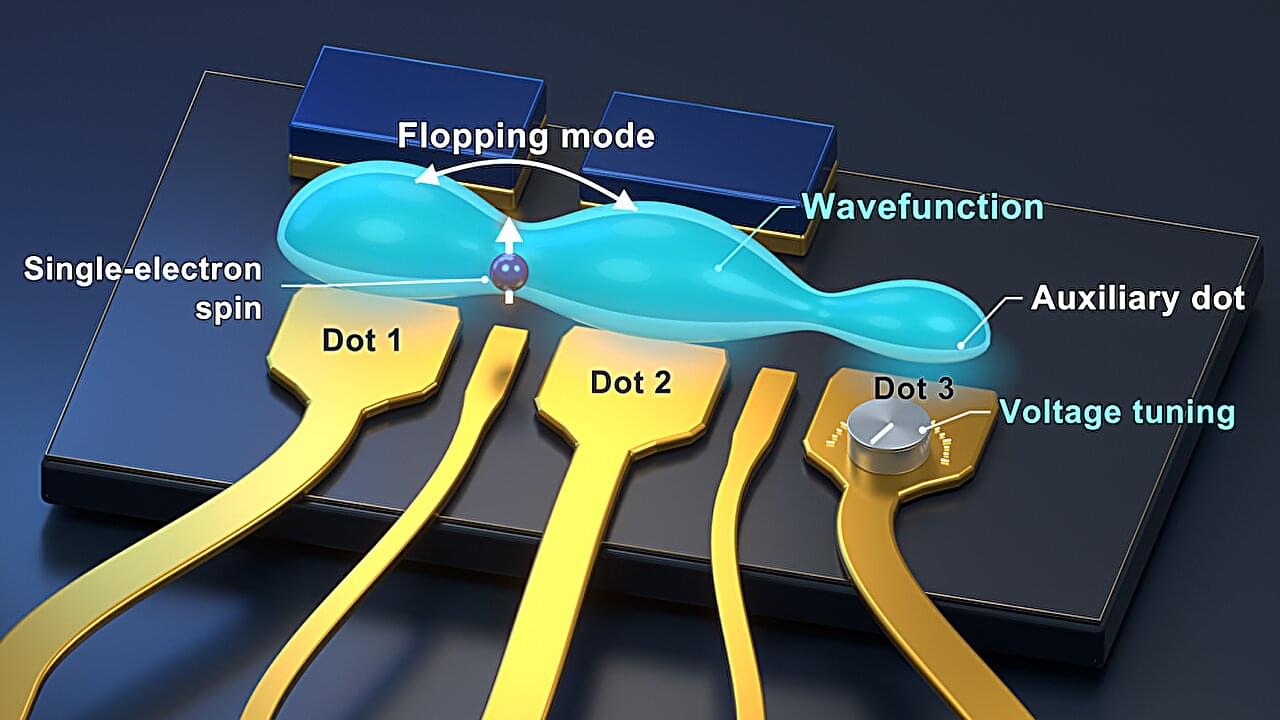
Semiconductor spin qubits are one of the most promising building blocks for future quantum computers, but turning them into a working, large-scale quantum computer has so far proven difficult. For now, two big questions remain open: how to connect qubits that aren’t sitting right next to each other, and how to control huge numbers of them without an unmanageable tangle of wiring.

Now, two independent studies published in Nature have each reported new experiments tackling these problems head-on.

/* */