Toggle light / dark theme

Get the latest international news and world events from around the world.

Log in for authorized contributors

Get access to all the best AI models in one place at Mammouth

https://mammouth.ai.

Timestamps:
00:00 — New Way Of Computing
06:46 — How It Works
09:39 — Outlook.

My Podcast on Apple: https://podcasts.apple.com/at/podcast… Podcast on Spotify: https://open.spotify.com/show/3drr7A8… Let’s connect on LinkedIn: / anastasiintech Newsletter: https://anastasiintech.substack.com Instagram: / anastasi.in.tech Patreon: / anastasiintech.

Let’s connect on LinkedIn: / anastasiintech
Newsletter: https://anastasiintech.substack.com
Instagram: / anastasi.in.tech
Patreon: / anastasiintech.

Read more

Goodbye, Prediabetes, Hello, Type 2 Diabetes Stages?

The concept of “prediabetes” may be on its way out. Some experts are proposing a shift to staging type 2 diabetes instead, arguing that the current label can be misleading and may delay more proactive treatment. A stage-based approach could better reflect disease progression and encourage earlier intervention.


Leaders in the diabetes field are proposing eliminating the prediabetes label in favor of type 2 diabetes stages.

New ‘Unifying Theory’ May Explain How Alzheimer’s Emerges in The Brain

The origins of Alzheimer’s remain contentious, but a new study suggests the disease may emerge as two key proteins compete inside brain cells.

Alzheimer’s disease, the most common form of dementia, has long been associated with the build-up of two proteins in the brain: amyloid-beta and tau.

This new study ties those two together, offering a “unifying theory” that, according to the team of chemists proposing it, resolves some conflicting ideas about Alzheimer’s.

Study points toward immune reprogramming to treat candidiasis

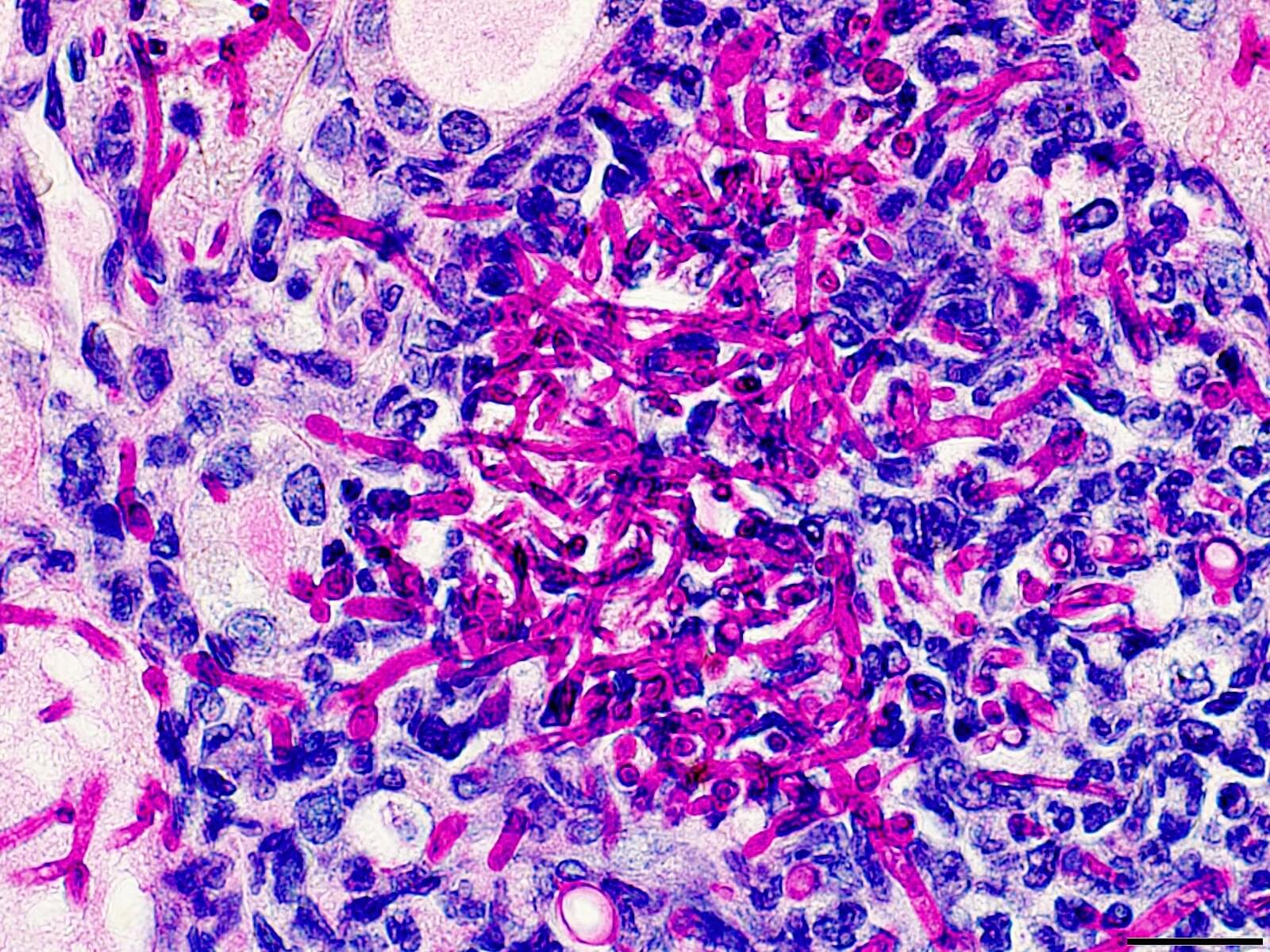
Systemic candidiasis is an opportunistic fungal infection that has been difficult to treat effectively. Research published in a paper in the April edition of Cell Host & Microbe suggests that immune metabolic reprogramming could be a new strategy to fight the infection rather than developing another specific antifungal medication.

The fungus Candida albicans causes infections that range from superficial on the skin and nails to invasive into organs and the bloodstream. In recent decades, systemic candidiasis has increased due to more patients with immunosuppression from disease or treatments, prolonged antibiotic exposure, and certain conditions such as kidney disease. Management of systemic candidiasis has become more difficult because of antifungal drug resistance, limited early diagnostic tools, and absence of approved fungal vaccines.

According to Partha Biswas, DVM, Ph.D., lead author of the paper, and a Professor in the Department of Microbiology and Immunology in the Renaissance School of Medicine (RSOM) at Stony Brook University, these challenges have become roadblocks to treating systemic candidiasis and illustrate the need for new and different therapeutic strategies.

Senescence in cancer: Hallmarks, paradoxes, and therapeutic promise

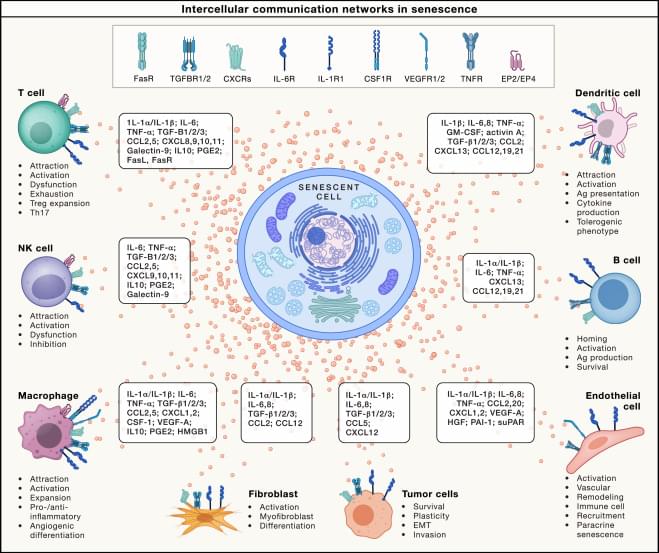
Now online! Cellular senescence, defined by six major hallmarks, is a program that halts cell division while rewiring chromatin, metabolism, microenvironment sensing, and immune interactions to either suppress or promote cancer and is an exciting frontier for precision therapy.

How noise limits today’s quantum circuits

Imagine you’re trying to build a very long, complicated chain of dominoes. The aim is that each domino hits the next one perfectly, all the way down the line, producing an amazing result at the end. A quantum circuit is like a domino chain: a long chain of tiny steps (“operations”) that work together to process information together in a powerful way.

Now imagine that every domino is a little wobbly. In the quantum circuit, that wobble is called “noise.” It might not look like much—after all, all regular systems are subjected to some kind of “noise”—but noise in quantum circuits can accumulate and build up to a crescendo of problems.

Ytterbium atomic clock could open a new window on fundamental physics

For the first time, an international team of physicists has successfully harnessed a rare orbital transition in atoms of ytterbium to create a new type of atomic clock that is both highly precise and extremely sensitive to fundamental physical effects. Publishing their results in Nature Photonics, the researchers, led by Taiki Ishiyama at Kyoto University, say their approach could pave the way for some of the most stringent tests yet of predictions made by the Standard Model.

To measure the passing of time, an atomic clock excites an electron in confined atoms to a higher energy level, then interrogates the transition frequency of the atoms. Because these oscillations display such little variation, atomic clocks are the most accurate timekeepers ever developed.

To date, the most precise devices involve atoms trapped in an optical lattice: a periodic array of light and darkness created by interfering laser beams. These clocks operate at optical frequencies with hundreds of trillions of oscillations per second—far surpassing the microwave frequencies used in previous atomic clock designs. Already, this extraordinary precision has enabled sensitive tests of fundamental physics, as described by the Standard Model.


Gravity from positivity: Single massive spin-3/2 particle makes gravity logically inevitable, study claims

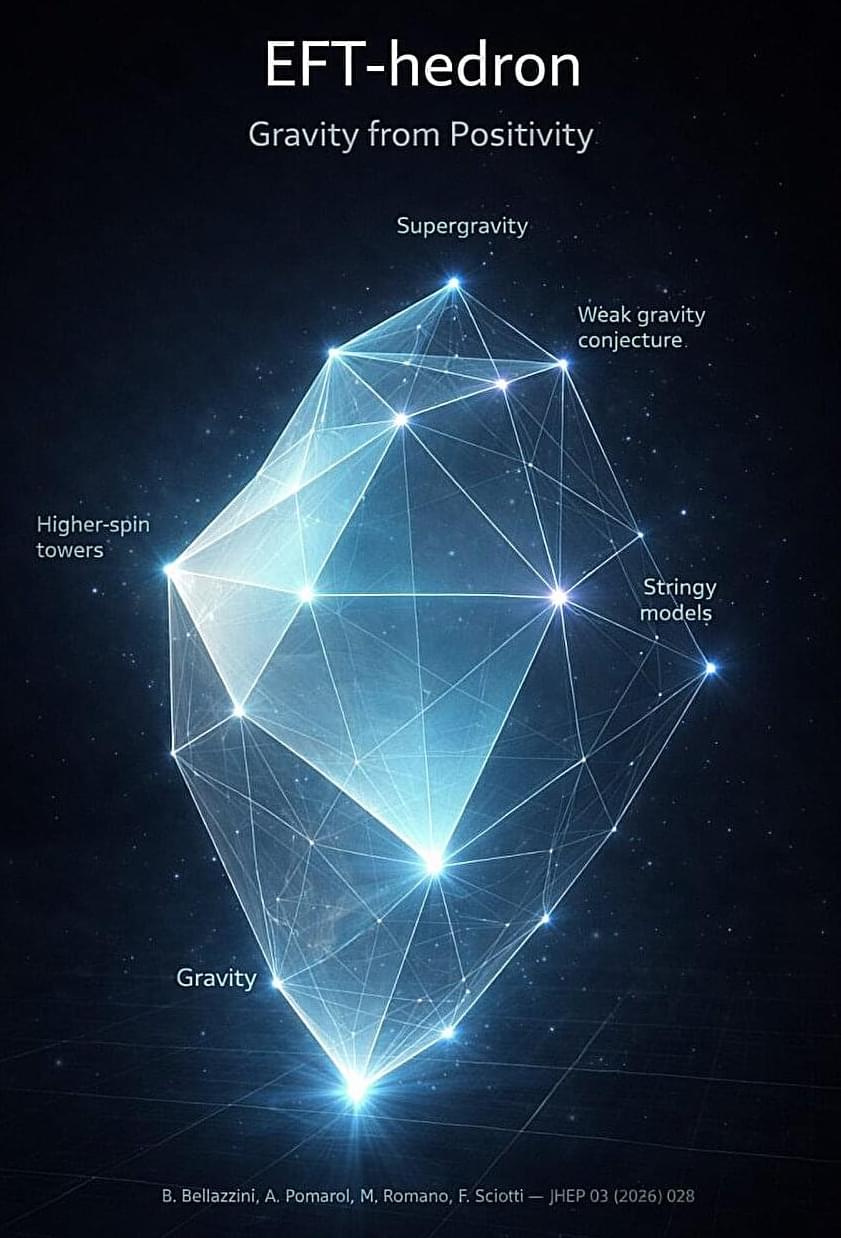
Researchers at IPhT (CEA, CNRS) and the Universitat Autònoma de Barcelona have shown that gravity—and with it, supersymmetry—emerge as logical necessities whenever a massive spin-3/2 particle exists in nature. Two principles are enough: causality, the fact that no signal can travel faster than light, and unitarity, the requirement that probabilities are conserved in quantum mechanics. The structure of supergravity is not assumed: it bootstraps itself.

In fundamental physics, gravity is usually thought of as an ingredient one adds to a theory. But could it instead be forced by the internal consistency of the quantum world? This is what a study published in the Journal of High Energy Physics demonstrates.

The starting point is disarmingly simple: a single massive spin-3/2 particle. The authors show that such a particle simply cannot exist in isolation within a consistent theory. Its scattering amplitudes grow too fast with energy, clashing with positivity inequalities—the mathematical encoding of causality (the speed of light as an absolute limit) and unitarity (the conservation of probabilities in every quantum process). The theory breaks down barely above the particle’s own mass.

/* */