Toggle light / dark theme

Get the latest international news and world events from around the world.

Log in for authorized contributors

CERN hails delicate test on transporting antimatter as a scientific success

Scientists in Geneva took some antiprotons out for a spin—a very delicate one—in a truck, in a never-tried-before test drive that has been deemed a success.

If this so-called antimatter had come into contact with actual matter, even for a fraction of an instant, it would have been annihilated in a quick flash of energy. So experts at the European Organization for Nuclear Research, known as CERN, had to be extra careful when they took 92 antiprotons on the road for a short ride on Tuesday.

The antiprotons were suspended in a vacuum inside a specially designed box and held in place by supercooled magnets.
Fish gill-inspired panels reveal path to efficient thermal mixing

A fascination with fish gills has led researchers at Cornell to develop a bio-inspired approach to mixing heat and molecules in fluids—findings that could inform future biomedical devices, heat exchangers and soft robotics.

Moving heat and mass efficiently through flowing liquids is central to technologies ranging from dialysis machines to industrial cooling systems, yet many of those technologies rely on rigid components to get the job done.

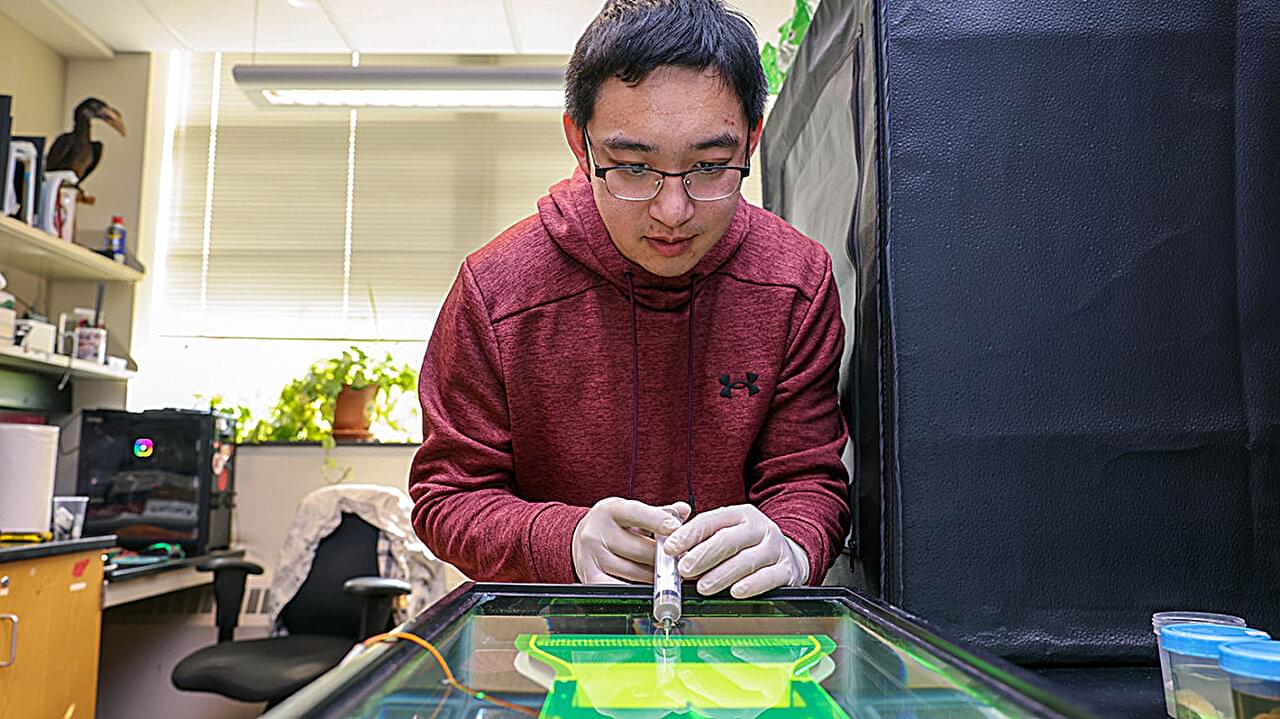
Looking for an alternative, Yicong Fu, a mechanical engineering doctoral student, turned to fish gills—soft, porous tissue that constantly stirs water to keep gases and ions flowing. Working with Sunghwan “Sunny” Jung, professor of biological and environmental engineering in the College of Agriculture and Life Sciences, Fu designed a gill-like thermal dispenser that is providing new insights into fluid-structure interactions.

A Bright Star Hid a Massive Secret for 50 Years: Mystery of Gamma Cassiopeiae Finally Solved

A naked-eye star’s 50-year mystery is solved—its bizarre X-rays come from a hidden, feeding white dwarf.

Easily visible in the night sky within the constellation Cassiopeia, the star γ Cas has puzzled astronomers for more than 50 years. It produces X-rays with energies and temperatures far beyond what is expected from a typical massive star. New observations using the Resolve instrument aboard Japan’s XRISM space telescope have now traced this unusual emission to a white dwarf orbiting the star. This finding also confirms a long-theorized class of binary systems that had never been clearly identified. The study, led by researchers at the University of Liège, was published today (March 24) in Astronomy & Astrophysics.

What makes be stars like gamma cassiopeiae unique.

PTC warns of imminent threat from critical Windchill, FlexPLM RCE bug

PTC Inc. is warning of a critical vulnerability in Windchill and FlexPLM, widely used product lifecycle management (PLM) solutions, that could allow remote code execution.

The security issue, identified as CVE-2026–4681, could be leveraged through the deserialization of trusted data.

Its severity has prompted emergency action from German authorities, with the federal police (BKA) reportedly sending agents to affected companies to alert them to the cybersecurity risk.

/* */