Case report: radiation-induced optic neuropathy following radiation therapy for a recurrent tuberculum sellae meningioma: a case report
🔗
Prior to the first surgery, the patient experienced progressive visual loss, resulting in a visual acuity of 20/200 in her right eye, and visual field loss in the temporally and lower 2 quadrants. Her vision was described as normal in the left eye prior to surgery. Visual function improved after surgery, and after 3 months visual acuity in the patient’s right eye was assessed to be 20/40. Despite the successful initial surgery, a tumor recurrence was detected 4 years later. At this time point, the patient had reduced vision and a progressive visual field loss in her right eye. After the second surgery, her visual acuity was 20/60 in her right eye and 20/22.5 in the left eye. The right visual field was substantially reduced, especially in the lower 2 quadrants.
Based on recurrent disease, high probability of microscopic residual tumor remnants, and progressive loss of visual function, the patient was offered postoperative radiation therapy delivered with photons. Radiation therapy was administered 4 months following the last surgical procedure, and a conservative fractionation of 1.8 Gy in 29 fractions, with a total dose of 52.2 Gy, was chosen to keep anterior visual pathway doses below what is considered safe (Table 1) according to the European Particle Therapy Network Consensus. These standards recommend doses below 55 Gy to 0.03 cm3 (D 0.03cc) to the chiasm and the optic nerves.1 For the chiasm, the maximum dose (D max) was 53.7 Gy and the mean dose (D mean) was 51.7 Gy. The right optic nerve had a D max of 53.3 Gy and a D mean of 48.8 Gy, whereas the left optic nerve had a D max of 52.3 Gy and a D mean of 30.5 Gy. Radiation therapy dose distribution is shown in Figure 3. After radiation therapy, the patient reported minor improvement in visual function. Unfortunately, 7 to 8 months later her visual function again deteriorated over only a few weeks. Both eyes were affected, and deterioration was most pronounced in her left eye, with only finger counting possible and nearly total visual field loss. In the right eye, visual acuity was 20/60, with a substantially reduced visual field, especially in the lower 2 quadrants.
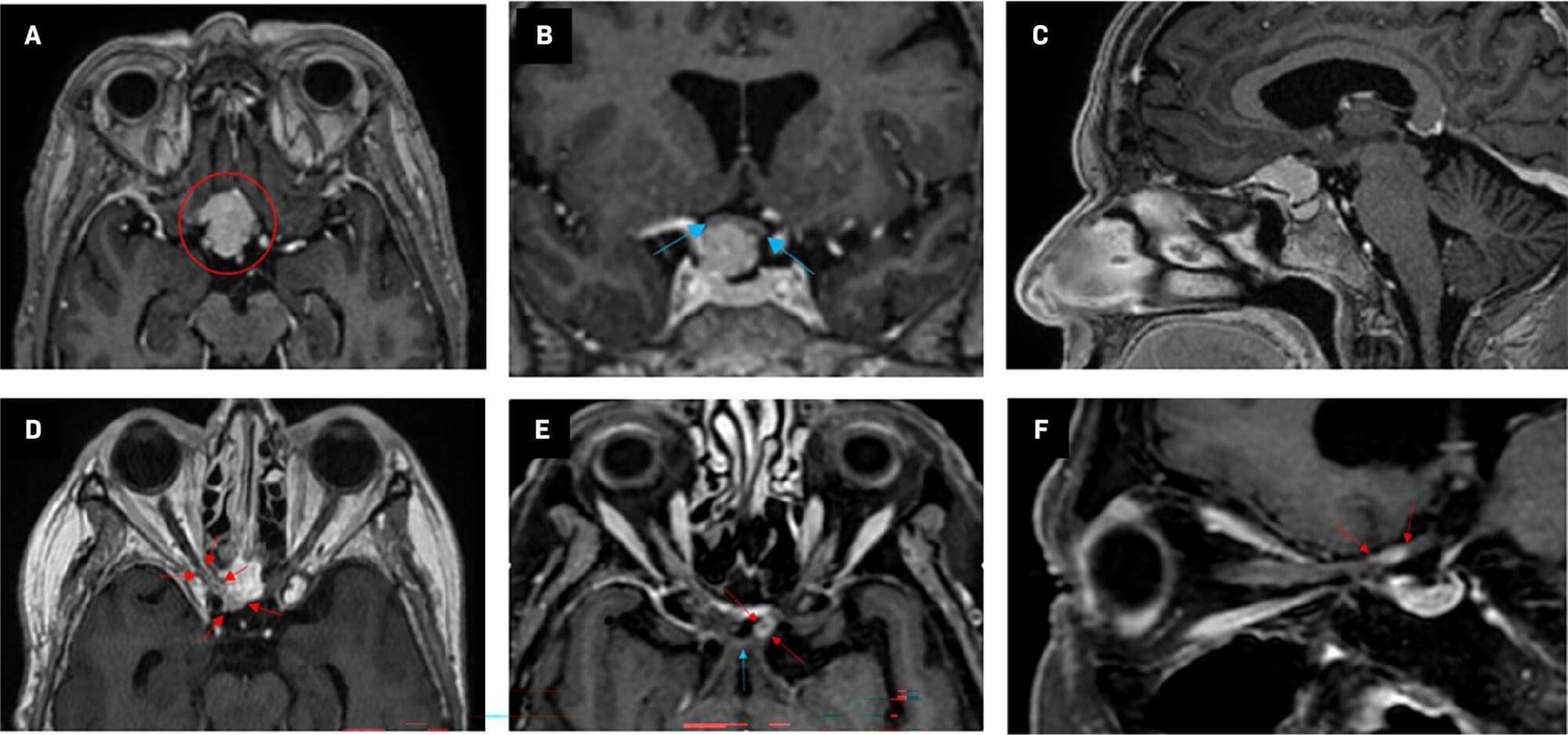
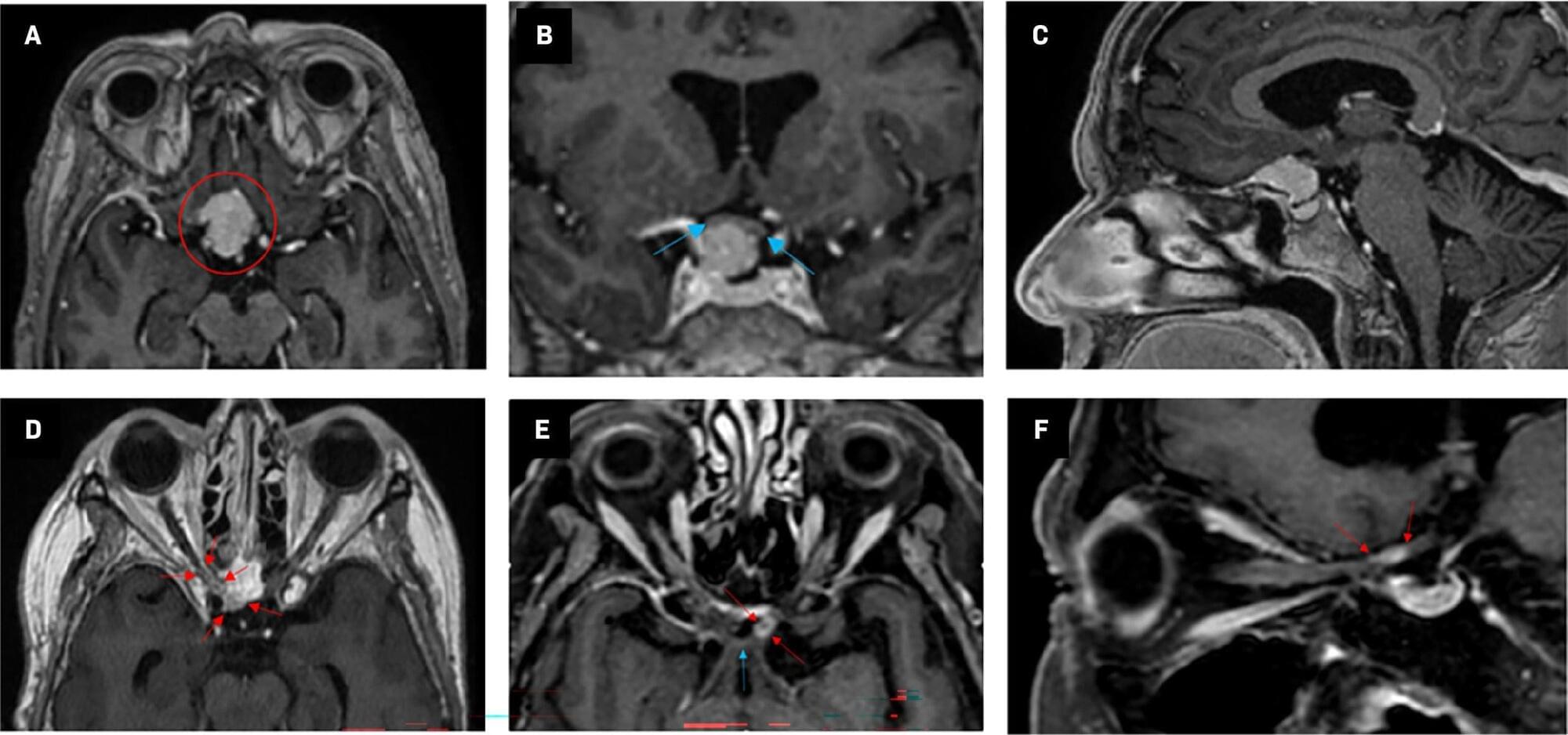
RION is primarily a diagnosis of exclusion, with tumor recurrence being the most important differential diagnosis. Tumor progression often results in a slower course of visual loss than RION.2 The patient’s vision loss was painless and rapid in onset, and radiological findings were bilateral and not consistent with neoplastic progression. Although MRI findings are nonspecific in RION-affected patients, neuro-ophthalmological examinations and clinical course/timing pointed to RION as the most likely cause of the patient’s visual loss. Systemic steroids in high doses were administered for 2 weeks before gradual tapering off, without any improvement in visual function. As a last effort to improve visual function, it was decided to try bevacizumab 7.5 mg/kg every 3 weeks. Treatment was well tolerated, with no reported side effects.