Understanding instabilities and turbulence in plasmas is one of the key challenges across a wide range of plasma research fields, including nuclear fusion, astrophysics and laser-plasma physics. In plasmas, slight disturbances can grow due to instabilities, and energy is transferred between structures of various sizes due to turbulence. These phenomena give rise to structures ranging from very small to large, which significantly influence the overall motion and energy flow of the plasma.
Since structures generated by instabilities and turbulence vary with even slight differences in conditions, it is not easy to reproduce the same state in every experiment. Therefore, there is a need for “spatially multiscale single-shot measurements” that can simultaneously capture structures of a wide range of sizes in a single measurement. In particular, in high-energy-density plasmas, instabilities grow in an extremely short time, so high temporal and spatial resolution is also required to capture their initial stages.
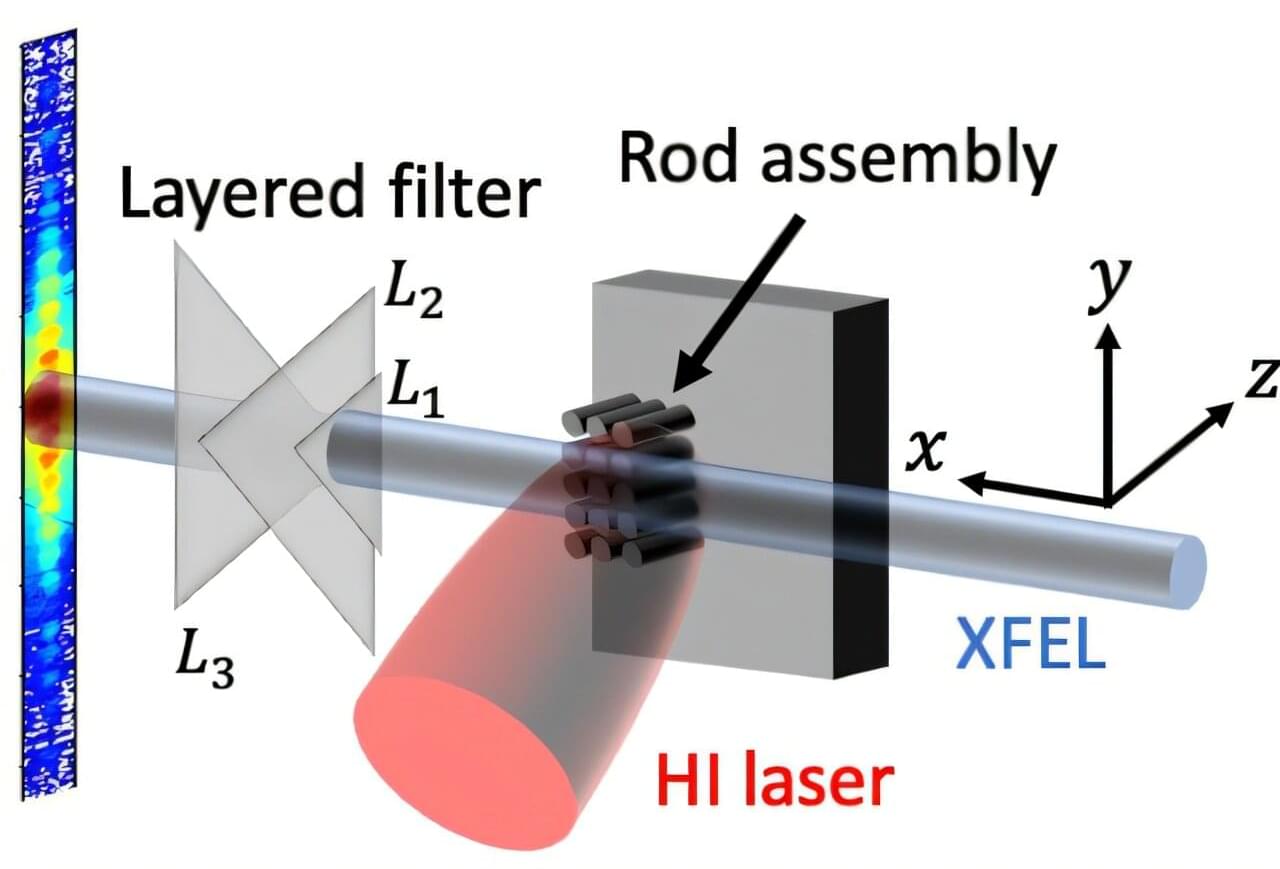
By combining the newly developed “beamstop-free X-ray small-angle scattering method” with an X-ray free-electron laser and a microscale rod assembly target, an international research group, led by Assistant Professor Masato Ota of the National Institute for Fusion Science (then a graduate student at the Graduate School of Science, Osaka University), Associate Professor Yoichi Sakawa of the Institute of Laser Engineering, Osaka University, succeeded in measuring the structural collapse and rarefaction processes of high-energy-density plasma across a wide range of spatial scales—from 10 nm to 500 nm—with sub-picosecond temporal resolution.