Toggle light / dark theme

BAM launches robo printer

BAM has teamed up with Universe Architecture to launch a ‘robo printer’ that can create free-form buildings in stone and concrete.

The ‘building machine’ is described as the first to link free-form print technology to automotive industry robotics. It is designed to make free-form architecture possible, as well as enable the creation of complex ornamental exteriors.

In 2013, architect Janjaap Ruijssenaars of Universe Architecture had plans for the creation of a building without beginning or end, Landscape House, using a 3D printer. The 3D Builder machine entered service yesterday and is starting with the construction of a 1:4 scale version of Landscape House at FabCity, a temporary sustainability campus in Amsterdam.

Researchers: 3D Printing Offers Great Benefits for Water Treatment Industry, But Progress is Slow Thus Far

Interesting; however, I will be interested still how QC and 3D printing can converge and possibly address challenges such as this one, mass production of synthetic diamonds, cell circuitry, etc.

https://3dprint.com/137952/3d-printing-water-treatment-industry/


You might be surprised at how often 3D printing and water intermingle. After all though—as you’ll well remember if you try to go without it for a few hours—water is our life force. And as innovative 3D technology is used at the hands of researchers and innovators around the world to make positive transformations in nearly every industry, surely water should be included.

Whether we are discussing how to recycle water bottles in an attractive manner, adopt new methods for desalination to increase worldwide accessibility, or actually using 3D scanners to detect corrosion in older water pipes in the UK, the seeds have been planted for allowing 3D technology to play a substantial and versatile role in how we deal with water in the future, on many levels.

We are ‘almost definitely’ living in a Matrix-style simulation, claims Elon Musk

Elon Musk, the billionaire entrepreneur and founder of Space X, Tesla and Paypal, has told an interviewer there is only a “one in billions” chance that we’re not living in a computer simulation.

Speaking at San Francisco’s Code Conference this week, Musk said that he has had “so many simulation discussions it’s crazy”, and that it got to the point where “every conversation [he had] was the AI/simulation conversation”.

He also claimed that, if we’re not living in a simulation, we could be approaching the end of the world.

Tungsten trioxide nanostructures for solar energy conversion

Low-cost, low-dimensional nanoarchitectures provide optimal structures for charge collection in large-scale solar energy harvesting and conversion applications.

Photoelectrochemical water splitting, where irradiation of a photoelectrode in water produces hydrogen and oxygen, can be used for solar energy harvesting and conversion.1 The process potentially offers a clean, sustainable, and large-scale energy resource. Photoanodes used in the photoelectrochemical process are generally made from Earth-abundant oxide semiconductors, such as titanium dioxide, tungsten trioxide, and iron (III) oxide.2 Among these metal oxide semiconductors, tungsten trioxide is regarded as one of the best candidates because of its visible light-driven photocatalytic activity, its good charge transport properties, and its relative stability in aqueous electrolytes. However, the light absorption and charge collection efficiency of tungsten trioxide—especially within a bulk structure—still needs to be improved to realize practical photoelectrochemical applications.

Scientists design energy-carrying particles called ‘topological plexcitons’

Scientists at UC San Diego, MIT and Harvard University have engineered “topological plexcitons,” energy-carrying particles that could help make possible the design of new kinds of solar cells and miniaturized optical circuitry.

The researchers report their advance in an article published in the current issue of Nature Communications.

Within the Lilliputian world of solid state physics, light and matter interact in strange ways, exchanging energy back and forth between them.

Using Adenosine Triphosphate to Create Biological Super-Computers

Machines running on human energy? Yes, it can happen, according to Dan Nicolau, Jr. from the Department of Integrative Biology at the University of California. Nicolau and his colleagues successfully completed a proof-of-concept study of a book-sized computer that runs on adenosine triphosphate (ATP), a biochemical that releases energy in cells and aids in energy transfer.

The study results published in the Proceedings of the National Academy of Sciences (PNAS), describe the combination of geometrical modeling and engineering as well as nanotechnology to create circuitry that uses 1.5 × 1.5 cm in area and the naturally occurring protein to operate.

A More Sustainable Option

Other than the mere presence of a human energy source in a machine, an astounding aspect of the device is how, as opposed to electrical energy that produces heat, the biological agent powering this new computer enables it to remain cool and energy efficient, making it more sustainable.

New “Bionic Leaf” Is More Efficient Than Photosynthesis

The latest of the bionic leaf. A little over a year ago reseachers made an amazing discovery on cell circuitry leaves. Here is more news from Harvard on their research on bionic leaves.


Harvard scientists designed a new artificial photosynthesis system that turns sunlight into liquid fuel, and it is already effective enough for use in commercial applications.

Here’s an alternative source of energy many have never heard of— bionic leaves.

Scientists from Harvard University just made photosynthesis more efficient with what its creators are calling the “bionic leaf 2.0.” They’ve invented a new system that splits water molecules with solar energy and produces liquid fuels with hydrogen-eating bacteria.

Tiny lasers on silicon means big things for electronics

Silicon forms the basis of everything from solar cells to the integrated circuits at the heart of our modern electronic gadgets. However the laser, one of the most ubiquitous of all electronic devices today, has long been one component unable to be successfully replicated in this material. Now researchers have found a way to create microscopically-small lasers directly from silicon, unlocking the possibilities of direct integration of photonics on silicon and taking a significant step towards light-based computers.

Whilst there has been a range of microminiature lasers incorporated directly into silicon over the years, including melding germanium-tin lasers with a silicon substrate and using gallium-arsenide (GaAs) to grow laser nanowires, these methods have involved compromise. With the new method, though, an international team of researchers has integrated sub-wavelength cavities, the basic components of their minuscule lasers, directly onto the silicon itself.

To help achieve this, a team of collaborating scientists from Hong Kong University of Science and Technology, the University of California, Santa Barbara, Sandia National Laboratories and Harvard University, first had to find a way to refine silicon crystal lattices so that their inherent defects were reduced significantly enough to match the smooth properties found in GaAs substrate lasers. They did this by etching nano-patterns directly onto the silicon to confine the defects and ensure the necessary quantum confinement of electrons within quantum dots grown on this template.

Elon Musk: We Are Less Than Two Years From Complete Car Autonomy

Elon Musk is known for his optimistic deadlines, but this one is very aggressive.

The Tesla CEO spoke at the Code Conference on Wednesday night and predicted that we’re closer to self-driving cars than anybody thinks. “I think we are less than two years away from complete autonomy, safer than humans, but regulations should take at least another year,” Musk said.

While many auto and tech companies—from Google to Uber and GM to Lyft and Apple to Ford—are researching and testing autonomous vehicles, the Tesla seems on the verge of announcing that its Model 3 consumer sedan will have full self-driving capabilities.

Chile is producing so much solar power, it’s giving it away for free

Market forces often produce strange quirks in the economic system, like the one we’re seeing in Chile this year: the country is producing so much solar power that it’s being sold for… nothing at all.

While it’s incredibly encouraging to see so much expansion in the country’s renewable energy output, this huge amount of supply does actually cause problems for the companies looking to invest in solar energy.

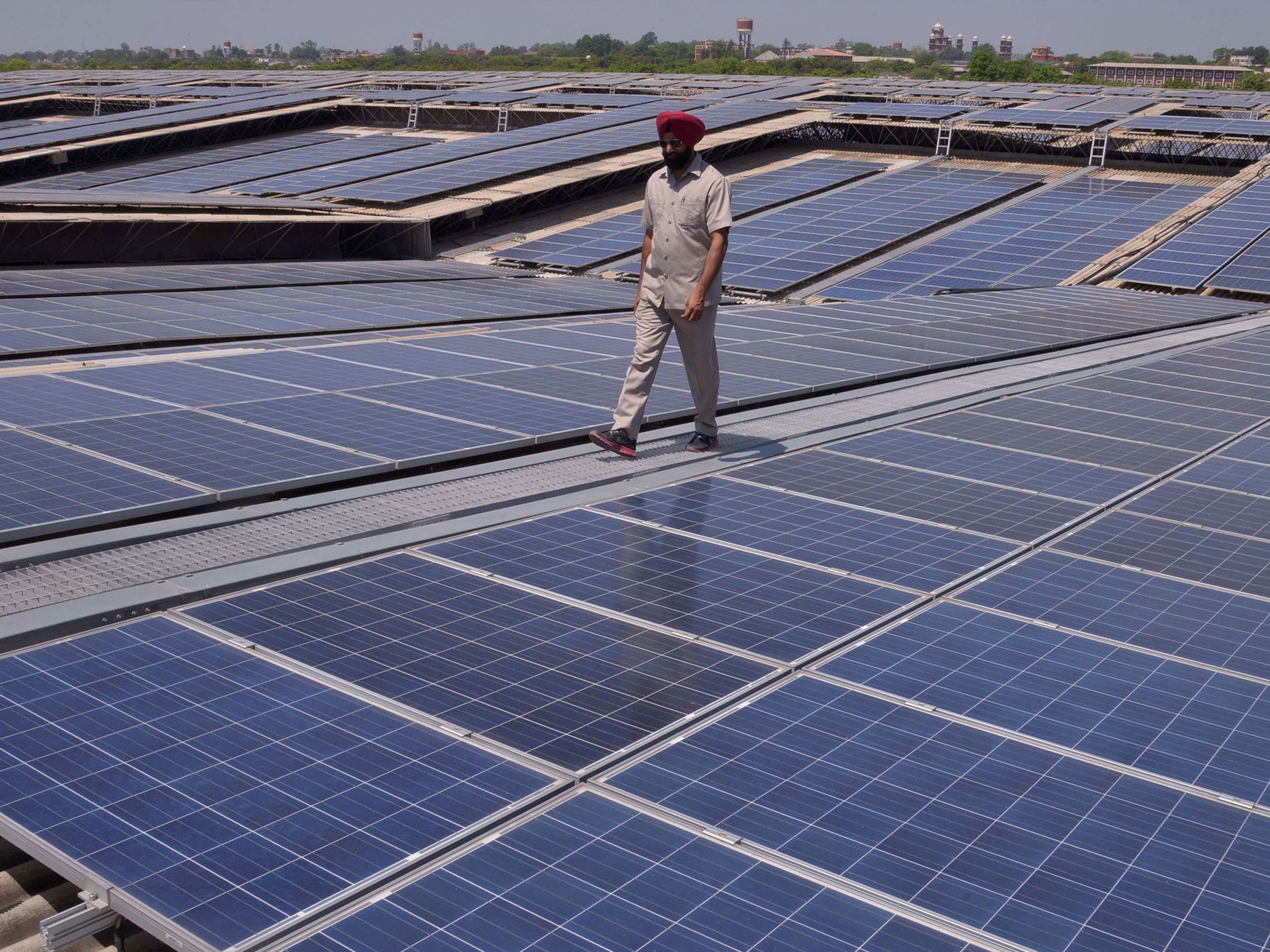
Solar capacity on Chile’s central power grid (called SIC or Sistema Interconectado Central) has more than quadrupled over the past three years to 770 megawatts – good news for the environment and customers paying their electricity bills.

/* */