Toggle light / dark theme

Artificial Intelligence May Soon Drive Your Car — And Keep You Company at the Same Time

Honda said in a press release that the AI will use conversations with the driver and other data it gathers ‘both to perceive the emotions of the driver and to engage in dialogue with the driver based on the vehicle’s own emotions.’ The just-announced partnership works toward application of the ‘emotion engine,’ which is ‘a set of AI technologies developed by cocoro SB Corp., which enable machines to artificially generate their own emotions.’


Image source: Getty Images.

Continue Reading Below.

Driverless cars are already being developed by nearly every automaker. And despite the recent Tesla Model S crash in which a driver was killed while using the car’s semi-autonomous Autopilot feature, they’re typically much safer than human drivers, and they’re getting better all of the time.

Smart bricks will transform how buildings work

Smart bricks capable of recycling wastewater and generating electricity from sunlight are being developed by a team of scientists from the University of the West of England (UWE Bristol). The bricks will be able to fit together and create ‘bioreactor walls’ which could then be incorporated in housing, public building and office spaces.

The UWE Bristol team is working on the smart technologies that will be integrated into the in this pan European ‘Living Architecture’ (LIAR) project led by Newcastle University. The LIAR project brings together living architecture, computing and engineering to find a new way to tackle global sustainability issues.

The smart living bricks will be made from bio-reactors filled with microbial cells and algae. Designed to self-adapt to changing environmental conditions the smart bricks will monitor and modify air in the building and recognise occupants.

PV Nano Cell’s nanometric silver conductive ink enables non-contact digital inkjet printing

Nice.


PV Nano Cell has commercially developed ‘Sicrys’, a single-crystal, nanometric silver conductive ink delivering enhanced performance for digital conductive printing in mass production applications. The inks are also available in copper-based form, delivering all of the product’s properties and advantages with improved cost efficiency.

Problem

Solar cell metallization is not yet fully optimized for cost and resource conservation. Cell producers currently endure silicon cell breakage during cell metallization, and higher-than-necessary costs for silver. Traditional screen printing of conductive grid lines involves direct contact with brittle cells, resulting in breakage and silicon waste. Additionally, the current technologies for metallization create lines that are wider and thicker than necessary, inflating silver costs.

Breakthrough solar cell captures carbon dioxide and sunlight, produces burnable fuel

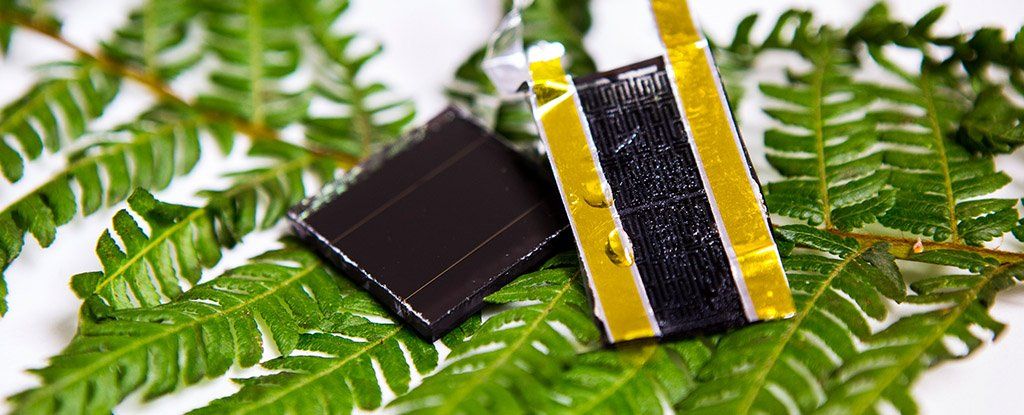
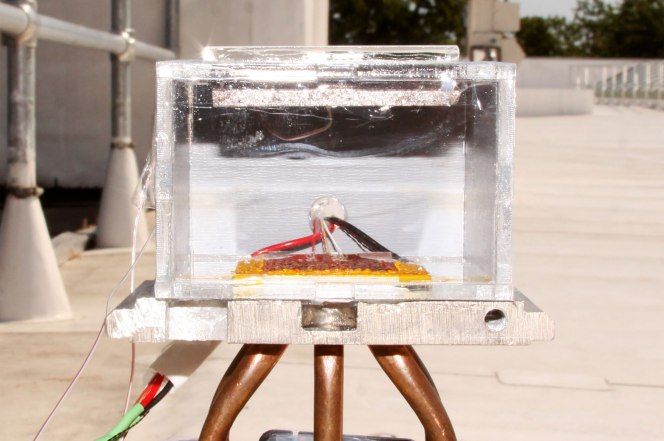
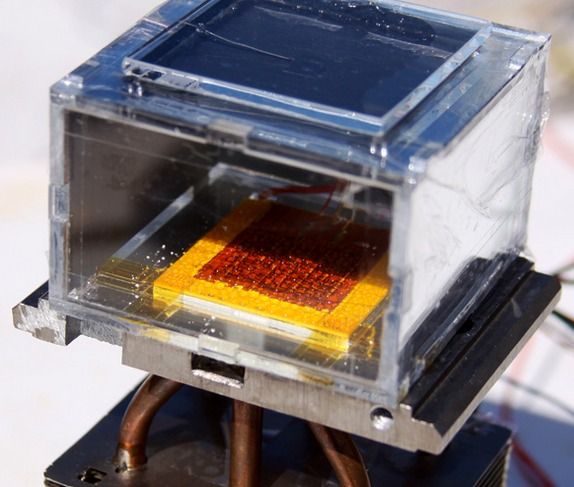
Researchers at the University of Illinois at Chicago have engineered a potentially game-changing solar cell that cheaply and efficiently converts atmospheric carbon dioxide directly into usable hydrocarbon fuel, using only sunlight for energy.

The finding is reported in the July 29 issue of Science and was funded by the National Science Foundation and the U.S. Department of Energy. A provisional patent application has been filed.

Unlike conventional , which convert sunlight into electricity that must be stored in heavy batteries, the new device essentially does the work of plants, converting into fuel, solving two crucial problems at once. A solar farm of such “artificial leaves” could remove significant amounts of carbon from the atmosphere and produce energy-dense fuel efficiently.

Scientists Synthesize Liquid Fuel from Solar Energy

The nextgen of Solar and fuel energy.


Scientists have just discovered a way to directly convert solar energy into a synthetic fuel using carbon dioxide. Current solar technologies operate in either photovoltaic solar or thermal solar. Photovoltaic solar energy is generated through solar panels, which are typically seen on the roofs of houses and many solar plants. The other method of thermal solar is typically only used in large-scale energy plants, as it used mirrors to focus solar energy to heat a liquid which then powers turbines. Both methods, however, involve the conversion of solar energy into electricity. While electricity is useful, much energy is lost in the storing of electricity, something that the conversion process to liquid fuel overcomes.

Welcome to Lab 2.0 Where Computers Replace Experimental Science

We spend our lives surrounded by high-tech materials and chemicals that make our batteries, solar cells and mobile phones work. But developing new technologies requires time-consuming, expensive and even dangerous experiments.

Luckily we now have a secret weapon that allows us to save time, money and risk by avoiding some of these experiments: computers.

Thanks to Moore’s law and a number of developments in physics, chemistry, computer science and mathematics over the past 50 years (leading to Nobel Prizes in chemistry in 1998 and 2013) we can now carry out many experiments entirely on computers using modeling.

Quantum dot photosensitizers as a new paradigm for photochemical activation

Interesting work on solar energy and Q-dot photosensitizers.


Interfacial triplet-triplet energy transfer is used to significantly extend the exciton lifetime of cadmium selenide nanocrystals in an experimental demonstration of their molecular-like photochemistry.

Photosensitizers are an essential component of solar energy conversion processes, in which they are used to generate the highly reactive excited states that enable energy conversion (e.g., photochemical upconversion).1, 2 Typically, molecular triplet photosensitizers are used for such applications, but to improve the solar energy conversion process, the identification and preparation of next-generation triplet photosensitizers is required. However, the design of such photosensitizers—suitable for solar energy conversion and photocatalytic applications—remains a challenge.3

/* */