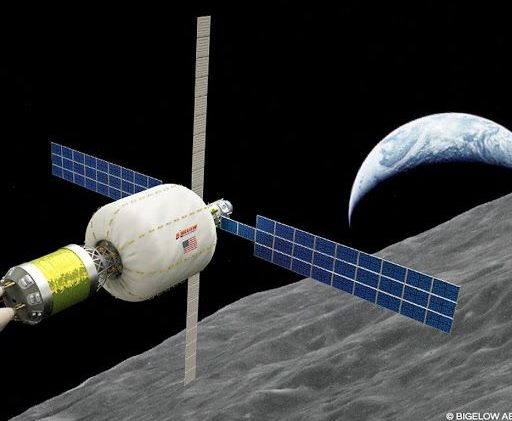
In a paper prepared for NASA, Bezos says his Blue Origin space company could land a delivery vehicle on the moon by 2020.
An answer to concerns about rejuvenation-induced overpopulation from a logistical point of view.
Why do we worry about overpopulation? What’s so bad about it? Well, several things. We could have too many people with respect to the space available on Earth; too many people and not enough jobs for everyone; too many people and not sufficient resources; too many people polluting the environment beyond what it can take.
All these potential problems need to be discussed. Thus, in this article I’m going to play accountant a little bit. You can read the whole article, or jump to the section that concerns you the most.
World View Enterprises, a private company that plans to sell balloon rides to the edge of space, has announced the grand opening of its new headquarters and a conjoined spaceport in Tucson, Arizona.
The new facility will soon be launching World View’s non-crewed high altitude balloons, which could provide a low-cost alternative to launching payloads into space, according to company representatives. The balloons can carry instruments and equipment that could, for example, be used to consistently observe severe weather events or natural disasters. The balloon could also carry equipment for scientific investigations, communications, remote sensing and wealth of other potential applications.
The newly completed Spaceport Tucson was built specifically to launch high-altitude balloons, and includes a 700-foot-wide (200 meters) launchpad. The spaceport is owned by Pima County (where it is located) but is operated by World View Enterprises, which now has its headquarters attached to the spaceport. World View employees have already started working out of the new digs, and the first uncrewed launches from Spaceport Tucson are expected to take place in the next few months, company representatives told Space.com. [World View’s Near-Space Balloon Rides in Pictures].
The discovery of seven habitable planets just 40 light years away is certainly impressive, but the fact is, they are still 40 light years away. Unless we’re willing and able to spend thousands of years traveling through space, we won’t be rolling into the TRAPPIST-1 system anytime soon. This means that over the coming decades, advanced scientific instruments closer to home will play very important roles in exploring these distant worlds – perhaps none more so than the James Webb Space Telescope. So what can we expect when it is fired into orbit next year? We checked in with some of the scientists behind yesterday’s hugely exciting discovery to learn how astronomers will use NASA’s next-generation space telescope to probe the secrets of the TRAPPIST-1 system.