Google just demoed a 100% natural-sounding AI that scheduled an appointment with a live human on the phone who didn’t know she was talking to a machine.

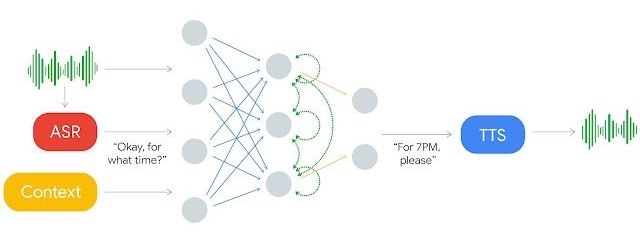
Take a listen to the recordings. That’s an AI doing that.
A long-standing goal of human-computer interaction has been to enable people to have a natural conversation with computers, as they would with each other. In recent years, we have witnessed a revolution in the ability of computers to understand and to generate natural speech, especially with the application of deep neural networks (e.g., Google voice search, WaveNet). Still, even with today’s state of the art systems, it is often frustrating having to talk to stilted computerized voices that don’t understand natural language. In particular, automated phone systems are still struggling to recognize simple words and commands. They don’t engage in a conversation flow and force the caller to adjust to the system instead of the system adjusting to the caller.
Today we announce Google Duplex, a new technology for conducting natural conversations to carry out “real world” tasks over the phone. The technology is directed towards completing specific tasks, such as scheduling certain types of appointments. For such tasks, the system makes the conversational experience as natural as possible, allowing people to speak normally, like they would to another person, without having to adapt to a machine.
One of the key research insights was to constrain Duplex to closed domains, which are narrow enough to explore extensively. Duplex can only carry out natural conversations after being deeply trained in such domains. It cannot carry out general conversations.
Summary: A new study sheds light on how the cerebellum is able to make predictions and learn from mistakes, especially when it comes to completing complex motor actions. The findings could help in the development of new machine learning technologies.
Source: Johns Hopkins Medicine.
In studies with monkeys, Johns Hopkins researchers report that they have uncovered significant new details about how the cerebellum — the “learning machine” of the mammalian brain — makes predictions and learns from its mistakes, helping us execute complex motor actions such as accurately shooting a basketball into a net or focusing your eyes on an object across the room.
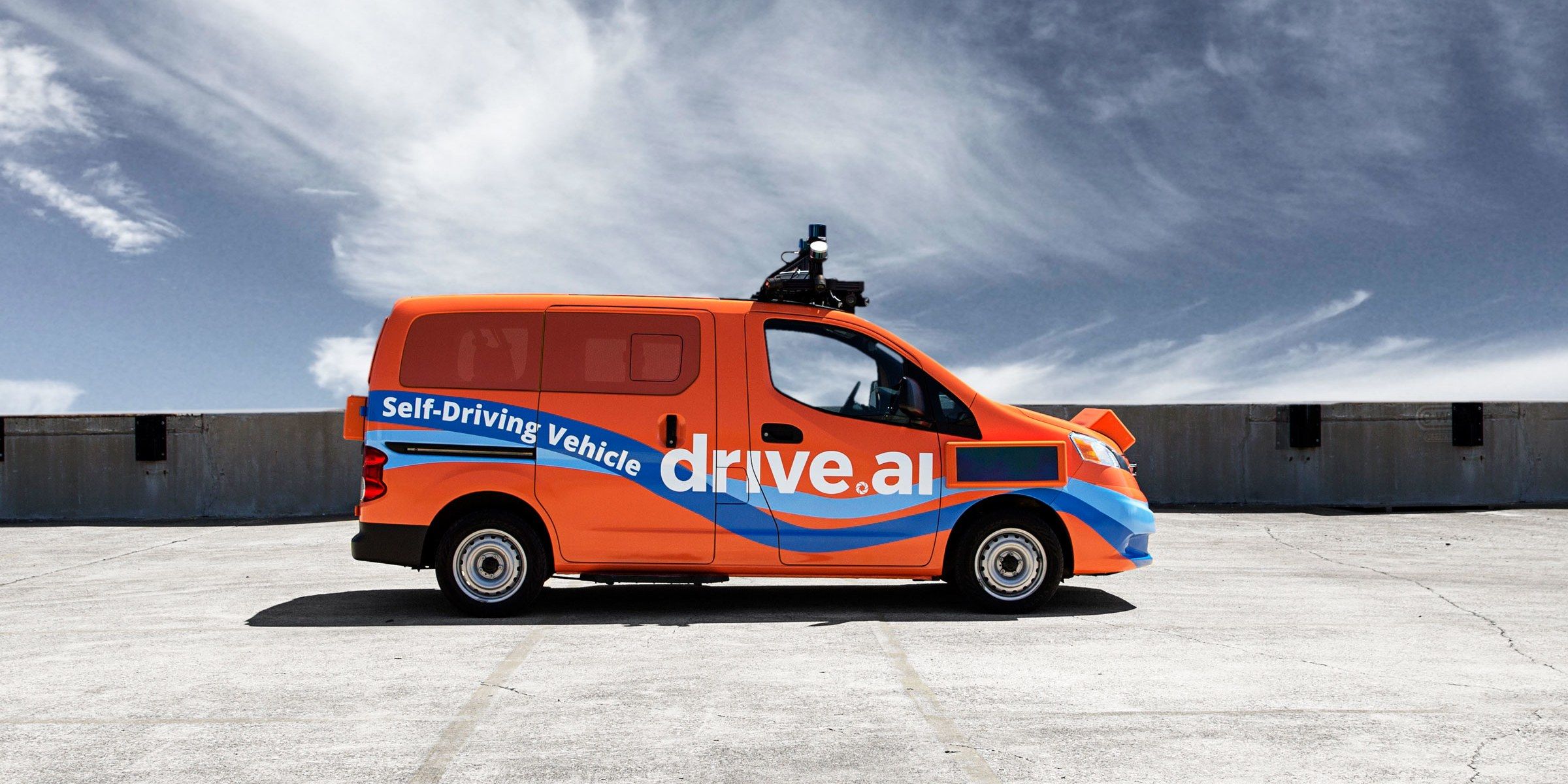
Silicon Valley’s Drive.ai is starting a pilot program to ferry office workers around a small area of Frisco, with vehicles that can “chat” with passers-by.
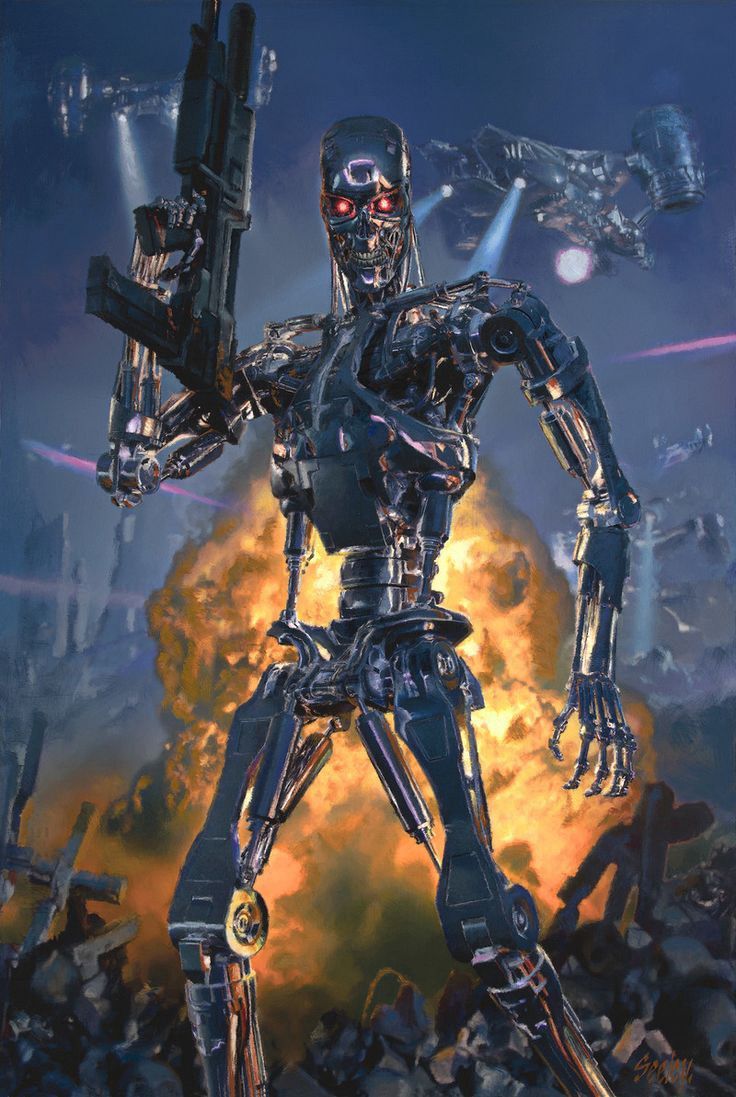
Lately, there has been a lot of concern about the recent explosion of AI, and how it could reach the point of 1) being more intelligent than humans, and 2) that it could decide that it no longer needs us and could in fact, take over the Earth.
Physicist Stephen Hawking famously told the BBC: “The development of full artificial intelligence could spell the end of the human race.” Billionaire Elon Musk has said that he thinks AI is the “biggest existential threat” to the human race.
Computers running the latest AI have already beaten humans at games ranging from Chess to Go to esports games (which is interesting, because this is a case where AI could be better than humans at playing games which were built as software from the ground up, unlike Chess and Go, which were developer before the computer age).
This machine can smooth 10,000 square feet of concrete — the equivalent of a New York City block — in an hour.

This is so cute!
In today’s adorable-and-I’m-not-crying-you’re-crying news, NDTL reports that an engineer in New Delhi named Milind Raj saved a puppy using a drone he equipped with a giant claw.
Raj was out for a morning walk in New Delhi when he heard whimpering and traced the sound to a puppy that had become stuck in a boggy drain between two roads. Raj said the condition of the puppy was “miserable” and tells The Verge that local residents had heard the animal crying for two days. Others hadn’t stepped up to the task of trying to rescue the pup because “the drain was so filthy,” says Raj. “It was not possible for a human to rescue the puppy without endangering their own life.”
Raj decided to take up the task himself, and immediately set to work constructing a drone capable of rescuing the pup. Even though Raj has an extensive history in both AI and robotics, he said building the right tools was a challenging exercise. Within a few hours, he had strapped a robotic arm with a claw of sorts to a six-rotor drone, both custom-made in his lab, located in the city of Lucknow. While he had built the drone itself two years ago, the arm he equipped it with was something he specifically created for this rescue, installing sensors to track heartbeat and breathing patterns to keep tabs on the wellness of the puppy. “The AI helped me monitor the animal’s heart rate,” he said. “If the grip was too tight, the pup would suffocate.”
The Dragon cargo ship made it back home on the same day NASA launched the InShight Mars lander, after its return to Earth was delayed for three days.
After a month of preparation, SpaceX’s unmanned Dragon capsule has finally returned to Earth on May 5, safely delivering its precious cargo, Space.com reports.
The Dragon cargo capsule splashed down in the Pacific Ocean at about 3 p.m. EDT (12 p.m. PDT, 19:00 GMT), a few hours after leaving the International Space Station (ISS).